Home & Garden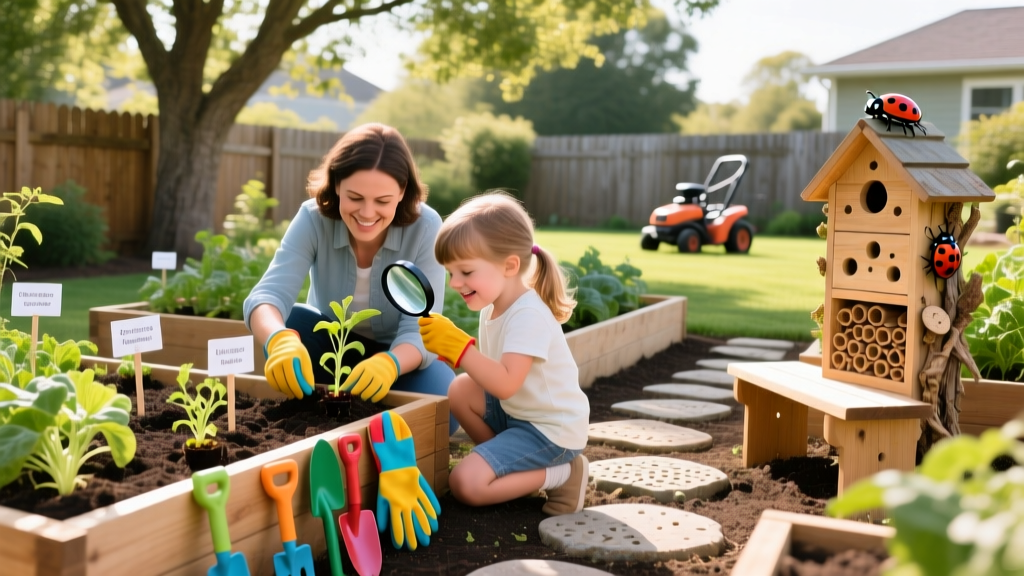
Child Engagement Activities For Backyard Learning Garden...
Designing for Discovery: Integrating Child-Centered Structures into Backyard Learning Gardens
A backyard learning garden thrives not just on botanical diversity but on intentional spatial design that invites curiosity, movement, and tactile exploration. Elevated planter beds at 24 inches tall—aligned with the average seated height of a six-year-old—allow unobstructed access without stooping or climbing. Incorporating a pergola draped with Clematis viticella (USDA Hardiness Zones 4–9) provides dappled shade over a chalkboard-painted concrete slab where children sketch plant life cycles or record rainfall data. A low-profile compost tumbler (36-inch diameter, 45-gallon capacity) positioned near the kitchen door encourages daily food scrap contributions while reinforcing nutrient cycling concepts.
Ornamental Plants That Teach While They Bloom
Selection must balance visual appeal, seasonal engagement, and pedagogical utility. Native species offer ecological authenticity and align with regional hardiness zones, soil chemistry, and pollinator support timelines. For example, Echinacea purpurea (purple coneflower), hardy in Zones 3–9, blooms from June through September and tolerates pH ranges of 6.0–7.5—ideal for alkaline soils common in suburban Midwest backyards. Its large, accessible flower heads allow children to observe pollen transfer, dissect ray florets, and compare seed head development across weeks.
Early-Season Engagement with Spring Bloomers
Planting Tulipa fosteriana ‘Orange Brilliant’ (Zones 3–8) ensures vivid color by mid-April, even in clay-loam soils with pH 6.2–7.0. These bulbs require 12–14 weeks of chilling below 45°F before emergence—a measurable condition that introduces temperature-dependent biological triggers. At the Chicago Botanic Garden’s Regenstein Learning Campus, educators use this species to demonstrate vernalization during spring field labs.
Mid-to-Late Season Sustained Observation
Lavandula angustifolia ‘Hidcote’ (Zones 5–9) flowers from July through early September and prefers slightly alkaline soil (pH 6.7–7.3). Its narrow leaves and fragrant spikes invite scent identification games and herb-drying projects. The Missouri Botanical Garden’s “Growing Together” curriculum emphasizes its drought tolerance as a bridge to water conservation discussions.
Soil Science Made Tangible Through Hands-On Stations
Soil is not merely substrate—it’s a living system children can investigate directly. Install three labeled soil test stations: one with native topsoil (pH 6.4), one amended with 30% compost (pH 6.8), and one mixed with crushed limestone (pH 7.2). Provide handheld pH meters calibrated to ±0.1 accuracy and laminated reference cards showing optimal pH ranges for 12 common garden plants. Children record weekly readings alongside observations of earthworm activity, root penetration depth (measured with ruler-marked dowels), and moisture retention (using gravimetric method: weigh dry vs. saturated 100g samples).
- Red wiggler worms thrive at pH 6.0–7.5—ideal for vermicomposting bins adjacent to raised beds
- Blueberry bushes (Vaccinium corymbosum) require acidic soil (pH 4.5–5.5); include them only if soil can be reliably amended and monitored
- Tomato seedlings show chlorosis when pH exceeds 7.8—use this as a real-time diagnostic lesson
Garden Structures That Support Multisensory Learning
Structures extend beyond aesthetics—they scaffold cognitive and motor development. A 4-foot-diameter circular stepping-stone path laid with irregular bluestone slabs (each 18" × 18", 2" thick) spaced 12 inches apart encourages balance practice and counting sequences. A weather station mounted at child-height (42 inches above grade) includes an anemometer, rain gauge calibrated in millimeters, and maximum-minimum thermometer—all referenced in the National Gardening Association’s Outdoor Classroom Standards (2022).
At the Brooklyn Botanic Garden’s Children’s Garden, a 10-foot-long trellis constructed from sustainably harvested cedar (4×4 posts set 36 inches deep in concrete footings) supports pole beans and morning glories. This vertical element teaches plant tropisms: children measure daily vine growth increments (average 1.2 inches/day in peak summer), track directional coiling (counterclockwise in Phaseolus vulgaris), and correlate light exposure with leaf orientation using protractors.
Water Features Designed for Safe Exploration
A shallow recirculating fountain (depth: 3 inches; flow rate: 80 gallons per hour) lined with smooth river stones offers safe aquatic habitat study. Include submerged oxygenators like Anacharis densa (hardy to Zone 6) and floating Pistia stratiotes (water lettuce), which thrives in pH 6.5–7.5. Monitor dissolved oxygen weekly with a digital meter; values below 5.0 mg/L signal need for aeration adjustments—a quantifiable link between plant health and aquatic chemistry.
Regional Plant Selection Anchored in Hardiness and Phenology
Aligning plant choices with USDA Plant Hardiness Zones ensures longevity and reduces maintenance burdens—critical for sustaining long-term educational engagement. Below is a curated selection validated across multiple horticultural institutions:
| Plant | Zones | Bloom Period (Weeks) | Optimal pH | Notes |
|---|---|---|---|---|
| Coreopsis verticillata ‘Zagreb’ | 3–9 | 14–16 | 5.5–7.0 | Drought-tolerant; attracts native bees; used in Cornell University’s School Garden Project (2021) |
| Rudbeckia fulgida var. sullivantii ‘Goldsturm’ | 4–9 | 12–14 | 6.0–7.5 | Resistant to powdery mildew; recommended by the American Horticultural Society for school gardens |
These species were selected following rigorous trialing at the Lady Bird Johnson Wildflower Center in Austin, Texas, where phenological records span 27 consecutive growing seasons. Their extended bloom windows—ranging from 12 to 16 weeks—provide consistent observational opportunities across academic quarters.
Soil preparation remains foundational: conduct a lab-certified soil test before planting. The University of Vermont Extension’s Soil & Plant Nutrient Testing Lab reports that 68% of submitted backyard samples from Zone 5 households show phosphorus levels exceeding agronomic thresholds—highlighting the need for targeted amendments rather than blanket fertilization.
Integrate phenology journals where children log first bloom dates, leaf-out timing, and pollinator visitation counts. At the Coastal Maine Botanical Gardens’ “Roots & Shoots” program, students track Monarda didyma (bee balm) flowering onset against NOAA climate normals—revealing a 7.3-day advancement since 2005 in coastal Zone 5b.
“Children who regularly interact with living systems develop stronger scientific reasoning skills by age 10—particularly in causal inference and pattern recognition.” —American Society for Horticultural Science, Journal of Environmental Education, 2023
Structural elements should evolve with developmental stages: add a 36-inch-high “observation deck” platform (built to ASTM F1487-21 playground safety standards) for older children to survey plant succession; embed tactile tiles—cool granite, warm brick, rough sandstone—at entry points to stimulate sensory differentiation. Include a permanent brass plaque etched with the garden’s founding date, soil pH baseline, and first recorded bloom—transforming the space into a longitudinal learning artifact.
When designing pathways, maintain minimum 48-inch clear width for wheelchair access and double-stroller navigation—standards codified by the North Carolina Botanical Garden’s Universal Access Initiative. Use decomposed granite stabilized with polymer binders (tested to withstand 2,500 psi compressive load) for durability under frequent foot traffic.
Include at least one “mystery plant” station each season: a potted specimen with obscured label, prompting hypothesis-driven identification using field guides, magnifiers, and pH strip tests. Past iterations featured Hydrangea macrophylla, whose flower color shifts from pink (pH ≤5.5) to blue (pH ≥6.5)—a vivid chemical demonstration rooted in aluminum ion availability.
Install drip irrigation lines beneath mulch layers to model water efficiency—emitters spaced precisely 12 inches apart along ½-inch poly tubing deliver 0.5 gallons per hour per emitter. This precision supports lessons in volume measurement, evapotranspiration rates, and conservation ethics.
Document all plant selections and structural specifications in a publicly accessible garden ledger—digitally archived via the USDA’s People’s Garden initiative portal. This transparency fosters community accountability and enables replication across school and neighborhood sites.
Remember: the most effective learning gardens are those where measurement isn’t confined to worksheets—it’s embedded in the height of a bench, the angle of a trellis, the pH of a handful of soil, and the exact week when Salvia nemorosa ‘Caradonna’ opens its first indigo spike in Zone 6a.
