Pest Control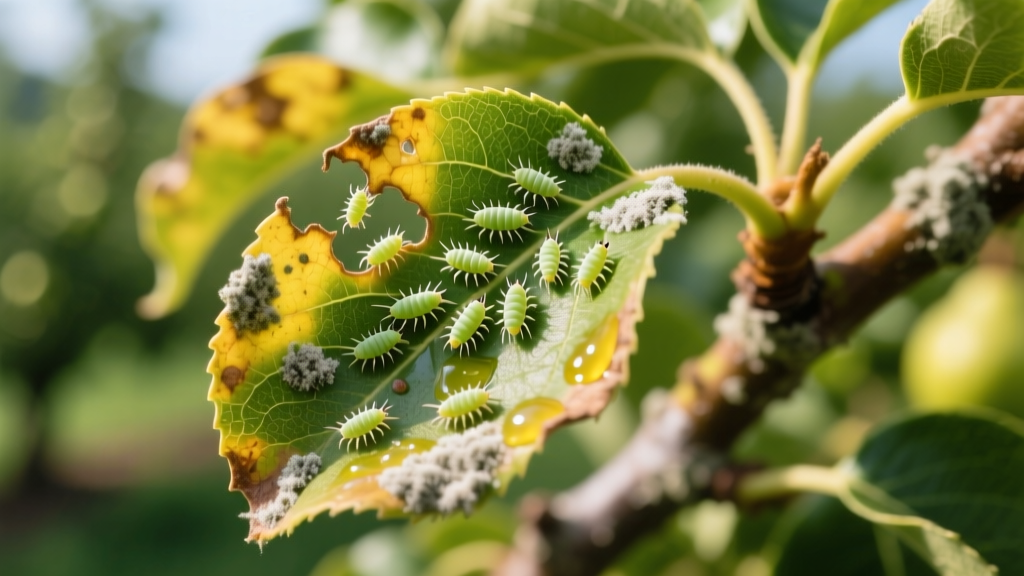
Diagnosing And Managing Pear Psylla In Orchard Trees
Emily WatsonPublished
Understanding Pear Psylla Biology and Seasonal Activity
Pear psylla (Cacopsylla pyricola) is a highly specialized, sap-feeding insect native to Europe but now established across North America’s commercial and backyard pear-growing regions. Unlike generalist pests, it feeds exclusively on Pyrus species—primarily European pears—and cannot complete its lifecycle on apple, quince, or ornamental trees. Its narrow host range makes monitoring straightforward but also increases the risk of rapid population buildup when host trees are abundant and unmanaged.
The pest undergoes incomplete metamorphosis with five nymphal instars and no pupal stage. Adults overwinter beneath bark scales or in leaf litter near the base of pear trunks. In early spring—typically between 50–70 growing degree days (GDD) base 43°F—adults become active and begin mating. Females lay up to 500 eggs over their lifetime, predominantly on bud scales and young leaf petioles. Egg hatch occurs within 5–10 days depending on temperature; at 68°F, median hatch time is 7.2 days (Washington State University Entomology, 2021).
Nymphs are sedentary, immobile after settling, and secrete copious amounts of honeydew—leading to sooty mold growth and fruit russeting. Development from egg to adult requires approximately 220 GDD. In central Washington’s irrigated orchards, three to four overlapping generations occur annually, while cooler maritime climates like western Oregon typically support only two full generations per season.
Diagnostic Signs and Field Identification
Early detection hinges on recognizing subtle but consistent indicators. Look for translucent, kidney-shaped eggs (0.25 mm long) glued singly to bud scales or leaf midribs in late March through April. First-instar nymphs are pale yellow and nearly microscopic (0.3 mm), whereas fifth-instar nymphs reach 1.8–2.2 mm in length and develop distinctive red eyes and wing pads. Adults measure 2.5–3.0 mm, with brownish bodies, transparent wings held roof-like over the abdomen, and prominent jumping ability.
Honeydew accumulation is often the first visible symptom—appearing as sticky, shiny droplets on leaves and fruit surfaces by mid-May. Within 48–72 hours under humid conditions, black sooty mold colonizes the honeydew, reducing photosynthesis and causing cosmetic blemishes. Severe infestations cause leaf curling, premature defoliation, and “psylla shock”—a physiological disorder marked by sudden leaf drop and shoot dieback due to toxin injection during feeding.
Monitoring Protocols for Accurate Thresholds
Effective management begins with systematic scouting. Place yellow sticky cards at eye level in the outer canopy of 10 representative trees per 5-acre block, checking weekly from green-tip through petal fall. A threshold of ≥10 adults per card per week triggers intervention. For nymphs, examine 20 buds and 20 leaves per tree; action is warranted when ≥20% of buds harbor eggs or ≥5% of leaves host ≥3 nymphs (Cornell University IPM Program, 2020).
Use a 10× hand lens to distinguish pear psylla from beneficial insects such as lacewing larvae or minute pirate bugs. Psylla nymphs lack chewing mouthparts and do not move when disturbed—unlike predatory mites or thrips—which aids rapid field differentiation.
Organic Control Strategies and Timing Precision
Organic interventions rely heavily on phenological alignment and physical disruption. Dormant-season applications of horticultural oil (superior grade, 2–3% concentration) applied at 40–50°F effectively smother overwintering adults and eggs. Timing is critical: apply only after temperatures remain above freezing for 24 hours and before bud swell—ideally between February 15 and March 10 in the Yakima Valley.
During the growing season, kaolin clay (e.g., Surround WP) forms a particle film barrier that deters egg-laying and disrupts nymphal feeding. Apply at 25 lb/acre mixed in 100 gallons water, beginning at tight cluster and repeating every 7–10 days until petal fall. Field trials at Oregon State University’s Mid-Columbia Agricultural Research and Extension Center showed a 68% reduction in nymphal density with three timely applications.
- Neem oil (azadirachtin) suppresses molting when applied to early instars; effective concentration: 0.5–1.0% v/v
- Beauveria bassiana strain GHA (e.g., BotaniGard ES) achieves ≥70% mortality under high humidity (>85%) and temperatures 68–77°F
- Summer oil (1–1.5% vol/vol) disrupts nymphal cuticle integrity but must avoid application above 85°F to prevent phytotoxicity
Chemical Interventions and Resistance Management
When populations exceed thresholds, targeted chemical controls remain essential—especially in high-density commercial orchards. Rotational use of chemically distinct modes of action prevents resistance development, which has already been documented to imidacloprid (neonicotinoid class) in multiple Pacific Northwest populations since 2016.
Preferred options include:
- Flonicamid (Applaud): Feeding inhibitor acting on nicotinic acetylcholine receptors; LD50 for psylla nymphs = 0.012 μg/insect
- Spirotetramat (Movento): Lipid biosynthesis inhibitor; systemic uptake via xylem and phloem; residual activity lasts ≥21 days
- Diflubenzuron (Micronized Dimilin): Chitin synthesis inhibitor; most effective against second- and third-instar nymphs
Application timing maximizes efficacy and minimizes non-target impact. The “golden window” spans from tight cluster to early petal fall—when adults are actively laying and nymphs are concentrated on new growth. Avoid spraying during bloom to protect pollinators; instead, target post-bloom nymph flushes using degree-day models calibrated to local weather stations.
Integrated Pest Management Frameworks
Successful long-term control integrates biological, cultural, and chemical tactics within an IPM framework endorsed by land-grant universities. The University of California IPM guidelines recommend conserving natural enemies—including Chrysoperla carnea (green lacewing), Orius tristicolor (minute pirate bug), and parasitoid wasps like Tamarixia tremex—by avoiding broad-spectrum pyrethroids during May–July.
Cultural practices reinforce chemical and organic efforts. Pruning to open canopy airflow reduces humidity favorable to sooty mold and improves spray penetration. Removing wild pear volunteers within 1,000 feet of orchards eliminates alternate breeding sites—documented to reduce initial inoculum by up to 40% in Hood River County, Oregon surveys.
Regional Adaptation and Climate Considerations
Management intensity must reflect local climate drivers. In the arid Columbia Basin, summer drought stress increases tree susceptibility, requiring earlier intervention thresholds (≥5 adults/sticky card). Conversely, in coastal Washington’s cooler, wetter microclimates, slower psylla development delays peak nymphal abundance by 10–14 days compared to inland sites.
A 2022 multi-year study across 12 orchards in Wenatchee, WA demonstrated that delaying first-season sprays by 5 days beyond conventional timing—based on real-time GDD tracking—reduced total pesticide applications by 2.3 sprays per season without yield loss. This precision approach aligns with USDA-funded Climate-Smart IPM initiatives piloted through Washington State University’s Tree Fruit Research & Extension Center.
“Pear psylla management isn’t about eradication—it’s about disrupting reproductive synchrony with host phenology. A single well-timed oil spray at delayed-dormant can suppress 90% of overwintering adults, buying critical time for biological controls to establish.” — Dr. Elizabeth Beers, WSU Tree Fruit Entomologist, 2023
Recordkeeping and Regulatory Compliance
Maintaining detailed spray logs—including product name, active ingredient concentration, application date, weather conditions, and pre-harvest interval (PHI)—is mandatory under EPA Worker Protection Standard and Washington State Department of Agriculture regulations. For example, spirotetramat carries a 7-day PHI, while flonicamid requires 14 days. Records must be retained for 2 years and made available for audit.
University extension resources provide free digital tools: the UC IPM Pest Management Guidelines website offers interactive GDD calculators updated hourly from NOAA stations, and Cornell’s “Psylla Tracker” app delivers real-time regional alerts based on trap data from New York’s Hudson Valley and Ontario’s Niagara Peninsula.
Growers in certified organic operations must verify all inputs against the National Organic Program (NOP) List of Allowed and Prohibited Substances. Kaolin clay and potassium salts of fatty acids are permitted; synthetic pyrethrins require documentation of pest pressure exceeding thresholds defined in the farm’s Organic System Plan.
Resistance monitoring remains a shared responsibility. The Pacific Northwest Pest Management Alliance coordinates annual psylla bioassays across commercial orchards in Yakima, Benton, and Chelan Counties. Results guide regional spray recommendations issued each January by WSU and OSU entomologists.
Historical data shows that orchards implementing full IPM protocols—including winter sanitation, targeted sprays, and conservation biologicals—reduce average annual treatment costs by $187–$243 per acre compared to calendar-based programs (UC Cooperative Extension, 2019). This economic advantage compounds over time as beneficial insect populations rebound and pesticide dependence declines.
Temperature-driven development models confirm that a sustained 3°F rise in average spring temperatures accelerates psylla emergence by 4.7 days per decade—a trend already observed in Longview, WA, where first adult captures now occur 11 days earlier than baseline data from 1990–2000.
Effective pear psylla management demands consistency—not just in application, but in observation, recordkeeping, and responsiveness to local ecological signals. It is a discipline rooted in entomology, agronomy, and attentive stewardship of both crop and ecosystem.