Home & Garden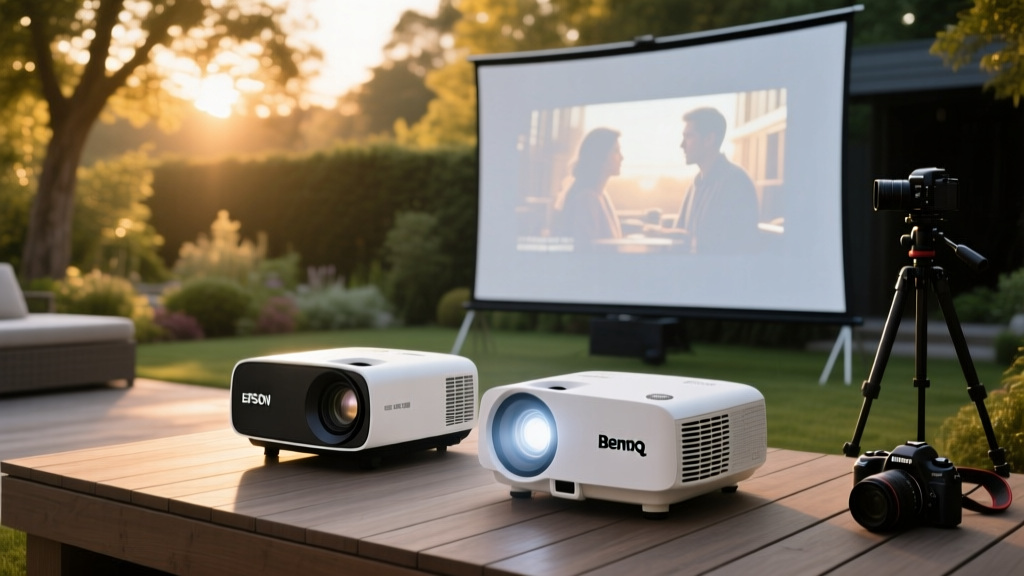
Epson vs BenQ Lumens: 2026 Outdoor Cinema Photo Guide
Robert HayesPublished
The Intersection of Outdoor Cinema and Garden Photography
As we move through the 2026 outdoor living season, the backyard has evolved far beyond a simple patio and grill setup. Today, the modern garden is a fully integrated entertainment hub, and the outdoor movie projector has become a centerpiece of landscape design. But for garden enthusiasts, landscape designers, and lifestyle photographers, an outdoor cinema night presents a unique opportunity: the chance to document the garden in a completely new light. Garden photography and documentation are no longer confined to macro shots of blooming hostas at high noon. Capturing the ambiance, lifestyle, and architectural lighting of an evening garden event requires a deep understanding of your primary light sources.
When setting up an outdoor theater, the choice of projector dictates not only the viewing experience but also the photographic outcome of your garden documentation. The two reigning champions in the high-brightness outdoor market are Epson and BenQ. Their differing approaches to lumen output, color temperature, and light spill dramatically alter how your garden looks through the lens of a camera. In this comprehensive 2026 guide, we will compare the lumen performance of Epson and BenQ flagships, exploring how their light output impacts both the cinematic experience and your nighttime garden photography portfolio.
Understanding Lumens in the 2026 Outdoor Environment
Before diving into the brand comparison, it is crucial to understand how lumens behave in an outdoor setting. Unlike a controlled indoor home theater, an outdoor environment is plagued by ambient light pollution, moonlight, and nearby streetlamps. The Projector Central screen calculator consistently demonstrates that outdoor environments require a minimum of 3,000 to 4,000 lumens to maintain image integrity against twilight and ambient garden path lighting.
However, from a photographic perspective, lumens represent more than just screen brightness; they represent spill light. Spill light is the ambient illumination that bounces off the projector screen and washes over the surrounding garden beds, hardscaping, and patio furniture. This spilled light acts as a massive, continuous fill-light for your camera sensor. The color temperature of this spill (usually calibrated between 6500K and 9000K for daylight-balanced movie content) will mix with the warm 2700K glow of your garden path lights, creating complex, mixed-lighting scenarios that challenge even the most advanced 2026 mirrorless camera sensors.
Epson vs BenQ: 2026 Flagship Lumen Comparison
To understand the photographic impact, we must compare two distinct philosophies in projector engineering. For this analysis, we are looking at the ultra-bright laser-driven Epson EpiqVision Ultra LS800 and the high-contrast, color-accurate BenQ TK860i. Both are staples for premium outdoor setups in 2026, but they achieve their brightness and color rendering in fundamentally different ways.
| Feature | Epson EpiqVision Ultra LS800 | BenQ TK860i |
|---|---|---|
| Peak Brightness | 4,000 Lumens | 3,300 Lumens |
| Light Source | Laser | Lamp |
| Color Accuracy | sRGB 90% | Rec. 709 98% |
| Throw Ratio | Ultra Short Throw (0.16) | Standard (1.15 - 1.50) |
| Photographic Spill | Broad, even ambient wash | Focused, high-contrast directional |
| Black Levels | Moderate (Gray wash in dark scenes) | Deep (Excellent shadow retention) |
Epson EpiqVision Ultra LS800: The 4,000-Lumen Flood
The Epson LS800 is a brute-force lighting instrument. Pushing 4,000 lumens via a laser light source, it is designed to cut through heavy twilight and ambient light pollution. Because it is an Ultra Short Throw (UST) projector, it sits directly beneath the screen, casting light upward at a steep angle. From a garden photography standpoint, this creates a wide, diffused wash of light that illuminates the patio floor, the lower foliage of nearby potted plants, and the legs of your outdoor furniture. It acts almost like a large studio softbox, providing even, shadowless fill light for wide-angle environmental portraits of your guests enjoying the movie.
BenQ TK860i: The 3,300-Lumen Cinematic Contrast
The BenQ TK860i takes a more refined approach. With 3,300 lumens and a focus on HDR-PRO color accuracy, it prioritizes contrast and deep blacks over raw, blinding brightness. Mounted on a standard throw from the back of the patio, its light beam is highly directional. The photographic spill from the BenQ is more contained, meaning the surrounding garden remains darker, preserving the moody, intimate shadows of the night landscape. This is ideal for photographers who want to emphasize the cinematic glow on their subjects' faces while keeping the background garden features cloaked in dramatic, natural darkness.
How Projector Lumens Affect Night Garden Photography
When documenting your outdoor living space for a design portfolio or a high-end lifestyle blog, the lumen output of your projector will dictate your camera settings and compositional choices. According to experts in night photography techniques, managing mixed light sources is the most critical skill for after-dark documentation. Here is how the Epson and BenQ lumen profiles change your photographic approach:
- The Epson 4,000-Lumen Advantage (Wide-Angle Landscapes): If your goal is to document the entire garden layout, the hardscaping, and the outdoor furniture arrangement, the Epson is your best tool. The massive lumen output bounces off the screen and illuminates the mid-ground of your garden. You can shoot at lower ISOs (e.g., ISO 800-1600 on a 2026 full-frame sensor) and capture the texture of stone pathways and the vibrant greens of nearby ferns without needing external flash units.
- The BenQ 3,300-Lumen Advantage (Intimate Portraiture & Mood): If your documentation focuses on the emotional experience—the cozy blankets, the glowing faces of the audience, and the intimate atmosphere—the BenQ is superior. Because it produces less ambient spill, the garden background falls off into deep, rich shadows. This allows you to use wide apertures (f/1.4 to f/2.8) to isolate your subjects against a beautifully blurred, dark botanical background, emphasizing the screen's glow as a natural rim-light.
Managing Light Pollution and Color Temperature
One of the greatest challenges in garden photography is balancing the cool, blue-toned light of a projector (often pushing 8000K during bright, daylight-balanced movie scenes) with the warm, orange glow of landscape lighting (2700K-3000K). The National Park Service guidelines on night photography emphasize the importance of understanding how artificial light sources interact with the natural environment, a principle that applies perfectly to the curated environment of a luxury garden.
With the 4,000-lumen Epson, the cool spill light is so intense that it can easily overpower your warm path lights, turning your garden beds an unnatural, clinical blue. To counteract this during a photoshoot, you may need to temporarily dim your smart garden lighting via your home automation app, or use a custom white balance in your camera to favor the warmer tones, allowing the projector light to act as a cool, contrasting rim-light. Conversely, the 3,300-lumen BenQ allows the warm garden lights to maintain their visual dominance in the background, creating a beautiful, cinematic color contrast between the warm foliage and the cool, crisp light emanating from the screen.
Setup Tips for the Perfect Photographic Documentation
To maximize the photographic potential of your outdoor cinema setup in 2026, consider the following placement and documentation strategies:
- Screen Placement for Framing: Do not place the screen flat against a fence. Pull it out into the open garden space. This allows the projector's spill light to wrap around the screen and illuminate the trees and shrubs behind it, adding depth and three-dimensionality to your wide-angle garden shots.
- The UST vs. Standard Throw Shadow Problem: When using a standard throw projector like the BenQ, anyone walking between the lens and the screen will cast a massive, harsh shadow. From a photography perspective, this can be used creatively to capture dramatic silhouettes against the bright screen. However, if you want clean, unobstructed environmental photos of the space, the Epson UST eliminates the walking-path shadow issue entirely, as the light beam is confined to the space immediately in front of the screen.
- Camera Settings for 2026 Sensors: Modern 2026 mirrorless cameras feature incredible dual-gain sensor architectures. When shooting the Epson's bright spill, keep your ISO at its second native gain (usually around ISO 3200) to minimize noise while capturing the subtle details in the dark garden corners. Use a shutter speed no slower than 1/60th of a second to freeze the subtle movements of wind-blown ornamental grasses illuminated by the projector's glow.
Final Verdict for the 2026 Season
Choosing between Epson and BenQ for your outdoor movie setup ultimately depends on your dual priorities as an entertainer and a garden documentarian. If your primary goal is to host large, vibrant parties where the garden remains brightly lit, and your photography focuses on wide-angle, environmental shots of the entire outdoor living space, the 4,000-lumen Epson EpiqVision Ultra LS800 is the undisputed champion. Its massive light output acts as a built-in landscape illuminator.
However, if you prefer a moody, intimate, and highly cinematic atmosphere, and your photography leans toward portraiture, detail shots, and dramatic shadow play, the 3,300-lumen BenQ TK860i is the superior choice. It respects the natural darkness of the night garden, allowing your carefully designed landscape lighting to share the stage with the cinematic glow. Whichever you choose, understanding the interplay of lumens, spill light, and camera sensors will elevate your garden documentation from simple snapshots to stunning, professional-grade lifestyle photography.
