Home & Garden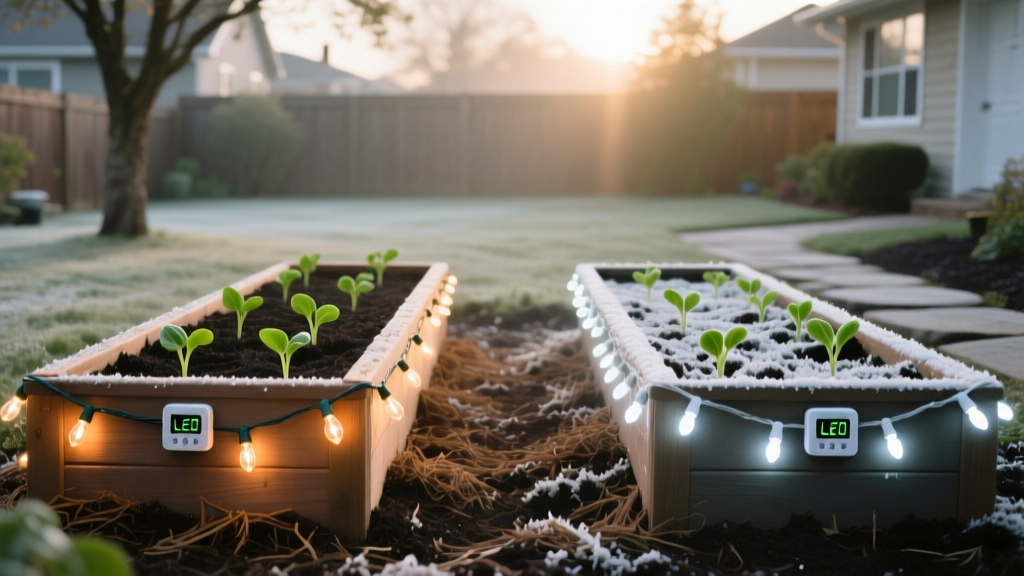
2026 Raised Bed Frost Protection: LED vs Incandescent Lights
Anna KowalskiPublished
Extending the 2026 Winter Harvest: The Holiday Light Trick
As the 2026 winter season approaches, raised bed vegetable gardeners are actively looking for ways to extend their harvest well past the first frost. Growing cold-hardy crops like Winter Spinach, Mache, Claytone, and sweet winter carrots in raised beds is incredibly rewarding, but the physics of raised beds work against you when temperatures plummet. Because raised beds are elevated, they are exposed to freezing air on all four sides, causing the soil to lose its thermal mass much faster than traditional in-ground gardens.
To combat this, many seasoned gardeners use a classic season-extension trick: stringing outdoor holiday lights under frost blankets, low tunnels, or cold frames to provide a gentle, ambient heat source that keeps the microclimate just above freezing. But as lighting technology has evolved, a critical debate has emerged in the gardening community. Should you use traditional incandescent holiday bulbs, or have modern LEDs rendered the old method obsolete? Understanding the difference in holiday outdoor lighting LED vs incandescent wattage and timer strategies is crucial for saving your winter crops and managing your energy bill in 2026.
The Physics of Raised Bed Microclimates
Before choosing your lighting, it is important to understand how frost protection works in a raised bed environment. According to The Old Farmer's Almanac, protecting plants from frost is less about blasting them with heat and more about trapping radiant heat and preventing ice crystals from forming on leaf tissue. When you drape a spun-bond polypropylene row cover (frost blanket) over a raised bed hoop, you create a dead-air space. The soil naturally radiates a small amount of geothermal heat upward. By introducing a mild heat source under that cover, you amplify this effect, keeping the interior temperature 4°F to 8°F warmer than the outside ambient air.
This is where holiday lights come into play. A string of C7 or C9 bulbs draped along the base of the raised bed or woven through the lower hoops of a cold frame acts as a distributed, low-wattage heater. However, the type of bulb you choose drastically changes the outcome.
Incandescent C9 Bulbs: The Traditional Heat Source
For decades, gardeners have relied on incandescent C7 and C9 outdoor holiday lights for frost protection. The secret to their effectiveness lies in their inefficiency. A standard incandescent C9 bulb consumes about 7 watts of electricity, but it converts roughly 90% of that energy into heat rather than light.
When you string 100 incandescent C9 bulbs along the perimeter of a 4x8 foot raised bed, you are essentially deploying a 700-watt space heater that is safely distributed across a wide area. This generates approximately 2,380 BTUs (British Thermal Units) of heat per hour. Under a sealed cold frame or heavy frost blanket, this gentle thermal output is more than enough to prevent a hard freeze, even when outside temperatures dip into the low 20s. For winter root crops and hardy greens, this ambient warmth prevents the soil in the raised bed from freezing solid, allowing you to harvest carrots and parsnips all winter long.
LED Holiday Lights: The 2026 Energy-Efficient Reality
Fast forward to 2026, and the market is dominated by LED holiday lights. The U.S. Department of Energy notes that LED lighting choices save significant energy and offer vastly superior lifespans compared to incandescent bulbs. A modern LED C9 bulb uses a mere 0.08 watts of electricity. While this is a massive victory for your energy bill and for illuminating your garden paths, it presents a major problem for frost protection: LEDs emit virtually zero heat.
If you drape a string of LED holiday lights under a frost blanket over your raised bed, your plants will still freeze. The LEDs simply do not draw enough wattage to create the thermal resistance required to warm the air inside the microclimate. Therefore, if your primary goal is frost protection, standard LED holiday lights will fail you. However, if your goal is simply to illuminate the raised bed for evening winter harvesting without tripping a breaker or creating a fire hazard near dry mulch, LEDs are the undisputed champion.
Wattage, Heat, and Cost Comparison Table
To help you plan your 2026 winter garden setup, here is a direct comparison of running 100 bulbs (enough for a large raised bed perimeter) for 10 hours a night, based on the national average electricity rate of $0.16 per kWh.
| Bulb Type | Wattage (per bulb) | Total Wattage (100 bulbs) | Heat Output (BTU/hr) | Cost per Night (10 hrs) | Frost Protection Viability |
|---|---|---|---|---|---|
| C9 Incandescent | 7.0W | 700W | ~2,380 BTU | $1.12 | Excellent (Primary Heat Source) |
| C9 LED (Standard) | 0.08W | 8W | ~27 BTU | $0.01 | Poor (Illumination Only) |
| S14 LED (Edison) | 1.0W | 100W | ~340 BTU | $0.16 | Fair (Mild Frost Buffer) |
Note: If you wish to use LEDs for frost protection in 2026, you must pair them with a dedicated seedling heat mat or a specialized horticultural heating cable placed directly on the raised bed soil surface.
Timer Strategies for Winter Garden Lighting
Whether you are using incandescent bulbs for heat or high-wattage S14 LEDs for a mild thermal buffer, you should never leave your raised bed lights running 24/7. Not only is it a waste of energy, but it can also confuse the photoperiodism of your winter vegetables, potentially causing crops like spinach to bolt prematurely. Utilizing the right timer strategy is essential for balancing plant health, frost protection, and energy efficiency.
1. Avoid Standard Photocells for Frost Protection
Many outdoor holiday light cords come with built-in photocell sensors that turn the lights on at dusk and off at dawn. For frost protection, this is highly inefficient. The coldest part of the night does not occur at 6:00 PM when the sun sets; it occurs between 3:00 AM and 6:00 AM, right before sunrise. Running incandescent lights all evening wastes wattage and can overheat your cold frame on mild nights, encouraging fungal diseases like powdery mildew on your winter greens.
2. Smart Plugs and Temperature Triggers
In 2026, the best approach for raised bed season extension is using a Wi-Fi-enabled outdoor smart plug (such as the Kasa EP400 or Wyze Plug Outdoor) paired with a smart home ecosystem. These devices allow you to set temperature-based automations rather than simple time-based schedules.
- Step 1: Place an outdoor smart temperature sensor near your raised bed, shielded from direct wind but exposed to the ambient air.
- Step 2: Program your smart plug to turn the incandescent C9 lights ON only when the sensor reads temperatures dropping below 34°F.
- Step 3: Set an automatic shut-off when the temperature rises above 38°F, or cap the maximum run time to 4 hours to prevent soil dehydration.
3. The Mechanical Interval Timer Backup
For gardeners who prefer not to rely on Wi-Fi in the backyard, a heavy-duty mechanical interval timer is the safest bet. Set the timer to activate the lights for two 2-hour intervals: once from 4:00 AM to 6:00 AM (the coldest window), and again from 6:00 PM to 8:00 PM to trap the residual daytime heat inside the cold frame before the deep freeze sets in.
Safety, Moisture, and IP Ratings in the Garden
Raised beds are inherently wet environments. Between watering your winter crops, melting snow, and condensation dripping from the inside of your cold frame poly-carbonate lids, moisture is everywhere. When deploying any electrical equipment near your vegetable garden, safety must be your top priority.
Ensure that any extension cords and light strings used near the soil level carry an IP65 water-resistance rating or higher. While incandescent bulbs get hot, they are generally sealed well enough to handle garden moisture. However, the connections between light strings are the weak point. In 2026, it is highly recommended to use silicone cord protectors or dielectric grease on all outdoor prong connections to prevent short circuits. Furthermore, always plug your garden lighting setup into a GFCI (Ground Fault Circuit Interrupter) outlet. If moisture breaches a connection and causes a fault, the GFCI will instantly cut the power, protecting both you and your garden infrastructure.
Conclusion: Choosing the Right Light for Your 2026 Harvest
The debate between holiday outdoor lighting LED vs incandescent wattage and timer setups ultimately comes down to your specific gardening goals. If you are trying to actively heat a raised bed cold frame to protect winter carrots and spinach from hard freezes, traditional incandescent C9 bulbs remain an unmatched, low-cost horticultural tool. Their high wattage and heat output are exactly what your microclimate needs. However, if you simply want to beautifully illuminate your winter raised beds for safe evening harvesting without spiking your utility bill, modern LEDs are the clear winner. By pairing your chosen lighting with smart, temperature-triggered timers, you can successfully bridge the gap between deep winter and early spring, ensuring your 2026 garden remains productive year-round.
