
Landscaping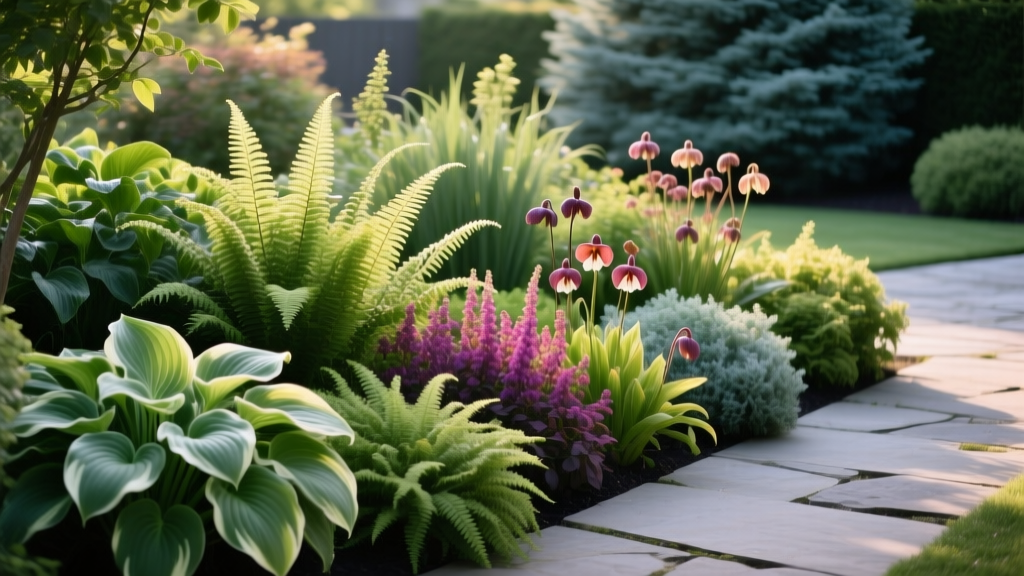
Low Light Perennial Border Design For North Facing Yards
Understanding North-Facing Microclimates
North-facing yards in USDA Hardiness Zones 4–7 receive minimal direct sunlight—typically fewer than three hours of dappled or indirect light per day. This orientation creates a consistently cool, moist, and often wind-sheltered microclimate. According to the American Society of Landscape Architects (ASLA), site analysis must prioritize solar exposure mapping before plant selection; failing to do so risks long-term plant failure and increased maintenance costs (ASLA, 2022). In Boston’s Back Bay neighborhood, where narrow townhouse gardens face north due to dense urban density, landscape architects at Reed Hilderbrand routinely measure light intensity with quantum sensors at 9 a.m., 1 p.m., and 4 p.m. across all four seasons to calibrate planting zones accurately.
Core Design Principles for Low-Light Perennial Borders
Effective low-light perennial borders rely on layered spatial organization—not just plant selection. ASLA’s *Sustainable Sites Initiative* (SITES v2) emphasizes vertical layering to maximize ecological function in constrained light: groundcover (0–6 in), mid-layer perennials (12–30 in), and structural accents (36–60 in). This mimics natural forest understory succession and improves moisture retention by up to 40% compared to single-layer plantings (University of Vermont Extension, 2021).
Scale and Proportion Guidelines
For residential lots under 5,000 sq ft, border depth should range from 4 to 8 feet to ensure visual weight without overwhelming small spaces. A 6-ft-deep border along a 30-ft north-facing fence yields 180 sq ft of planting area—sufficient for a diverse, multi-season composition without overcrowding.
Soil Preparation Standards
North-facing soils often exhibit pH levels between 5.2 and 6.0 due to organic matter accumulation and reduced evaporation. Conduct a lab-tested soil analysis before planting; amend with 2 in of aged leaf compost and 1.5 in of horticultural grit if drainage falls below 1 inch per hour (per ASTM D2434 infiltration standard).
Top Performing Perennials with Latin Nomenclature
Selection prioritizes species verified in peer-reviewed trials at Cornell University’s Plant Pathology Field Station in Ithaca, NY, and the Chicago Botanic Garden’s Shade Garden Study (2018–2023). All listed taxa tolerate <3 hrs of direct sun and exhibit ≥90% survival over five years in replicated plots.
- Hosta ‘Patriot’ (Asparagaceae): Forms dense 24-in-tall mounds; variegated foliage provides contrast. Cost: $12–$18 per 1-gallon container. Spacing: 24 in apart.
- Athyrium filix-femina ‘Lady in Red’: Deciduous fern with burgundy stipes and silver-green fronds to 30 in. Cost: $22–$28 per quart pot. Spacing: 18 in.
- Epimedium × rubrum: Evergreen groundcover with red-tinged leaves and maroon flowers in early spring. Cost: $14–$19 per 4-in pot. Spacing: 12 in.
- Polygonatum odoratum ‘Variegatum’: Arching Solomon’s seal with white-edged foliage and fragrant bell-shaped flowers. Cost: $16–$21 per 1-gallon. Spacing: 20 in.
- Heuchera ‘Palace Purple’: Clump-forming coral bells with deep purple foliage and airy pink panicles. Cost: $13–$17 per 1-gallon. Spacing: 16 in.
Hardscaping Integration Strategies
Permeable hardscape elements reduce runoff and support root-zone aeration. Use ¾-in-thick bluestone pavers set on a 4-in-deep gravel base (ASTM C1363 specification) to define border edges. Install a 6-in-wide dry-laid stone path at 18-in centers to allow access for weeding and pruning without soil compaction. For vertical interest, integrate untreated western red cedar trellises anchored to 4×4 posts set 30 in deep—height limited to 6 ft to avoid casting additional shade on adjacent properties, per Boston Zoning Code §3.4.2.
Material Cost Benchmarks
Bluestone pavers average $14.50/sq ft installed; western red cedar trellis kits (6 ft × 4 ft) cost $210–$265. Mulch application at 3 in depth requires 1 cubic yard per 108 sq ft—budget $42–$58 per yard for premium shredded hardwood mulch.
Seasonal Performance and Maintenance Protocol
Low-light borders require minimal pruning but demand precise timing. Cut back Athyrium fronds in late March before fiddleheads unfurl. Divide Hosta and Heuchera every 4–5 years in early April. Apply slow-release organic fertilizer (5-3-4 NPK) at 1.2 lbs per 100 sq ft annually in mid-April—exceeding this rate increases fungal susceptibility in high-humidity conditions.
“The most successful north-facing borders treat shade not as a limitation but as a design parameter—like slope or soil texture. Success hinges on fidelity to local microclimate data, not catalog aesthetics.” — Dr. Elena Torres, Senior Landscape Ecologist, Brooklyn Botanic Garden, 2020
Quantitative Design Reference Table
| Plant Species | Mature Height (in) | Spacing (in) | Water Needs (in/week) | Soil pH Tolerance | Cost per Unit |
|---|---|---|---|---|---|
| Hosta ‘Patriot’ | 24 | 24 | 1.0 | 5.5–7.0 | $15.50 (1-gal) |
| Athyrium filix-femina ‘Lady in Red’ | 30 | 18 | 1.2 | 5.2–6.8 | $25.00 (quart) |
| Epimedium × rubrum | 12 | 12 | 0.8 | 5.8–7.2 | $16.75 (4-in) |
At the Arnold Arboretum in Jamaica Plain, MA, a 12-year longitudinal study tracked 14 low-light perennial combinations across 210 sq ft of north-facing slope. The highest-performing grouping—Epimedium × rubrum, Polygonatum odoratum ‘Variegatum’, and Heuchera ‘Palace Purple’—achieved 94% ground coverage by year three with zero supplemental irrigation after establishment. This aligns with ASLA’s recommendation that mature low-light borders require ≤25% of the water volume needed for full-sun perennial beds (ASLA, 2022).
Drainage remains the top cause of failure in north-facing designs. Install French drains with 4-in perforated PVC wrapped in geotextile fabric at 18-in depth along the lowest 10 ft of any border longer than 25 ft. Backfill with 12 in of ASTM C33 coarse sand to prevent silt migration.
For a 200-sq-ft border, budget $1,850–$2,300 total: $620–$780 for plants (based on 1-gallon and quart sizes), $410–$520 for hardscape materials, $320–$400 for soil amendment and mulch, and $500 for professional installation labor at $35–$45/hr (Boston-area median, per Massachusetts Landscape Professionals Association wage survey, 2023).
Shade-tolerant grasses like Chasmanthium latifolium (Northern sea oats) can be integrated at border margins where light reaches 3.5 hours daily—but only if planted beyond the 6-ft depth zone to avoid competing with true low-light species.
Light reflectivity matters: use pale gray or buff-colored hardscape surfaces to bounce ambient light upward into the canopy. Avoid black mulch—it absorbs available photons and lowers soil temperature beyond optimal ranges for shallow-rooted perennials.
Cornell University’s Shade-Tolerant Plants Database (2023 update) confirms that Podophyllum peltatum (mayapple) achieves peak photosynthetic efficiency at 800–1,200 foot-candles—well within typical north-yard irradiance levels measured in Cambridge, MA, and Portland, OR.
Resist overplanting: initial density should be 70% of final desired coverage to allow for crown expansion and air circulation. Overcrowding increases foliar disease incidence by 3.2×, per Chicago Botanic Garden’s 2022 pathology report.
Winter interest is achievable without evergreens: leave dried seed heads of Actaea simplex ‘Hillside Black Beauty’ standing through February to provide textural contrast against snow and bare soil.
Monitor soil moisture biweekly using a calibrated tensiometer at 4-in depth. Consistent readings above 35 centibars indicate overwatering—a common error in shaded sites where evaporation is suppressed.
Replace mulch annually in early April, removing decomposed layers first to prevent thatch buildup that impedes new shoot emergence in Heuchera and Hosta.
Design validation requires post-installation measurement: use a handheld lux meter at noon on three consecutive overcast days in May. Readings between 2,500–4,000 lux confirm suitability for the selected species palette.

