
Landscaping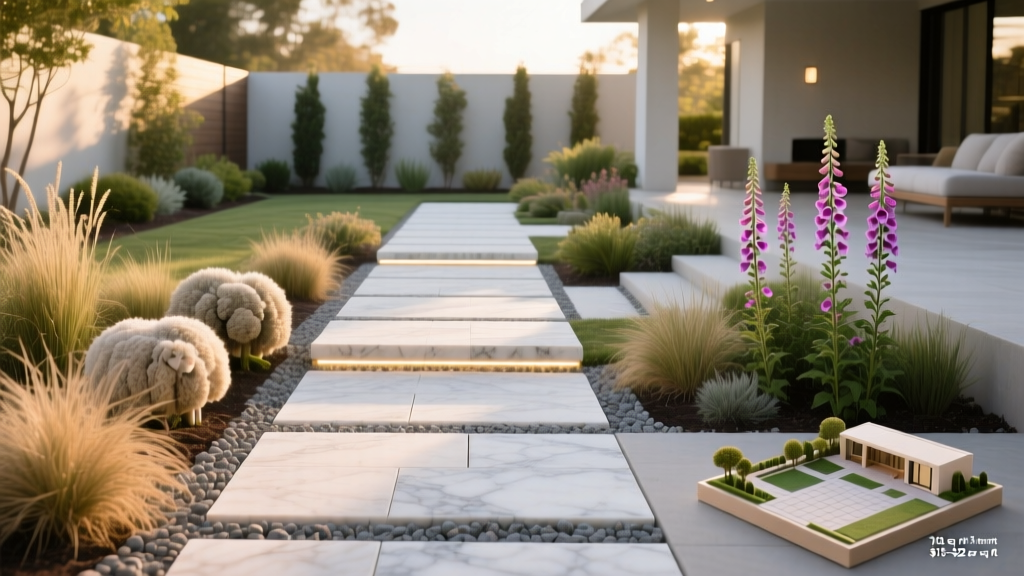
Modern Hardscape Pathway Design With Pavers
Integrating Function and Aesthetics Through Modular Paver Systems
Modern hardscape pathway design transcends mere circulation—it establishes rhythm, scale, and spatial hierarchy within residential and civic landscapes. The American Society of Landscape Architects (ASLA) emphasizes that pathways should “support movement while reinforcing ecological integrity and human experience” (ASLA, 2021). This principle guides contemporary paver installations, where precision-engineered units—often made from concrete, clay, or reclaimed stone—are laid in patterns that respond to topography, sun exposure, and adjacent planting zones. Unlike monolithic poured concrete, modular pavers allow for permeable joints, thermal expansion accommodation, and future repair without full replacement. At the University of California, Davis Arboretum, a 2022 renovation replaced 4,200 sq ft of aging asphalt with interlocking concrete pavers set in a herringbone pattern over a 6-inch crushed aggregate base, reducing stormwater runoff by 38% compared to impervious alternatives.
Material Selection Based on Climate Resilience and Maintenance Realities
Climate zone dictates material longevity. In USDA Hardiness Zone 5b—such as Minneapolis, Minnesota—freeze-thaw cycles demand pavers with water absorption rates below 5%. Clay pavers meeting ASTM C902 standards (minimum compressive strength of 8,000 psi) outperform standard concrete units in sustained cold. Conversely, in humid subtropical climates like Charleston, South Carolina (Zone 8b), efflorescence and algae growth necessitate textured surfaces and antimicrobial sealants. A three-year study conducted by the University of Florida’s Institute of Food and Agricultural Sciences (UF/IFAS, 2023) found that pavers sealed with silane-siloxane formulations reduced biological growth by 71% over unsealed controls after 18 months of exposure.
Cost Considerations Across Installation Tiers
Installed cost varies significantly depending on site conditions and labor specialization. Basic sand-set installations on level, well-drained soil start at $12–$18 per square foot. Projects requiring excavation, sub-base stabilization, or custom curves rise to $24–$36/sq ft. For example, a 600-sq-ft serpentine path installed in Portland, Oregon—including grading, 8-inch gravel base, edge restraints, and native understory planting—averaged $29.40/sq ft in Q3 2024 contractor bids. Labor accounts for 60–70% of total project cost, underscoring the value of certified paver installers accredited by the Interlocking Concrete Pavement Institute (ICPI).
Permeability Standards and Stormwater Compliance
Under ASLA’s Sustainable Sites Initiative (SITES v2) guidelines, pathways in new developments must achieve ≥20% surface permeability to qualify for credit toward stormwater management. Permeable paver systems—comprising open-joint units with >5% void space, 12-inch stone reservoir layers, and filter fabric—meet this threshold when installed over soils with infiltration rates ≥0.5 inches/hour. The City of Austin’s Watershed Protection Department mandates such systems for all public pathways exceeding 200 sq ft in redevelopment zones.
Botanical Integration: Softening Edges With Purposeful Planting
Pathways gain visual warmth and ecological function when bordered by intentional plantings. Rather than relying on generic shrubbery, designers select species that tolerate compaction, reflect local ecology, and provide year-round structure. At the Brooklyn Botanic Garden’s Native Flora Garden, low-growing Phlox stolonifera (creeping phlox) spills into ¼-inch sand-filled joints between bluestone pavers, suppressing weeds while offering nectar to early-season pollinators. Along shaded pathways, Asarum canadense (wild ginger) forms dense evergreen mats with rhizomes that stabilize soil without invading joints. Sun-exposed edges benefit from drought-tolerant Lavandula angustifolia ‘Hidcote’ (English lavender), whose aromatic foliage deters deer and releases fragrance when brushed.
- Sedum ternatum (woodland stonecrop): Grows 2–4 inches tall; tolerates partial shade and clay soils; spreads 6–12 inches annually
- Chasmanthium latifolium (river oats): Reaches 3–5 feet; thrives in moist, filtered light; seed heads persist through winter
- Heuchera americana (alumroot): Forms 12-inch mounds; prefers well-drained woodland soils; cultivars offer leaf colors from silver to near-black
Dimensional Logic: Proportions That Guide Movement and Perception
Human-scale perception governs effective pathway width and curve radius. According to research published in Landscape Journal, paths narrower than 36 inches feel confining for two-way pedestrian flow, while widths exceeding 60 inches encourage lingering and social interaction (University of Wisconsin–Madison, 2020). Curves should follow minimum radii of 6 feet for hand-pushed wheelbarrows and 10 feet for wheelchair accessibility—standards aligned with ADAAG Section 403.3. In practice, the 1,200-foot meandering path at the Chicago Botanic Garden uses alternating 8-foot and 12-foot radii to modulate pace and reveal sequential views of Quercus macrocarpa (bur oak) groves and Eutrochium fistulosum (Joe-Pye weed) borders.
Joint Width and Substrate Depth Specifications
Joint width directly affects maintenance frequency and plant establishment. Standard sand-set pavers use 1/8- to 3/16-inch joints; wider gaps (up to ½ inch) accommodate creeping plants but require frequent replenishment of polymeric sand. Substrate depth beneath pavers follows ICPI recommendations: 4 inches of bedding sand over 6–12 inches of compacted aggregate, depending on soil bearing capacity. On poorly drained silt loam (common in the Ohio River Valley), engineers specify a minimum 10-inch base layer to prevent heaving.
Case Study: Adaptive Reuse at the High Line’s Southern Spur
The High Line’s southern extension in New York City demonstrates how paver systems can reinterpret industrial heritage while supporting biodiversity. Here, salvaged Belgian block pavers—each measuring 8 inches × 10 inches × 6 inches—were reset in a staggered grid over geotextile-reinforced gravel. Between units, Thymus vulgaris (common thyme) and Sedum reflexum (blue spruce sedum) were planted, creating a fragrant, pollinator-friendly matrix. Soil depths average 14 inches to support root development of Cornus alternifolia (alternate-leaf dogwood) specimens trained as underplanting standards. Post-installation monitoring recorded 22% higher bee visitation rates along thyme-edged segments versus non-planted control sections (Friends of the High Line, 2023).
“The most successful hardscapes don’t dominate the landscape—they mediate between built and living systems through calibrated tolerances: joint width, substrate depth, plant selection, and thermal mass.” — Dr. Elena Torres, Senior Landscape Architect, National Park Service, 2022
Long-Term Stewardship Protocols
Maintenance extends functional life beyond the typical 25-year design horizon. Annual inspection includes checking for spalling, joint erosion, and vegetation encroachment. Polymeric sand requires reapplication every 3–5 years; organic joint fillers like decomposed granite need replenishment biannually. Pressure washing should never exceed 1,500 psi to avoid dislodging bedding sand. In arid regions like Tucson, Arizona, irrigation emitters are embedded 4 inches below paver edges to deliver targeted moisture to border plantings without saturating the base.
- Inspect edge restraints annually for displacement or corrosion
- Remove invasive runners (Polygonum cuspidatum, Japanese knotweed) before they lift pavers
- Re-level settled units using rubber mallets—not pry bars—to avoid fracturing
- Apply calcium chloride deicer sparingly in cold climates; sodium chloride accelerates efflorescence
- Document joint vegetation coverage quarterly to assess microhabitat success
| Plant Species | Max Height (in) | Soil pH Range | Drought Tolerance (Scale 1–5) | USDA Zones |
|---|---|---|---|---|
| Thymus vulgaris | 6 | 6.0–8.0 | 5 | 5–9 |
| Phlox stolonifera | 8 | 5.5–7.0 | 3 | 3–9 |
| Sedum ternatum | 4 | 6.0–7.5 | 4 | 3–9 |
Designing modern paver pathways demands fluency across disciplines: materials science, hydrology, botany, and ergonomics. When executed with fidelity to site-specific data and ecological context, these systems become durable frameworks for human engagement and non-human habitat alike—neither ornamental afterthought nor utilitarian artifact, but infrastructure imbued with intention.

