Home & Garden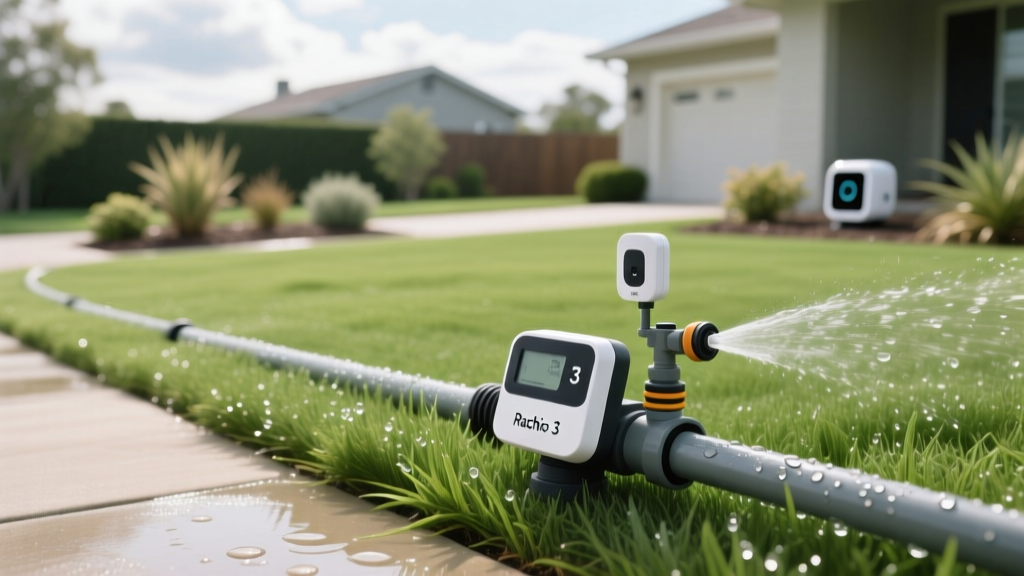
Rachio 3 Smart Irrigation: Rain Sensor & Zone Control Guide 2026
Robert HayesPublished
The 2026 Landscape: Why Smart Irrigation Matters
As we navigate the changing climate patterns of 2026, water conservation has transitioned from a niche environmental concern to a fundamental aspect of responsible homeownership. Municipal water rates have continued their upward trajectory this year, making efficient outdoor water use a financial necessity as much as an ecological one. At the forefront of this movement is the Rachio 3 Smart Sprinkler Controller, a device that remains an industry standard for its intuitive interface and Weather Intelligence Plus™ algorithms. However, to truly unlock the potential of your irrigation system, relying solely on Wi-Fi-based weather forecasts is not enough. Integrating a physical rain sensor and meticulously calibrating your zone control settings are the two most critical steps you can take to optimize your landscape hydration in 2026.
According to the EPA WaterSense program, smart irrigation controllers can save the average home nearly 7,600 gallons of water annually. But these savings are only realized when the hardware is properly configured to match the unique microclimate and soil conditions of your specific property. This comprehensive guide will walk you through the exact steps to integrate a rain sensor with your Rachio 3 and master advanced zone control techniques for a flawless, water-efficient lawn.
Bridging the Gap: Adding a Physical Rain Sensor to Rachio 3
One of the most common questions we receive at lawnsguide.com is why a homeowner would need a physical rain sensor when the Rachio 3 already pulls hyper-local weather data from the internet. The answer lies in the limitations of radar-based forecasting and the reality of microclimates. Weather Intelligence Plus is phenomenal at anticipating regional fronts and adjusting schedules based on evapotranspiration rates. However, localized convective storms—common in the summer months—can drop a half-inch of rain on your specific neighborhood while the nearest official weather station, located five miles away, records nothing.
Furthermore, physical rain sensors provide an immediate, fail-safe hardware interrupt. If your home internet connection drops during a heavy downpour, a Wi-Fi-dependent controller might continue to water your lawn, leading to severe runoff and root asphyxiation. A hardwired rain sensor bypasses the need for an internet connection, ensuring that your system physically cannot activate its valves when local precipitation thresholds are met. In 2026, combining the predictive power of Rachio's cloud algorithms with the reactive certainty of a local hardware sensor represents the gold standard in residential irrigation.
Step-by-Step Rain Sensor Wiring Guide
Integrating a standard normally-closed rain sensor (such as the Hunter Mini-Clik or Toro RainSensor) with the Rachio 3 is a straightforward process that requires minimal tools. Before beginning, ensure you have turned off the power to your irrigation system at the circuit breaker.
- Step 1: Access the Terminals. Remove the Rachio 3 from its wall mount and press the release tab to remove the terminal strip cover. Locate the sensor terminals labeled S1 and S2.
- Step 2: Remove the Jumper Wire. Out of the box, a small yellow jumper wire connects S1 and S2 to complete the circuit. Carefully remove this jumper wire. If left in place, the controller will ignore your rain sensor.
- Step 3: Connect the Sensor Wires. Take the two wires from your rain sensor and insert one into the S1 terminal and the other into the S2 terminal. Because standard rain sensors act as simple switches, polarity does not matter; either wire can go into either terminal.
- Step 4: Enable in the App. Restore power to the unit. Open your Rachio app, navigate to 'More' > 'Controller Settings' > 'Connected Sensors', and toggle the Rain Sensor option to 'On'. You can also set a delay period here, dictating how long the system should wait to resume watering after the sensor dries out.
Mastering Zone Control: Beyond the Basics
While the Rachio 3's 'Smart Cycle' and 'Weather Intelligence' features are powerful out of the box, treating every zone on your property as a monolith is a recipe for inefficiency. Proper zone control requires you to act as a landscape agronomist, inputting precise data into the Rachio app so the algorithm can calculate exact runtimes.
The foundation of zone control relies on understanding your soil profile. As noted in the EPA's outdoor water use guidelines, overwatering is a primary cause of landscape disease, nutrient leaching, and harmful urban runoff. If you have heavy clay soil, water infiltrates at a remarkably slow rate—often less than a quarter-inch per hour. If your zone is programmed to run for 20 continuous minutes, the last 15 minutes are likely producing runoff that carries fertilizers into storm drains. Conversely, sandy soils drain rapidly and require shorter, more frequent watering cycles to keep moisture within the root zone.
In the 2026 Rachio app interface, navigate to each individual zone and meticulously update the following parameters:
- Vegetation Type: Differentiate between cool-season turf, warm-season turf, shrubs, and garden beds. Each has a different crop coefficient (Kc), which dictates its water demand relative to baseline evapotranspiration.
- Soil Type: Select from Clay, Loam, or Sand. This directly influences the scheduling algorithm's infiltration rate calculations.
- Slope: If a zone is on a gradient, mark it as sloped. The Rachio 3 will automatically employ 'Cycle and Soak' methodology to prevent runoff.
- Sprinkler Head Type: Accurately categorize each zone by nozzle type (Rotor, Spray, Drip, or Rotary Nozzle). Mixing rotary nozzles and standard spray heads on the same zone is a critical error that results in severe uneven distribution.
- Sun Exposure: Adjust the shade/sun slider based on the zone's daily light integral. Deeply shaded zones under mature canopies require significantly less water than south-facing exposures.
2026 Zone Configuration Matrix
To help you visualize how these variables interact, refer to the configuration matrix below. This table provides baseline recommendations for setting up your Rachio 3 zones based on common 2026 landscape scenarios.
| Zone Profile | Soil Type | Sprinkler Head | Sun Exposure | Recommended Rachio Strategy |
|---|---|---|---|---|
| Front Lawn (Flat) | Clay Loam | Rotary Nozzle | Full Sun | Flex Daily, Cycle & Soak (3 cycles) |
| Side Yard (Shaded) | Clay | Drip Emitter | Full Shade | Flex Monthly, Low Kc, Deep Soak |
| Backyard (Sloped) | Sandy Loam | MP Rotator | Partial Sun | Flex Daily, Slope Enabled, 2 cycles |
| Vegetable Garden | Amended Loam | Drip Line | Full Sun | Fixed Schedule, High Kc, Daily Short |
Leveraging Cycle and Soak for Clay and Slopes
The 'Cycle and Soak' feature is arguably the most valuable tool within the Rachio ecosystem for homeowners dealing with challenging topography or dense soils. When enabled, the Rachio 3 breaks a zone's total required runtime into smaller, manageable increments. For example, if a clay-soil zone requires 18 minutes of water, the controller might run the zone for 6 minutes, move on to the next zone, and then return to the original zone later. This pause allows the water to percolate deeply into the soil profile rather than pooling on the surface and running off into the street.
In 2026, with many municipalities enforcing strict stormwater management regulations, eliminating runoff is not just about saving money on your water bill; it is about compliance and environmental stewardship. Ensure that 'Cycle and Soak' is toggled on for any zone where you observe water pooling on sidewalks or driveways during the final minutes of a watering cycle.
Maximizing Municipal Rebates and ROI
Investing time into perfecting your Rachio 3 setup yields rapid financial returns. Across North America, 2026 water utility rate hikes have made outdoor irrigation one of the most expensive line items on a homeowner's monthly utility bill. By utilizing the Rachio 3's Flex Daily scheduling—which waters only when the soil moisture depletion reaches a critical threshold rather than on arbitrary days of the week—homeowners routinely report a 30% to 50% reduction in outdoor water consumption.
Additionally, many local water districts continue to offer aggressive rebate programs for EPA WaterSense-labeled smart controllers and the integration of flow meters. If you have not yet added the Rachio Flow Meter accessory to your system, 2026 is the year to do so. The flow meter provides real-time, zone-by-zone water usage data and will automatically shut off your system if it detects a catastrophic leak, such as a severed PVC mainline or a blown sprinkler head, saving you from catastrophic water bills and landscape erosion.
Conclusion
The Rachio 3 remains a powerhouse in the smart home irrigation space, but its true efficacy is entirely dependent on the quality of its inputs and hardware integrations. By taking the time to hardwire a local rain sensor, you protect your landscape from the blind spots of radar forecasting. By diving deep into zone control, soil profiling, and Cycle and Soak methodologies, you transform your sprinkler system from a blunt instrument into a precision agricultural tool. Embrace these advanced configurations in 2026, and your lawn will reward you with deep, drought-resistant root systems and vibrant health, all while keeping your water footprint remarkably small.
