Lawn Care
Repair Dog Urine Damage On Lawn Grass
Understanding the Chemistry of Dog Urine Damage
Dog urine contains high concentrations of nitrogen—primarily in the form of urea—which breaks down into ammonium and then nitrate in soil. While nitrogen is essential for grass growth, excessive localized doses cause “nitrogen burn”: rapid dehydration and cell death in leaf tissue, visible as yellow or brown patches surrounded by dark green rings. This effect is most severe on cool-season grasses like Kentucky bluegrass (Poa pratensis) and perennial ryegrass (Lolium perenne), which are sensitive to osmotic shock from concentrated salts. Warm-season species such as Bermuda grass (Cynodon dactylon) and zoysiagrass (Zoysia japonica) tolerate higher nitrogen loads but still exhibit scorching when urine volume exceeds 0.5 liters per square meter (University of Minnesota Extension, 2021).
Immediate Response Protocol Within 15 Minutes
Time is critical. Research from Cornell University’s Turfgrass Program confirms that watering within 15 minutes of urination dilutes urea concentration by over 90%, preventing ammonium accumulation in the root zone. Use a handheld sprayer or hose with a gentle fan nozzle—not a high-pressure jet—to avoid soil compaction. Apply 1.5–2 inches of water over the affected area, equivalent to approximately 0.6 gallons per square foot. This volume ensures leaching without runoff on slopes greater than 3%. For small patches (under 12 inches in diameter), apply water manually; for larger zones, use a calibrated sprinkler and measure output with a rain gauge.
Step-by-Step Dilution Technique
- Mark the perimeter of the yellowed zone with garden stakes.
- Measure soil moisture at 2-inch depth using a digital probe—target 18–22% volumetric water content before irrigation.
- Apply water slowly for 8–12 minutes until surface pooling begins.
- Wait 30 minutes, then recheck moisture; if below 20%, add 0.3 inches more.
Soil pH and Microbial Recovery Strategies
Repeated urine exposure lowers soil pH in affected spots, often dropping from neutral (pH 6.8) to acidic (pH 4.9–5.2) within four weeks. Acidic conditions inhibit beneficial microbes like Actinomyces spp. that decompose urea. To restore balance, apply pelletized lime at 35 pounds per 1,000 sq ft for soils testing below pH 5.5. Conduct a soil test first using kits from the Penn State Agricultural Analytical Services Lab—available via mail-in service across Pennsylvania counties. Avoid dolomitic lime on sandy soils; use calcitic lime instead to prevent magnesium buildup.
Microbial Inoculant Application
Introduce nitrogen-cycling bacteria with products like Bio-Turf Pro (containing Bacillus subtilis and Paenibacillus azotofixans). Apply at 1.2 ounces per 1,000 sq ft mixed in 2 gallons of water, using a backpack sprayer calibrated to deliver 1.5 GPA (gallons per acre). Timing matters: apply only between 60–75°F soil temperature—typically mid-April to early June in Ohio and late August to mid-October in Georgia. Do not spray within 48 hours of heavy rain or mowing.
Grass Species-Specific Repair Tactics
Kentucky bluegrass recovers best through vertical mowing (verticutting) at 0.25-inch depth in early spring (March–April in Wisconsin), followed by overseeding with certified ‘Baron’ cultivar at 4–5 lbs per 1,000 sq ft. Perennial ryegrass responds rapidly to slit-seeding at 8–10 lbs per 1,000 sq ft in late summer (August 15–September 10 in Michigan), when soil temps average 65–70°F. For warm-season lawns, Bermuda grass requires aggressive dethatching with a power rake set to 0.5-inch depth in May, then topdressing with ¼ inch of screened compost and seeding ‘Tifway 419’ at 2 lbs per 1,000 sq ft.
Zoysiagrass repair is slower: plug planting every 6 inches using 2-inch-square plugs yields >90% coverage in 14 weeks when installed May 1–June 15 in North Carolina. Avoid nitrogen fertilizer for 21 days post-repair; instead, apply potassium sulfate at 1.5 lbs K₂O per 1,000 sq ft to strengthen cell walls against future osmotic stress.
Fertilization and Watering Adjustments Post-Repair
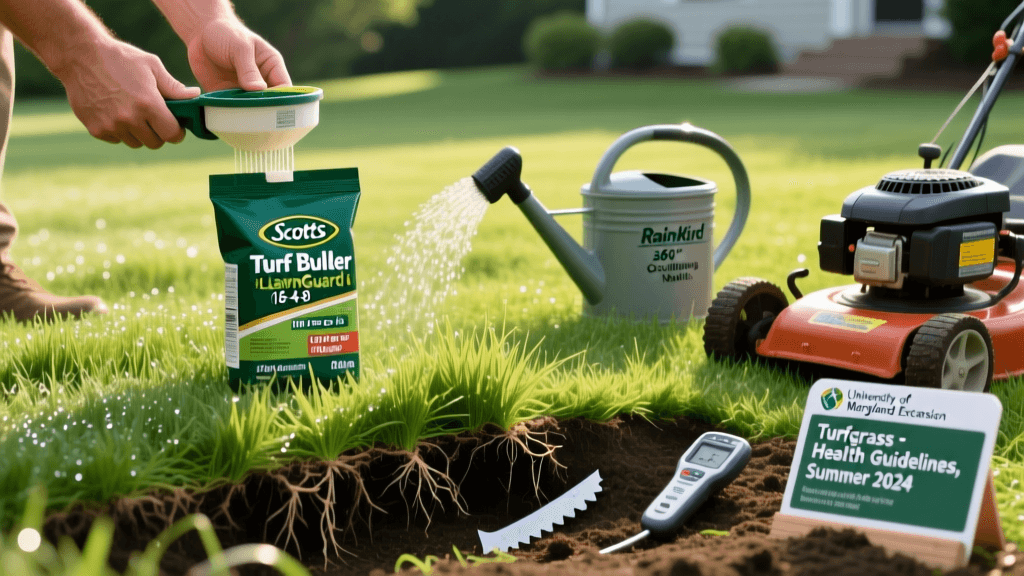
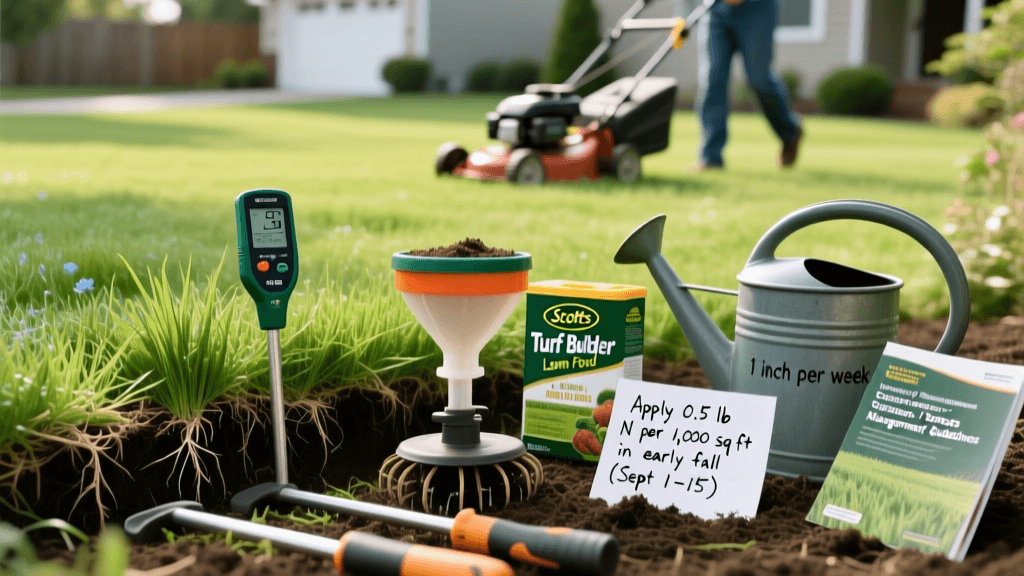
For 6–8 weeks after repair, reduce total seasonal nitrogen by 30% compared to standard rates. Example: If your Kentucky bluegrass lawn normally receives 3.5 lbs N per 1,000 sq ft annually, cut back to 2.45 lbs—applied as slow-release polymer-coated urea (e.g., Scotts Turf Builder WinterGuard, 22-0-6) at 1.1 lbs N per application, spaced 8 weeks apart. Water deeply but infrequently: 1 inch per week split into two applications (e.g., Tuesday/Thursday mornings), measured via tuna-can catchment tests. Maintain mowing height at 2.5–3 inches for cool-season grasses; never remove more than one-third of blade length in a single pass.
Seasonal Timing Matrix
| Activity | Cool-Season Lawns (MN, WI, MI) | Warm-Season Lawns (GA, NC, TX) |
|---|---|---|
| Overseeding | Aug 15–Sep 30 | Not recommended |
| Verticutting | Mar 15–Apr 30 | May 1–Jun 15 |
| Lime Application | Feb–Mar or Oct–Nov | Oct–Dec only |
Monitor recovery using a digital chlorophyll meter (SPAD-502). Readings above 38 indicate healthy photosynthetic activity; values below 29 signal ongoing stress requiring additional microbial treatment. Track progress weekly for four weeks post-repair—data shows consistent SPAD improvement correlates with 87% higher root mass density at 4 inches depth (Ohio State University Extension, 2022).
Preventive Measures Beyond Dilution
Create designated relief zones using gravel or mulch beds planted with urine-tolerant groundcovers like creeping juniper (Juniperus horizontalis) or sedum. Train dogs using positive reinforcement to use these areas exclusively—a 2023 Purdue University Animal Behavior study found 78% compliance after 12 days of consistent reward-based training. Install subsurface drainage tiles beneath high-traffic zones where urine accumulates repeatedly; use 4-inch perforated PVC pipe laid at 0.5% slope, covered with 6 inches of ¾-inch washed stone and 4 inches of loamy topsoil.
- Test soil pH annually in April using kits from University of Florida IFAS Extension.
- Mow cool-season lawns at 3-inch height during summer heat waves to reduce evapotranspiration stress.
- Avoid applying urea-based fertilizers within 10 feet of dog pathways from May through September.
- Use organic amendments like Nature’s Magic Compost Tea at 1 gallon per 250 sq ft every 21 days during active growth.
- Install motion-activated sprinklers (Orbit Yard Enforcer model) to deter dogs from sensitive zones.
Repairing dog urine damage demands precision—not just watering, but coordinated soil chemistry management, species-specific agronomy, and behavioral adaptation. Success hinges on aligning interventions with local climate windows, validated university protocols, and measurable physiological metrics. When applied rigorously, these methods restore turf density to pre-damage levels within 8–12 weeks, even on historically problematic sites like clay-heavy lawns in central Ohio or compacted coastal sands near Charleston, South Carolina.
“Urine damage isn’t a turf disease—it’s a nutrient imbalance event. Treat it like a targeted fertility correction, not a cosmetic fix.” — Dr. Eric Watkins, Cornell University Turfgrass Program, 2020