Home & Garden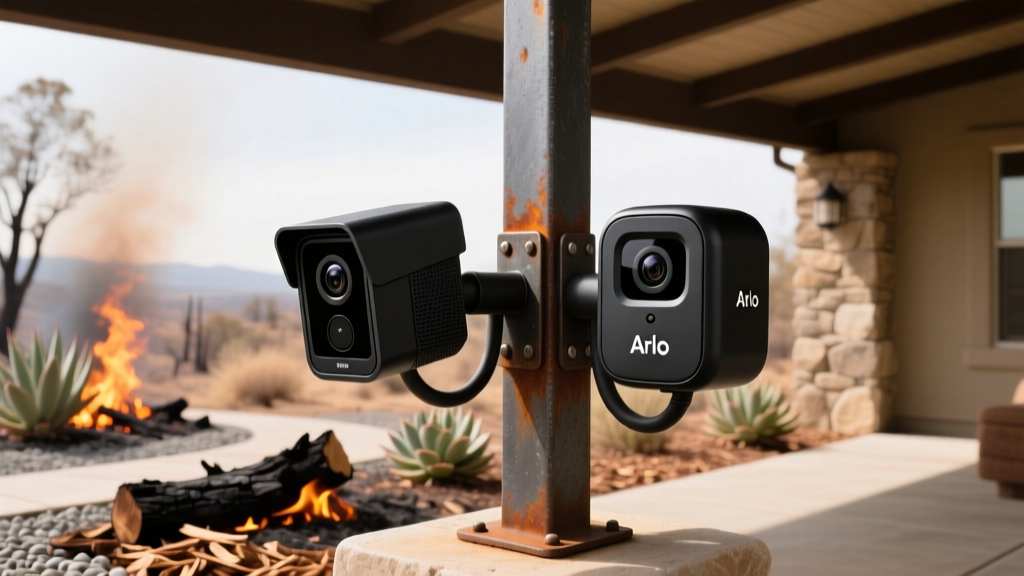
Ring vs Arlo 2026: Weatherproof Cameras for Fire-Resistant Yards
James MillerPublished
The Intersection of Smart Security and Fire-Resistant Landscaping in 2026
As we navigate the increasingly complex environmental challenges of 2026, homeowners in wildfire-prone regions are fundamentally rethinking their outdoor spaces. Fire-resistant landscaping is no longer just about choosing the right drought-tolerant plants or laying down gravel mulch; it is about creating a cohesive, defensible ecosystem that integrates smart home technology seamlessly and safely. Outdoor security cameras are a vital component of modern home protection, but in fire zones, they face extreme environmental stressors that go far beyond standard rain and snow. From airborne ash and fine soot to extreme radiant heat and direct ember intrusion, the weatherproofing capabilities of your security cameras can mean the difference between maintaining a watchful eye on your property and suffering a total system failure when you need it most.
In this comprehensive guide, we compare the flagship 2026 models from Ring and Arlo, evaluating their weatherproofing, heat tolerance, and integration potential within a meticulously planned fire-resistant landscape. Whether you are fortifying your home's immediate perimeter or monitoring the outer edges of your defensible space, understanding how these devices handle the harsh realities of wildfire season is critical for any modern homeowner.
Understanding Defensible Space and Strategic Camera Placement
Before comparing hardware, it is essential to understand where outdoor cameras belong within the framework of a fire-resistant yard. According to CAL FIRE's defensible space guidelines, the area immediately surrounding your home is divided into distinct zones, each with specific landscaping and material requirements. Zone 0, the area extending zero to five feet from your home, must be entirely non-combustible. This is where hardscaping, pavers, and crushed gravel dominate, and it is also the primary mounting zone for eaves and soffit security cameras.
Zone 1 (five to thirty feet) focuses on lean, clean, and green vegetation, utilizing smart drip irrigation and fire-resistant flora like succulents, rockrose, and carefully spaced deciduous trees. Zone 2 (thirty to one hundred feet) is dedicated to fuel reduction. The National Fire Protection Association (NFPA) emphasizes that any equipment mounted in or near Zone 0 must not introduce combustible materials or create hidden cavities where wind-blown embers can lodge and ignite. Therefore, the physical housing, mounting brackets, and wiring conduits of your Ring or Arlo cameras must be evaluated not just for their electronic weatherproofing, but for their physical fire resilience.
Weatherproofing Showdown: IP Ratings and Ash Intrusion
When discussing weatherproofing, most consumers look immediately at Ingress Protection (IP) ratings. For 2026, the Ring Spotlight Cam Pro boasts an IP65 rating, while the Arlo Pro 5S 2K features an IP67 rating. But what do these numbers actually mean for a homeowner dealing with the aftermath of a nearby wildfire or the dry, dusty conditions that precede one?
The first digit, '6' in both cases, indicates that the devices are completely dust-tight. This is arguably the most critical factor for fire-resistant landscaping. Wildfire ash is incredibly fine and abrasive. If ash infiltrates a camera housing, it can coat the internal lens elements, obscure infrared (IR) night vision sensors, and cause moving parts—such as the Ring Pan-Tilt mechanisms—to grind and fail. Both Ring and Arlo have excelled in sealing their 2026 models against fine particulate matter, ensuring that heavy ash fall will not compromise the internal electronics.
The second digit relates to water resistance. Ring's '5' means protection against low-pressure water jets from any direction. Arlo's '7' means protection against temporary immersion in water. In a fire zone, you are rarely submerging your cameras, but you are frequently washing them. After a fire event or a controlled burn, homeowners must gently wash ash and acidic soot off their camera lenses and housings to prevent long-term degradation. Arlo's IP67 rating provides a slightly wider margin of error when using a garden hose to rinse off heavy soot accumulation, though both cameras will easily survive standard maintenance cleaning.
Operating Temperatures: Surviving the Heatwave
Fire-prone regions are synonymous with extreme summer heatwaves. The Insurance Institute for Business & Home Safety (IBHS) notes that ambient air temperatures in these zones frequently exceed 105°F, with surfaces exposed to direct sunlight reaching much higher. Security cameras contain lithium-ion batteries and heat-generating processors that can throttle performance or shut down entirely if their thermal thresholds are breached.
The 2026 Ring Spotlight Cam Pro operates safely between -5°F and 120°F (-20°C to 48°C). The Arlo Pro 5S 2K has a slightly narrower operational window of -4°F to 113°F (-20°C to 45°C). In the peak of a late-summer heatwave, a camera mounted on a dark-colored fascia board in direct, unshaded sunlight can easily push past 115°F. Ring holds a slight advantage in raw thermal tolerance, making it a marginally safer bet for unshaded, south-facing eaves. However, best practices in fire-resistant landscaping dictate that you should mount cameras under the shade of non-combustible eaves (such as metal or fiber-cement soffits) to protect them from both direct UV degradation and radiant heat from potential ground fires.
2026 Feature Comparison: Ring vs. Arlo for Fire Zones
| Feature | Ring Spotlight Cam Pro (2026) | Arlo Pro 5S 2K (2026) |
|---|---|---|
| Weather Resistance | IP65 (Dust-tight, water jets) | IP67 (Dust-tight, temporary immersion) |
| Operating Temperature | -5°F to 120°F | -4°F to 113°F |
| Housing Material | UV-Stabilized Polycarbonate | UV-Stabilized Polycarbonate |
| Ash Cleanability | Moderate (Textured mounting base) | High (Smooth dome design) |
| AI Smoke/Fire Alerts | Yes (via Ring Home Subscription) | Yes (via Arlo Secure Subscription) |
| Power Options | Hardwired / Battery / Solar | Battery / Solar |
AI Smoke Detection and Smart Irrigation Integration
One of the most significant advancements in 2026 smart home technology is the integration of AI-driven environmental threat detection. Both Ring and Arlo have updated their premium subscription services to include visual smoke and fire plume detection. If a brush fire ignites in your Zone 2 fuel-reduction area, the camera's AI can identify the visual signature of smoke before it triggers a neighborhood-wide emergency alert, sending a push notification directly to your phone. This early warning is invaluable for triggering your smart home routines.
For homeowners with smart irrigation systems integrated into their fire-resistant landscapes, this AI detection can be life-saving. By linking your camera's smart alerts to your irrigation controller via platforms like Amazon Alexa or Apple HomeKit, you can program your system to automatically activate your perimeter sprinklers or drip lines if smoke is detected. While the CAL FIRE's defensible space guidelines caution against relying solely on sprinklers during a fast-moving wind-driven fire, pre-wetting your Zone 1 fire-resistant flora and hardscaping can help suppress wind-blown embers before they ignite dry mulch or debris.
Landscaping Integration: Solar, Wiring, and Flora
Integrating cameras into your landscape without violating fire-safe principles requires careful planning. Ring offers excellent hardwired options, which are ideal for Zone 0. When running low-voltage wiring to a Ring camera, you can trench the cables beneath your Zone 0 gravel or paver pathways. This keeps the wires hidden and protected without introducing combustible conduit materials near the home's foundation. Avoid running wires through wood fences or near the base of highly flammable plants like junipers or ornamental grasses, which should be removed from fire-resistant yards entirely.
Arlo's wire-free architecture and highly efficient 2026 solar panels make it the superior choice for Zone 1 and Zone 2 monitoring. You can mount an Arlo camera and its accompanying solar panel on a metal stake positioned among drought-tolerant, fire-resistant plants like Agave, Yucca, or Aloe. These succulents have high moisture content and low flammability, making them safe companions for electronic equipment. Ensure the solar panel is positioned to receive maximum sunlight without being shaded by the broad leaves of your fire-resistant canopy trees, such as Coast Live Oaks or Maples, which are excellent choices for shading the home and reducing ambient ground temperatures.
Maintenance: Cleaning Ash and Soot from Lenses
Even with IP65 and IP67 ratings, the exterior lenses of your cameras will accumulate ash, pollen, and soot during fire season. This buildup can blind the camera's motion sensors and degrade video quality. Because both Ring and Arlo use UV-stabilized polycarbonate lenses rather than glass, they are susceptible to micro-scratches if cleaned improperly.
When maintaining your cameras in a fire-resistant landscape, never use abrasive cloths or harsh chemical degreasers to remove soot. Instead, use a microfiber cloth dampened with distilled water or a specialized optical lens cleaner. For heavy ash accumulation, gently blow the debris off with a manual air blower before wiping. Additionally, inspect the silicone weather-sealing rings around the battery compartments and charging ports annually. Prolonged exposure to high UV indexes and extreme heat can cause these seals to dry out and crack, compromising the camera's dust-tight integrity just as wildfire season begins.
Final Verdict for the Fire-Resistant Yard
Choosing between Ring and Arlo in 2026 ultimately depends on how your specific fire-resistant landscape is zoned and wired. If your priority is fortifying Zone 0 with hardwired, high-heat-tolerant cameras mounted beneath non-combustible eaves, the Ring Spotlight Cam Pro's superior thermal threshold and reliable wired connectivity make it the premier choice. Its ability to integrate seamlessly with existing low-voltage landscape lighting trenches keeps your hardscaping pristine and safe.
Conversely, if your strategy involves monitoring the expansive, fuel-reduced perimeters of Zone 1 and Zone 2, Arlo's wire-free flexibility, superior IP67 water resistance for heavy soot-washing, and highly efficient solar charging ecosystem are unmatched. By strategically deploying these weatherproof cameras in harmony with your defensible space landscaping, you create a resilient, intelligent perimeter that protects your home against both intruders and the unpredictable forces of nature.
