Lawn Care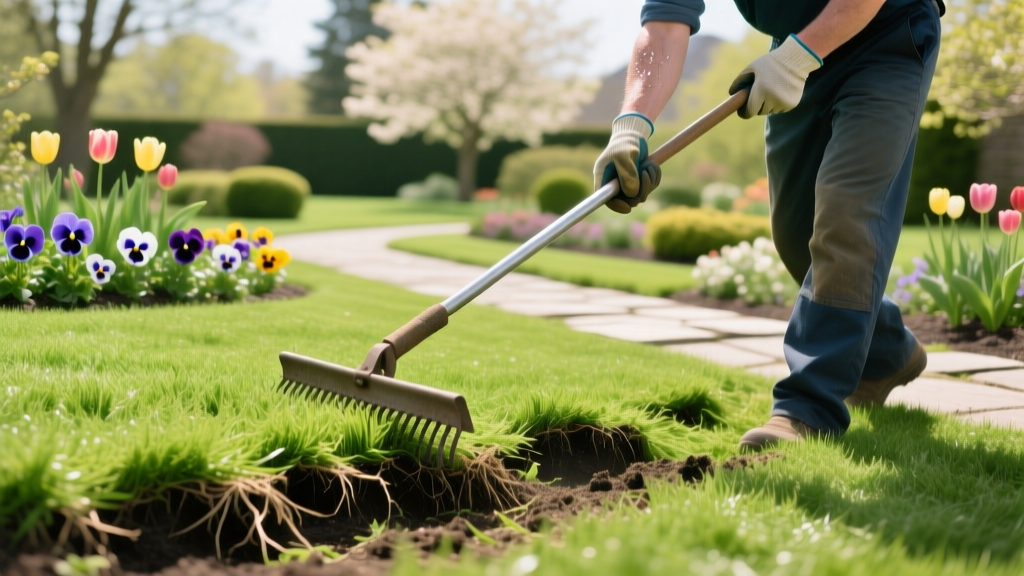
Spring Lawn Dethatching Timing And Technique Guide
Understanding Thatch and Its Impact on Grass Health
Thatch is a tightly interwoven layer of living and dead organic matter—primarily stems, stolons, rhizomes, and roots—that accumulates between the green vegetation and the soil surface. While a thin thatch layer (½ inch or less) can insulate soil and buffer temperature extremes, excessive thatch (>¾ inch) impedes water infiltration, restricts gas exchange, and creates a favorable environment for fungal pathogens like *Rhizoctonia solani*, the causal agent of brown patch. Research from the University of Minnesota Turfgrass Science Program confirms that Kentucky bluegrass (Poa pratensis) and creeping bentgrass (Agrostis stolonifera) are especially prone to thatch accumulation due to their dense, horizontal growth habits.
In contrast, tall fescue (Festuca arundinacea) and perennial ryegrass (Lolium perenne) rarely develop problematic thatch because of their upright growth patterns and faster decomposition rates. A 2021 field study at Rutgers University’s Snyder Research and Extension Farm found that tall fescue lawns averaged only 0.3 inches of thatch after five years of standard maintenance, whereas Kentucky bluegrass plots reached 1.1 inches under identical conditions.
Optimal Timing by Grass Species and Region
Dethatching timing must align with grass growth cycles—not calendar dates—to avoid stressing turf during vulnerable periods. Cool-season grasses recover best when dethatching occurs during peak active growth: early to mid-spring (late March through mid-May) in the northern U.S., and again in early fall (September). Warm-season grasses—including Bermuda grass (Cynodon dactylon), zoysiagrass (Zoysia japonica), and St. Augustine grass (Stenotaphrum secundatum)—should be dethatched only after full green-up in late spring to early summer, typically May–June in the Transition Zone and June–July across the Deep South.
Mid-Atlantic Timing Windows
In the Washington, D.C. metro area, extension agents at the University of Maryland Extension recommend dethatching Kentucky bluegrass lawns between April 10 and May 15—after two consecutive mowings but before daytime highs exceed 75°F for three days straight. For warm-season lawns in Richmond, VA, the optimal window shifts to June 1–20, coinciding with consistent soil temperatures above 65°F at the 2-inch depth.
Upper Midwest Guidelines
In Minneapolis, MN, the Minnesota Extension advises waiting until soil temperatures at 4 inches reach 55°F for five consecutive days—usually around April 22–May 5—and avoiding dethatching if frost is forecast within 10 days. This precision prevents root damage while maximizing regrowth capacity.
Mechanical vs. Manual Dethatching Techniques
For lawns with >¾ inch of thatch, mechanical dethatching is essential. Power rakes (also called vertical mowers) equipped with fixed tines set to a ¼-inch depth are appropriate for most residential applications. Adjustable tine depth allows customization: set to ⅛ inch for light grooming of tall fescue, or up to ⅜ inch for aggressive removal in mature Kentucky bluegrass stands. Avoid using power rakes on newly seeded lawns (<12 months old) or on slopes exceeding 15% grade.
Manual dethatching with a thatch rake remains viable for small areas (<500 sq ft) or very light buildup. Apply firm, overlapping strokes, working perpendicular to the previous pass. Expect to remove approximately 1.5–2.0 bushels of debris per 1,000 sq ft using this method—significantly less than mechanical units, which yield 4–6 bushels per 1,000 sq ft.
- Recommended equipment: Agri-Fab 45-0462 40-Inch Self-Propelled Dethatcher (tine depth adjustable from 0 to 1.5 inches)
- Alternative option: Sun Joe AJ802E Electric Dethatcher (12-amp motor, 13-inch width, max ¾-inch depth)
- For large properties (>1 acre): John Deere 325D Vertical Mower (96-inch width, hydraulic tine depth control)
Fertilizing and Watering After Dethatching
Post-dethatching nutrition must support rapid recovery without stimulating excessive top growth that competes with root repair. Apply a balanced, slow-release nitrogen fertilizer at a rate of 0.5 lb N per 1,000 sq ft within 3–5 days of dethatching. Use a product such as Scotts Turf Builder WinterGuard Fall Weed & Feed (22-0-4) for cool-season lawns or The Andersons 19-0-5 Green Edge (19% N, 5% K) for warm-season species. Do not apply quick-release urea-based fertilizers immediately post-dethatch—the salt index may burn exposed crowns.
Watering strategy shifts dramatically after dethatching. Instead of deep, infrequent irrigation, initiate frequent, shallow watering: 0.1 inch every 12 hours for the first 72 hours, then 0.15 inch every 24 hours for days 4–7. This maintains consistent moisture in the upper 1 inch of soil where new roots emerge. Once regrowth is visible (typically day 8–10), resume normal irrigation: 1.0 inch per week split across two applications.
“Dethatching removes protective cover—soil surface temperature can spike 8–12°F higher than shaded areas within 24 hours. Consistent moisture is non-negotiable for cell turgor and meristem activity.” — Dr. Eric Watkins, Professor of Turfgrass Science, University of Minnesota, 2020
Integrating Dethatching With Other Lawn Maintenance Practices
Dethatching should never occur in isolation. It must be sequenced with mowing, aeration, and overseeding to maximize long-term turf density and resilience. Begin mowing at the recommended height for your grass species 7 days before dethatching—this ensures uniform stem length and reduces clogging in power rakes. For example, maintain Kentucky bluegrass at 2.5–3.0 inches and zoysiagrass at 1.0–1.5 inches prior to treatment.
Aeration should follow dethatching by 10–14 days—not simultaneously. Core aeration after dethatching improves soil-to-thatch interface contact and enhances microbial breakdown of residual organic material. Purdue University Extension trials showed that combining dethatching with core aeration increased root mass by 37% over two growing seasons compared to either practice alone.
Overseeding is most effective when done within 48 hours of dethatching, particularly for thinning Kentucky bluegrass or fine fescue lawns. Use certified seed blends such as Jonathan Green Black Beauty Ultra (80% Kentucky bluegrass, 15% perennial ryegrass, 5% fine fescue) at a rate of 4–6 lbs per 1,000 sq ft. Lightly rake seed into the soil surface and cover with a ¼-inch layer of compost or peat moss to retain moisture.
| Grass Species | Max Acceptable Thatch Depth (inches) | Recommended Dethatching Frequency (years) | Soil Temp Threshold (°F, 4-in depth) | Post-Dethatch N Rate (lb/1000 sq ft) |
|---|---|---|---|---|
| Kentucky bluegrass | 0.75 | 2–3 | 55 | 0.5 |
| Zoysiagrass | 0.85 | 3–5 | 65 | 0.4 |
| Tall fescue | 0.30 | 5–7 | 50 | 0.5 |
Always calibrate spreaders before applying amendments. Use the University of Illinois Extension’s free online spreader calibration tool (2022 release) to match product label rates with your specific equipment model. Never dethatch during drought stress—even if timing appears correct—as soil moisture below 12% volumetric water content severely limits recovery.
Monitor results closely: healthy regrowth should appear within 10–14 days. If no visible green tissue emerges by day 16, conduct a soil test through Penn State Agricultural Analytical Services Lab to rule out pH imbalance or nutrient deficiency. Their standard turf package includes Mehlich-3 extraction and reports on phosphorus, potassium, calcium, magnesium, and organic matter—critical metrics for diagnosing stalled recovery.
Repeat dethatching too frequently disrupts soil structure and depletes beneficial microbes. Data from the Ohio State University Extension shows that annual dethatching reduced earthworm populations by 62% and increased bulk density by 0.18 g/cm³ over four years in clay-loam soils near Columbus.
Finally, record all interventions in a lawn journal: date, grass species, thatch measurement (use a sharpened screwdriver to probe depth), equipment used, fertilizer applied, and weather conditions. This longitudinal data helps refine future timing decisions—especially valuable in variable climates like those observed across the Appalachian foothills near Asheville, NC.
When executed with species-specific precision and integrated into a holistic maintenance calendar, dethatching becomes a catalyst—not a crisis—for sustained lawn vitality.