Lawn Care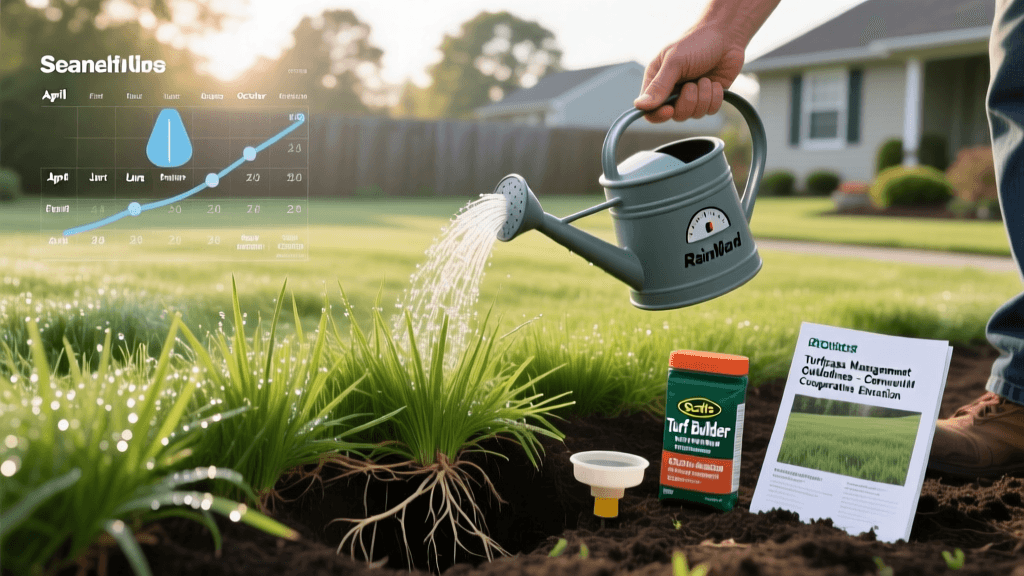
Summer Lawn Watering Schedule For Deep Root Growth
Understanding Root Depth and Watering Frequency
Deep root growth is the cornerstone of drought resilience, reduced disease pressure, and long-term lawn sustainability. Shallow roots—often resulting from frequent, light watering—confine grass to the top 1–2 inches of soil, where temperatures fluctuate wildly and moisture evaporates rapidly. In contrast, Kentucky bluegrass (Poa pratensis) and tall fescue (Festuca arundinacea) can develop roots 6–8 inches deep under optimal irrigation, while warm-season species like Bermuda grass (Cynodon dactylon) may reach 10–12 inches in well-drained soils. The University of Nebraska–Lincoln Extension emphasizes that “roots grow downward in search of water, not upward toward the surface”—meaning consistent, infrequent watering triggers this natural response (UNL Extension, 2022).
Grass-Specific Watering Windows by Region
Timing matters as much as volume. Cool-season grasses—including Kentucky bluegrass, perennial ryegrass (Lolium perenne), and fine fescues—thrive when watered between 4:00 a.m. and 9:00 a.m. This window minimizes evaporation loss (up to 30% less than midday applications) and allows leaf blades to dry before evening, reducing fungal risk. Warm-season grasses like zoysiagrass (Zoysia japonica) and St. Augustinegrass (Stenotaphrum secundatum) benefit from slightly later morning windows (5:30–10:00 a.m.) due to their slower morning transpiration rates.
Midwest and Great Lakes Zone (USDA Zones 4–6)
In cities like Chicago and Indianapolis, cool-season lawns require 1.0–1.25 inches of water per week during peak summer (June–August), applied in two sessions spaced 3–4 days apart. Purdue University’s Turfgrass Program recommends splitting this into 0.6 inches per session to avoid runoff on clay-heavy soils common in the region (Purdue Extension, 2021). Use a calibrated rain gauge or tuna can to verify output—most rotary sprinklers deliver 0.3 inches per hour, meaning two hours per zone is needed for 0.6 inches.
Southeastern Coastal Plain (USDA Zones 7–9)
Here, St. Augustinegrass dominates residential lawns. Research from the University of Florida IFAS shows this species requires only 0.75 inches per week in July–September if soil organic matter exceeds 3%. However, sandy soils in Jacksonville and Savannah demand split applications of 0.4 inches every 3 days to prevent leaching of nitrogen and potassium. Avoid watering after 4:00 p.m., as prolonged leaf wetness increases gray leaf spot incidence by up to 40% (UF/IFAS, 2020).
Measuring and Delivering Precise Water Volume
Guesswork leads to overwatering—responsible for 60% of summer turf diseases in home lawns (Rutgers Turfgrass Program, 2023). Install six identical shallow containers (e.g., Campbell Soup Company 10.75 oz cans) across your lawn before running your system. Run it for 20 minutes, then measure depth in each can with a ruler. Average the readings: if average = 0.25 inches, you need 48 minutes to deliver 0.6 inches (0.6 ÷ 0.25 × 20 = 48). Repeat monthly as nozzle wear alters output.
Smart controllers like Rachio 3 or WeatherTRAK ET Pro adjust run times using local evapotranspiration (ET) data. For example, in Portland, Oregon, where July ET averages 0.18 inches/day, a tall fescue lawn needs just 1.26 inches weekly (0.18 × 7), delivered in two 0.63-inch sessions. In Phoenix, Arizona, July ET climbs to 0.32 inches/day—requiring 2.24 inches weekly, but only for Bermuda grass; cool-season lawns should be dormant or replaced.
Fertilizer and Mowing Synergy with Irrigation
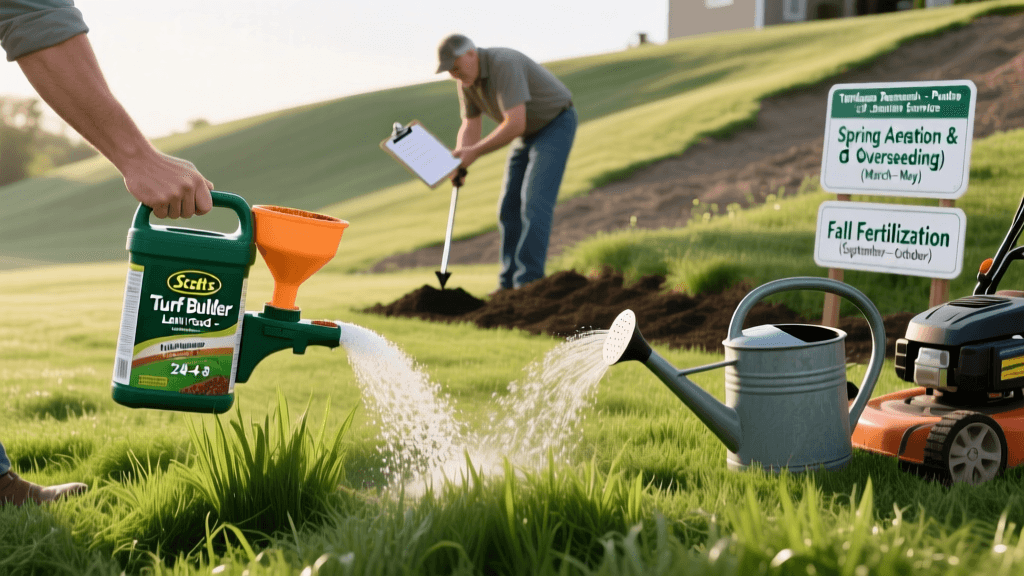
Watering and fertilizing must be coordinated. Apply slow-release nitrogen (e.g., Scotts Turf Builder WinterGuard Fall Weed & Feed, 22-0-4) no more than 0.9 pounds N per 1,000 sq ft per application—and always water in within 24 hours. For summer feeding of warm-season grasses, use a low-nitrogen, high-potassium product like Milorganite (6-2-0) at 3.5 lbs per 1,000 sq ft every 8–10 weeks. Potassium strengthens cell walls, improving drought tolerance without stimulating vulnerable top growth.
Mowing Height Adjustments
Raise mower decks during heat stress: Kentucky bluegrass should be cut at 3.0–3.5 inches; tall fescue at 3.5–4.0 inches; zoysiagrass at 1.5–2.0 inches. A study at Michigan State University found that raising mowing height by 0.5 inches increased root mass by 22% in plots receiving identical irrigation (MSU Turfgrass Science, 2022). Never remove more than one-third of blade height at once—this stresses plants and invites weeds.
Soil Preparation and Mulching for Water Retention
Core aeration every 12–18 months—ideally in early fall for cool-season lawns and late spring for warm-season—creates 2–3 inch deep holes spaced 2–4 inches apart. This relieves compaction and allows water to penetrate deeper. Follow immediately with a ¼-inch layer of compost (e.g., Soil3 Black Gold Compost) worked into holes with a stiff broom. Compost increases water-holding capacity by up to 20% in sandy soils and improves infiltration rates by 40% in clays (Penn State Extension, 2021).
Topdressing with screened compost also moderates soil temperature. In field trials near Raleigh, North Carolina, compost-amended plots maintained 5.2°F cooler soil temps at 2-inch depth compared to bare soil during 95°F air temperatures—reducing root respiration stress and encouraging deeper growth.
Troubleshooting Common Summer Watering Pitfalls
Yellowing patches despite regular watering often signal localized dry spots caused by hydrophobic soil or sprinkler overlap gaps. Test by pushing a 6-inch screwdriver into affected and healthy areas—if resistance differs by >50%, apply a soil wetting agent like Revive Super Concentrate at 1 oz per 1,000 sq ft diluted in 2 gallons water. Reapply every 4–6 weeks during drought.
Runoff on slopes is another frequent issue. Break watering into cycles: run sprinklers for 8 minutes, wait 30 minutes for absorption, then repeat until target depth is reached. This “cycle and soak” method reduces erosion and increases effective infiltration by 65% on 10% grade lawns (Ohio State University Extension, 2020).
- Kentucky bluegrass root depth: 6–8 inches under ideal irrigation
- Purdue University recommends 0.6 inches per watering session in clay soils
- UF/IFAS research shows St. Augustinegrass needs only 0.75 inches/week in humid coastal zones
- Michigan State University found 0.5-inch mowing height increase boosted root mass by 22%
- Compost topdressing improves infiltration rates by 40% in compacted clay
“The single most effective cultural practice for promoting deep roots is infrequent, deep irrigation—not fertilizer, not aeration, not even mowing height. Everything else supports this foundation.” — Dr. Becky Griffin, University of Georgia Cooperative Extension, 2023
Monitor soil moisture beyond the surface. Insert a trowel 4 inches deep at multiple locations: if soil crumbles and feels dry below 2 inches, it’s time to water—even if the surface appears damp. Conversely, if soil remains cool and dark at 4 inches, delay irrigation. This tactile check prevents overwatering far more reliably than smart controllers alone.
For shaded lawns under mature oaks or maples, reduce total weekly water by 25–30% compared to full-sun areas. Shade lowers ET by up to 45%, yet many homeowners overcompensate with extra water, inviting fairy ring and Pythium blight. In Seattle, Washington, where summer shade is prevalent, University of Washington Extension advises irrigating shaded tall fescue only once weekly with 0.5 inches—applied before sunrise to avoid dew accumulation.
Finally, calibrate your system seasonally. Nozzle output degrades 12–18% annually due to mineral buildup and wear. Clean nozzles quarterly with white vinegar and a toothbrush; replace any emitting <90% of rated flow. Document all measurements in a simple log: date, zone, run time, measured depth, and weather notes. Over time, this builds an irreplaceable site-specific reference for maximizing root development year after year.
| Grass Species | Ideal Summer Mowing Height (in) | Weekly Water Target (in) | Preferred Watering Interval | Key Regional Reference |
|---|---|---|---|---|
| Kentucky bluegrass | 3.0–3.5 | 1.0–1.25 | Every 3–4 days | University of Nebraska–Lincoln |
| Tall fescue | 3.5–4.0 | 1.0–1.25 | Every 4–5 days | Purdue University |
| Zoysiagrass | 1.5–2.0 | 0.75–1.0 | Every 5–7 days | University of Georgia |
Consistency—not intensity—drives root architecture. When your irrigation rhythm aligns with species physiology, soil structure, and local climate, your lawn doesn’t just survive summer—it thrives, anchoring itself deeper with every cycle. That resilience becomes visible not in lush green color alone, but in steady growth through August heat, minimal weed invasion, and recovery within 48 hours of foot traffic compression.
Track changes over three seasons. Measure root depth annually in early September using a soil probe or spade: dig a 6-inch square, gently wash soil from roots, and measure longest intact root with calipers. Expect incremental gains—0.5–1.0 inch per year—with proper scheduling. These small increments compound into a dense, drought-adapted sward that conserves water, supports pollinators, and endures decades of seasonal change.
Remember: deep roots are grown, not installed. They respond to repetition, precision, and patience—not products or promises. Your lawn’s underground infrastructure is built one thoughtful watering session at a time.