
Landscaping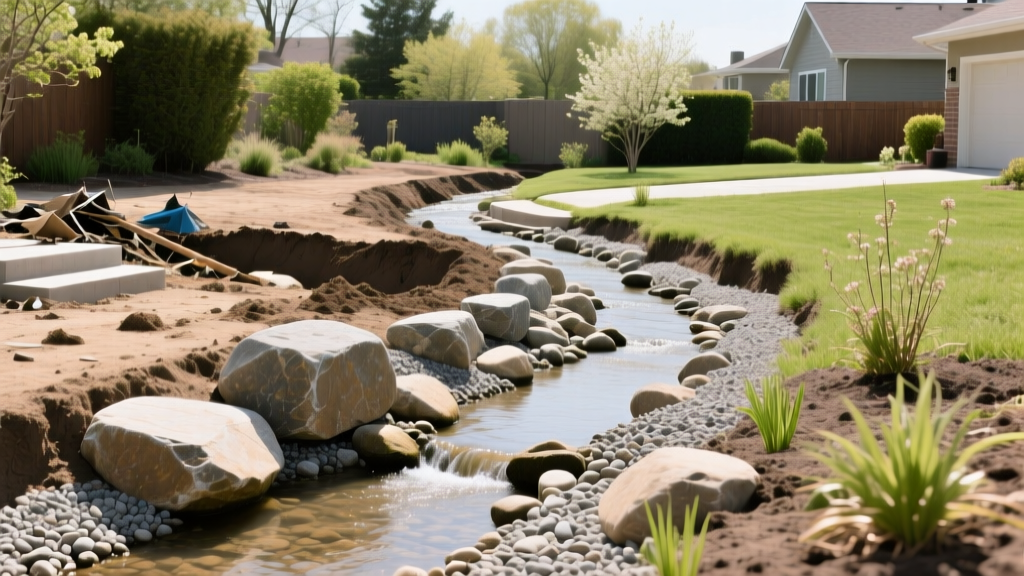
Step By Step Dry Creek Bed Installation For Drainage
Understanding the Hydrological Function of Dry Creek Beds
Dry creek beds—also known as dry streambeds or arroyos—are intentional hardscape features designed to mimic natural ephemeral waterways. They serve a primary hydrological function: directing surface runoff away from foundations, retaining walls, and low-lying planting areas while minimizing soil erosion. Unlike traditional French drains, which operate subsurface, dry creek beds manage sheet flow visibly and aesthetically. According to the American Society of Landscape Architects (ASLA) Stormwater Management Guidelines (2021), properly sized and aligned dry creek beds can reduce peak runoff volume by up to 40% in residential-scale landscapes when integrated with upstream swales and permeable paving.
The design must respect site topography. A minimum longitudinal slope of 1% (1 foot of drop per 100 feet of run) is required for effective conveyance without scouring; slopes exceeding 5% necessitate stepped weirs or boulder sills to prevent velocity-induced erosion. At the University of California, Davis Arboretum, dry creek installations on the west slope of the Gazebo Lawn reduced localized flooding during 10-year storm events by channeling runoff into an adjacent bioswale planted with Carex vulpinoidea and Eutrochium maculatum.
Site Assessment and Layout Planning
Begin with a detailed site survey using a digital level or laser transit. Record existing grade at 5-foot intervals across the proposed path. Identify inlet points (e.g., downspout discharge, paved patio edges) and outlet zones (e.g., vegetated swale, rain garden, or municipal storm drain). The ASLA recommends maintaining a minimum 3-foot setback from any building foundation to avoid moisture migration.
Width and depth are determined by anticipated flow volume. For a typical residential lot with 800–1,200 sq ft of impervious surface contributing to the bed, a base width of 24 inches and depth of 12 inches is sufficient. Larger sites—such as the 1.7-acre campus landscape at the Brooklyn Botanic Garden—use modular dry creek sections averaging 48 inches wide and 18 inches deep, segmented every 20 linear feet with native granite weirs.
Key Measurements for Residential Applications
- Minimum functional slope: 1% (0.01 ft/ft)
- Standard residential width range: 24–36 inches
- Recommended gravel depth over filter fabric: 4–6 inches
- Boulder diameter for structural stability: ≥12 inches (for beds >30 inches wide)
- Maximum recommended length before energy dissipation feature: 50 linear feet
Material Selection and Sourcing
Gravel composition critically affects both performance and aesthetics. Angular, non-friable stone—such as crushed granite or decomposed granite—interlocks under flow, resisting displacement. Rounded river rock, while visually appealing, shifts easily and is discouraged for primary flow paths per the National Association of Landscape Professionals (NALP) Hardscape Installation Standards (2022). For a 30-linear-foot bed averaging 30 inches wide and 6 inches deep, you’ll need approximately 2.8 cubic yards of gravel—calculated as (30 × 2.5 × 0.5) ÷ 27.
Filter fabric must be non-woven geotextile rated for long-term UV resistance and hydraulic conductivity ≥100 gal/min/ft². Avoid woven polypropylene, which clogs rapidly in clay-dominant soils like those found in the Piedmont region near Duke University’s Sarah P. Duke Gardens.
Cost Breakdown Per 100 Linear Feet (2024 Averages)
| Item | Quantity | Estimated Cost |
|---|---|---|
| Crushed granite gravel (¾”) | 8.5 yd³ | $680–$920 |
| Non-woven geotextile fabric | 1,200 sq ft | $240–$360 |
| Fieldstone boulders (12–18” diameter) | 12–15 pieces | $1,050–$1,800 |
Installation Sequence and Grading Techniques
Excavation begins after marking the centerline with string and stakes. Remove topsoil to a uniform depth—typically 18 inches—to accommodate 6 inches of gravel, 2 inches of sand bedding (optional but recommended for leveling), 6 inches of compacted sub-base (¼” minus gravel), and 4 inches of filter fabric overlap at edges. Slope must be verified continuously using a 4-foot level or digital inclinometer.
Install the geotextile with 12-inch overlaps, pinning edges with landscape staples every 24 inches. Then place the sub-base layer and compact it to 95% Standard Proctor density using a plate compactor. This step is essential on sites with high clay content—such as those surrounding the Missouri Botanical Garden’s Climatron perimeter—to prevent differential settlement.
Position boulders first along both banks, embedding each at least one-third of its height into the sub-base. Use a spirit level to ensure tops align horizontally across the cross-section. Fill the center with gravel in 2-inch lifts, compacting each layer lightly with hand-tamping—never heavy machinery, which fractures stone edges and degrades interlock.
Plant Integration and Ecological Enhancement
A well-designed dry creek bed functions as both infrastructure and habitat. Native riparian species stabilize banks, slow flow velocity through stem drag, and support pollinators. Plant selection follows ASLA’s Ecological Site Analysis Framework, prioritizing species with fibrous root systems that bind soil without invasive lateral spread.
For sun-exposed banks in USDA Hardiness Zones 6–8, use Asclepias tuberosa (butterfly weed) and Solidago rugosa ‘Fireworks’ (wrinkleleaf goldenrod) in alternating clusters spaced 18 inches apart. In partial shade—like the north-facing slope of the Chicago Botanic Garden’s Regenstein Learning Campus—Chelone glabra (white turtlehead) and Polystichum acrostichoides (Christmas fern) thrive within 2 feet of the gravel edge. All plants should be installed at least 12 inches back from the gravel’s outer lip to allow for mulch maintenance and prevent gravel wash-in.
Apply 2 inches of shredded hardwood mulch between plants, avoiding coverage of crowns. Replenish annually to maintain moisture retention and suppress weeds. Avoid pine bark nuggets—they float and scatter during high-flow events.
“Dry creek beds succeed not when they hide utility, but when they reveal hydrology as legible, beautiful, and ecologically generative.” — American Society of Landscape Architects, Designing with Water, 2020
Recommended Native Plants with Latin Nomenclature
- Eutrochium fistulosum (Joe-Pye weed): Tolerates periodic inundation; height 4–7 ft; spacing 36 inches
- Iris versicolor (blue flag iris): Emergent at bed margins; requires consistent moisture; zone 3–9
- Monarda didyma (bee balm): Drought-tolerant once established; attracts hummingbirds; plant 24 inches apart
- Panicum virgatum ‘Shenandoah’: Ornamental grass with deep roots; stabilizes upper banks; mature height 4 ft
- Coreopsis verticillata ‘Moonbeam’: Fine-textured perennial; tolerates gravel splash zone; spreads 18 inches
Maintenance during the first growing season is critical. Hand-weed biweekly and irrigate deeply twice weekly until root systems penetrate the sub-base. After establishment, irrigation is rarely needed except during extended droughts exceeding 21 consecutive days without rain—conditions monitored via local NOAA Climate Normals data.
At the Lady Bird Johnson Wildflower Center in Austin, TX, dry creek beds installed along the entrance drive reduced sediment load entering the adjacent rain garden by 62% over three years of post-construction monitoring. Their success relied equally on precise grading, locally quarried limestone gravel, and a phased planting strategy beginning with Bouteloua curtipendula (sideoats grama) for rapid bank anchoring.
Remember: a dry creek bed is not static infrastructure. It evolves with seasonal flow patterns, plant growth, and sediment deposition. Annual inspection—checking for gravel displacement, fabric exposure, or invasive root intrusion—ensures longevity beyond 15 years. When designed with attention to slope, material integrity, and botanical synergy, it becomes a resilient component of climate-adaptive landscape architecture.

