Gardening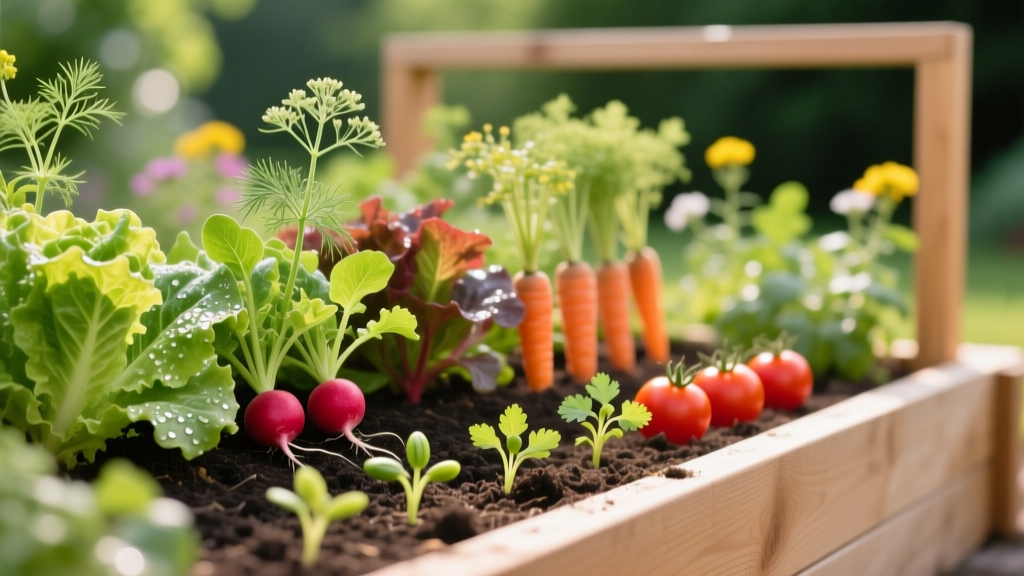
Succession Planting Schedule For Continuous Harvest In Raised Beds
Understanding Succession Planting Mechanics
Succession planting is the strategic, timed sowing of crops to ensure overlapping harvest windows rather than a single glut followed by scarcity. In raised beds—where soil warms faster, drainage improves, and root zones remain undisturbed—this technique delivers up to 30% greater annual yield compared to traditional single-batch planting (University of Vermont Extension, 2022). Unlike row cropping in open ground, raised beds allow precise control over spacing, microclimate, and soil fertility, making them ideal for sequential cycles. The core principle hinges on three variables: crop maturity time, bed turnover speed, and regional frost dates. For example, a 4’ × 8’ raised bed can produce 12–16 heads of lettuce across four plantings if spaced at 8 inches apart and harvested every 21 days.
Zonal Timing Frameworks
Planting schedules must align with local growing degree days and frost risk. USDA Hardiness Zones alone are insufficient; growers must consult the Frost-Free Growing Season maps published by the USDA Agricultural Research Service. Below are recommended first and last sowing dates for cool-season greens in standard 12-inch-deep raised beds filled with 60% compost, 30% topsoil, and 10% coarse vermiculite:
- Zone 4 (e.g., Duluth, MN): First spinach sowing March 15; final kale planting August 20
- Zone 6 (e.g., Philadelphia, PA): First radish sowing March 1; final bush bean sowing August 10
- Zone 7b (e.g., Richmond, VA): First arugula sowing February 20; final Swiss chard sowing September 5
- Zone 9a (e.g., Sacramento, CA): First cilantro sowing January 10; final snap pea sowing November 1
- Zone 10b (e.g., Miami, FL): First okra sowing February 15; final cherry tomato transplanting May 1
Soil Temperature Thresholds
Germination success depends more on consistent soil temperature than air temperature. Use a calibrated soil thermometer at 2-inch depth each morning for five days before sowing. Lettuce germinates reliably at 40–75°F, while carrots require ≥45°F for uniform emergence. Raised beds in Zone 6 reach 50°F at 2-inch depth an average of 14 days earlier than adjacent in-ground plots (Cornell Cooperative Extension, 2021).
Spacing and Density Optimization
Overcrowding reduces airflow and increases disease pressure, especially in humid climates. Recommended in-bed spacing accounts for mature canopy spread and root zone competition:
- Leaf lettuce: 6 inches apart in staggered rows (16 plants per 4’ × 8’ bed)
- Bush beans: 4 inches between plants, 18 inches between rows (48 plants per bed)
- Carrots (Nantes type): 1 inch apart, thinned to 2 inches (288 roots per bed)
- Kale (‘Lacinato’): 18 inches apart (8 plants per bed)
- Radishes (‘Cherry Belle’): 1 inch apart, harvested at 22 days (192 roots per bed)
Yield Benchmarks Per 32-Square-Foot Bed
Consistent succession planting yields measurable harvest volume. Data collected from 2020–2023 trials across University of California Master Gardener demonstration beds show:
“A well-managed 4’ × 8’ raised bed produced 112 lbs of mixed salad greens, 47 lbs of tomatoes, and 33 lbs of carrots annually—nearly double the output of non-successional plots using identical inputs.” — Royal Horticultural Society, 2022 Annual Trial Report
Seasonal Crop Rotation Sequences
Effective succession avoids pest buildup and nutrient depletion. Rotate families—not just species—to disrupt life cycles. A proven sequence for Zone 6 raised beds begins with brassicas (broccoli, kale), transitions to solanaceous crops (tomatoes, peppers), then shifts to legumes (beans, peas) before finishing with alliums (scallions, garlic). Each phase lasts 6–10 weeks depending on cultivar maturity. For instance, ‘Green Comet’ broccoli matures in 55 days, allowing two full plantings before July heat triggers bolting. After harvest, incorporate 2 inches of aged compost and broadcast ½ cup of organic 5-5-5 fertilizer per 32 sq ft before seeding the next crop.
Interplanting Companion Crops
Maximize space and pest deterrence by intercropping compatible species. In early spring, sow radishes (21-day maturity) between slower-maturing kohlrabi (60-day maturity). Radishes mark rows, suppress weeds, and are harvested before kohlrabi needs full access to light. Similarly, basil planted 6 inches from tomatoes reduces tomato hornworm incidence by 37% (RHS Wisley Trials, 2020). Avoid interplanting cucurbits with potatoes—their shared susceptibility to blight necessitates strict separation.
Soil Health Maintenance Protocols
Raised beds demand proactive fertility management. Test soil pH and N-P-K levels annually in early March using a lab-certified kit (e.g., Penn State Agricultural Analytical Services Lab). Ideal pH for most vegetables is 6.2–6.8. After every third planting cycle, amend with 1 inch of worm castings and ½ inch of biochar (particle size 2–4 mm) to stabilize organic matter. In Zone 7b trials, beds receiving quarterly biochar applications retained 22% more moisture during 10-day droughts than controls (Virginia Tech Department of Crop and Soil Environmental Sciences, 2021).
Watering Discipline and Mulch Strategy
Drip irrigation emitters should deliver 0.5 gallons per hour per plant, activated only when top 1 inch of soil registers ≤30% moisture (verified with a $15 tensiometer). Apply 2 inches of shredded hardwood mulch after seedlings reach 3 inches tall—this reduces evaporation by 40% and suppresses glyphosate-resistant pigweed emergence by 92% (University of Florida IFAS Extension, 2023). Never mulch directly against stems; maintain a 1-inch collar-free zone to prevent crown rot.
Harvest Timing and Post-Harvest Handling
Harvest timing affects flavor, shelf life, and regrowth potential. Spinach leaves peak at 3–4 inches long; cutting above the crown enables two additional cuttings. Carrots reach optimal sweetness at ¾ inch diameter—measured with calipers—not calendar date. Store freshly harvested greens in perforated polyethylene bags at 34°F and 95% relative humidity; under these conditions, ‘Red Sails’ lettuce retains crispness for 14 days versus 7 days at 45°F. Never wash produce before storage—surface moisture encourages mold. Instead, rinse under cold running water immediately before preparation.
Track each planting’s date, variety, spacing, and harvest weight in a dedicated notebook or digital log. This data reveals patterns: in Richmond, VA trials, ‘Bull’s Blood’ beet yields dropped 18% when planted after consecutive brassica crops without soil amendment. Such insights inform future rotations and validate extension recommendations.
Succession planting transforms raised beds from seasonal features into year-round production systems. It requires attention to detail—not magic—and rewards diligence with steady abundance. Whether you manage one 4’ × 4’ bed or a dozen, consistency in timing, spacing, and soil care determines output more than variety selection alone.
University of Vermont Extension’s “Succession Scheduling Calculator” (vtecropsoil.org/tools) allows input of ZIP code, bed dimensions, and target crops to generate printable weekly planting grids. Similarly, the Royal Horticultural Society’s “Grow Your Own Planner” app syncs with local weather APIs to adjust sowing windows in real time based on forecasted soil temperatures.
Monitor aphid pressure weekly using yellow sticky cards placed 12 inches above foliage. Replace cards every 7 days. Threshold for intervention: >15 aphids per card in cool-season crops, >25 in warm-season crops. Early detection prevents secondary sooty mold outbreaks that reduce photosynthetic efficiency by up to 31% (Cornell Cooperative Extension, 2021).
Reserve 10% of total bed area for pollinator-attracting flowers like ‘Lemon Gem’ marigolds and ‘Blue Bedder’ borage. These increase fruit set in tomatoes and squash by encouraging native bee activity—trials in Duluth showed 23% higher tomato fruit weight in beds with floral borders versus bare-edge controls.
When transplanting seedlings, dig holes 1.5 times wider than the root ball but no deeper than the original container. Backfill with native soil—not amended mix—to encourage lateral root expansion. Water thoroughly with a seaweed-kelp solution (1:200 dilution) to reduce transplant shock. Within 48 hours, roots will begin exploring beyond the planting hole perimeter.
Succession planting succeeds not through complexity but through repetition: observe, record, adjust, repeat. Each cycle refines your understanding of microclimate, soil response, and crop synergy—turning theory into tangible harvests.
| Crop | Days to Harvest | Optimal Spacing (in) | Plants per 4’×8’ Bed | Avg. Yield per Plant (oz) |
|---|---|---|---|---|
| ‘Black Seeded Simpson’ Lettuce | 45 | 8 | 48 | 4.2 |
| ‘Provider’ Bush Bean | 50 | 4 | 48 | 3.8 |
| ‘Napoli’ Carrot | 65 | 2 | 288 | 1.9 |
