Home & Garden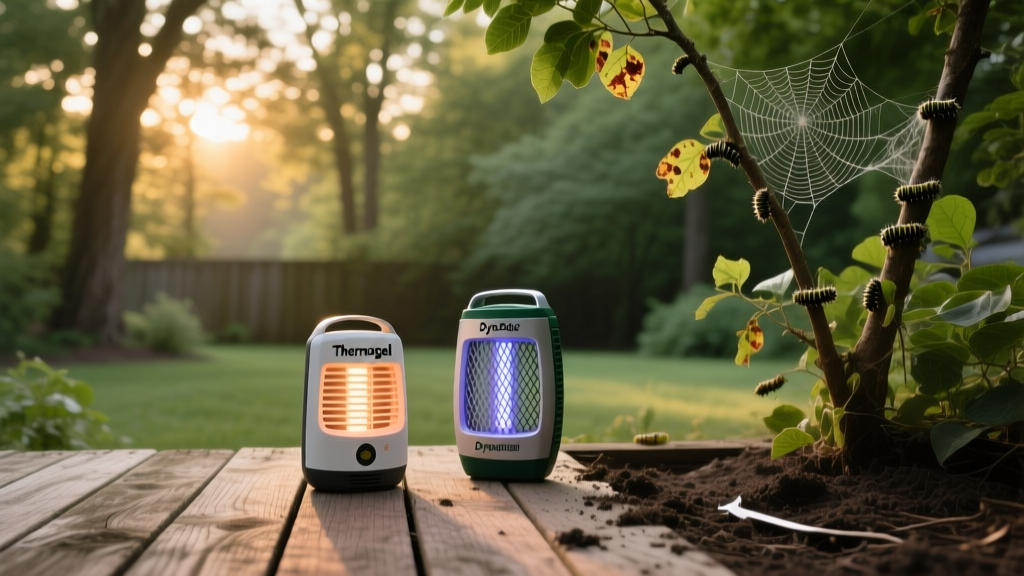
Thermacel vs DynaTrap 2026: Mosquito Control In Wooded Yards
Mike RodriguezPublished
The Canopy Conundrum: Tree Web Worms and Mosquitoes
As a certified arborist and tree web worm control specialist, I spend my summers looking up. My primary target is the fall webworm (Hyphantria cunea), a notorious defoliator that builds massive, unsightly silken tents in the outer branches of oaks, pecans, and fruit trees. However, homeowners who call me for webworm removal almost always have a secondary, ground-level complaint: mosquitoes. Yards with mature, dense tree canopies are prime real estate for both pests. The heavy shade and moisture retention that allow tree web worm populations to thrive also create the perfect humid microclimates for mosquito breeding and resting.
When managing a wooded yard, you cannot treat the trees and the patio as separate ecosystems. The physical structure of your tree canopy directly impacts the efficacy of your mosquito control devices. As we navigate the 2026 pest season, the debate between spatial repellents like Thermacel and suction traps like DynaTrap is more relevant than ever for homeowners with heavy tree cover. In this guide, I will break down how these two leading mosquito control systems perform in shaded, tree-heavy environments, and how your tree web worm management strategy can actually improve your mosquito defense.
Understanding the Shaded Yard Ecosystem
Before comparing devices, we must understand how tree canopies alter pest dynamics. According to Penn State Extension, fall webworms construct their tents at the terminal ends of branches, which can severely densify the outer canopy and block sunlight. This dense foliage acts as a windbreak, trapping humidity near the ground. Mosquitoes, being weak fliers, rely on these wind-protected, humid zones to avoid desiccation.
When you introduce mosquito control devices into this environment, the canopy dictates their success. Windbreaks can either help contain chemical repellents or suffocate the dispersal of CO2 plumes used by traps. Furthermore, the physical presence of webworm tents and dense, unpruned branches can obstruct the line-of-sight and light emissions required by certain trap technologies. Let us look at how the top 2026 models from Thermacel and DynaTrap handle these unique wooded yard challenges.
Thermacel 2026 Lineup: Spatial Repellents Under the Trees
Thermacel devices work by heating a mat or liquid cartridge containing a spatial repellent (typically metofluthrin or allethrin) to create an invisible, odorless dome of protection. The 2026 lineup, particularly the Thermacel E55 rechargeable and the smart-home-integrated Thermacel LIV system, offers excellent localized protection for patios and seating areas.
Performance in Dense Canopies
In an open yard, a Thermacel device easily establishes a 15 to 20-foot protection zone. However, in a yard heavily shaded by trees, the canopy acts as a double-edged sword. On the positive side, the tree canopy blocks strong, sweeping winds that would otherwise blow the repellent vapor away. The natural windbreak provided by mature trees helps the Thermacel maintain a stable dome over your patio furniture.
On the negative side, low-hanging branches and dense foliage can disrupt the thermal updraft required to lift and evenly distribute the vapor. If you have neglected tree web worm control, the heavy, web-laden branches hanging over your patio can actually trap the repellent vapor too high up, or cause it to pool unevenly. For optimal Thermacel performance in wooded yards, I recommend pruning the lower canopy to at least 8 feet above the patio surface to allow proper vapor circulation.
DynaTrap 2026 Models: UV and CO2 in Dense Foliage
DynaTrap takes a completely different approach. Instead of repelling mosquitoes, it attracts and eliminates them. The 2026 DynaTrap models, such as the DT1260 and the commercial-grade XL, use a combination of UV light and a titanium dioxide (TiO2) coated surface that produces a faint CO2 plume when exposed to sunlight or ambient light. A quiet fan then sucks the approaching insects into a holding cage.
The Challenge of Canopy Obstruction
For a DynaTrap to work, mosquitoes must be able to see the UV light and detect the CO2 gradient from a distance. This is where tree web worms and dense canopies become a major obstacle. The silken tents created by webworms are highly reflective and opaque. If your trees are heavily infested, these tents can physically block the UV light emission, drastically reducing the trap's effective radius.
Furthermore, the Environmental Protection Agency (EPA) notes that mosquito traps relying on visual cues need clear sightlines to be effective across a yard. In a heavily wooded property, you cannot simply place a DynaTrap on the patio. It must be placed 20 to 40 feet away from human seating areas, ideally in a shaded but open corridor between trees. If you are actively managing a tree web worm infestation, removing the tents and thinning the inner canopy will significantly improve the UV light penetration and CO2 dispersal, making your DynaTrap vastly more effective.
Head-to-Head Comparison: Thermacel vs. DynaTrap for Wooded Yards
To help you decide which system fits your specific tree-heavy property, I have compiled a comparison based on 2026 field performance in shaded, wooded environments.
| Feature | Thermacel (E55 / LIV System) | DynaTrap (DT1260 / XL) |
|---|---|---|
| Primary Mechanism | Spatial Repellent (Metofluthrin/Allethrin) | UV Light Attraction + CO2 + Suction Fan |
| Effective Range | 15 to 20 feet (Localized Dome) | Up to 1/2 Acre (Area Reduction) |
| Impact of Tree Canopy | Canopy blocks wind (Good), but low branches disrupt vapor lift (Bad) | Dense leaves and webworm tents block UV light and CO2 plumes (Bad) |
| Placement Strategy | Directly on patio tables or mounted to deck railings | 20-40 feet away from seating, in a clear corridor between trees |
| 2026 Estimated Cost | $25 - $150 (plus annual refill cartridges) | $130 - $250 (plus annual bulb replacements) |
| Best For | Immediate patio relief during outdoor dining or evening gatherings | Long-term population reduction in the broader wooded yard |
Integrating Mosquito Control with Tree Web Worm Management
As a tree care professional, I always advocate for an integrated pest management (IPM) approach. Treating your trees for webworms and your yard for mosquitoes should be complementary, not conflicting, processes.
Biological Sprays and Trap Synergy
When treating tree web worms, the gold standard is Bacillus thuringiensis var. kurstaki (Btk). Btk is a naturally occurring soil bacterium that specifically targets the digestive systems of caterpillars when ingested. It is entirely harmless to humans, pets, beneficial pollinators, and mosquitoes. Spraying your canopy with Btk to eliminate webworms will not interfere with your DynaTrap's CO2 plume or your Thermacel's spatial repellent. In fact, by eliminating the webworm tents, you open up the canopy, allowing better airflow for the Thermacel and better light penetration for the DynaTrap.
Avoid Broad-Spectrum Foggers
Many homeowners mistakenly use broad-spectrum pyrethroid foggers to treat both the lower tree canopy and the lawn for mosquitoes. As the American Mosquito Control Association frequently warns, these foggers are non-selective. They will kill beneficial insects that prey on webworms, such as parasitic wasps and predatory stink bugs, potentially making your tree web worm problem worse in the long run. Stick to targeted Btk for the trees, and rely on Thermacel or DynaTrap for the mosquitoes.
Strategic Placement and Timing for 2026
If you are deploying a DynaTrap in a wooded yard, timing is everything. Turn the trap on at dusk, when mosquitoes are most active and the UV light is most visible against the darkening tree line. Ensure the trap is hung at a height of 3 to 5 feet, mimicking the flight path of a host-seeking mosquito, and clear away any low-hanging branches or lingering webworm debris that might cast a shadow over the device.
For Thermacel users, remember that spatial repellents take about 15 minutes to establish a full dome. Turn your E55 or LIV system on before you even step outside. If you have a large, irregularly shaped patio surrounded by trees, the 2026 Thermacel LIV multi-repeller system allows you to sync up to four devices, creating an overlapping grid of protection that compensates for the uneven airflow caused by dense tree trunks and shrubbery.
Final Verdict for the Tree-Heavy Yard
Choosing between Thermacel and DynaTrap in a wooded yard ultimately depends on your primary goal. If you want immediate, guaranteed relief while sitting on your patio, the Thermacel spatial repellent is superior, provided you keep the overhead canopy pruned to allow the vapor to circulate. If your goal is to reduce the overall mosquito population across your entire wooded property, the DynaTrap is the better investment, but it requires diligent tree maintenance—specifically the removal of webworm tents and dense inner-branch foliage—to ensure the UV light and CO2 can travel unobstructed.
By viewing your yard as a single, interconnected ecosystem, you can master both tree web worm control and mosquito management. Keep your canopy healthy, your sightlines clear, and your 2026 pest control devices strategically placed, and you will reclaim your outdoor living space from both the webs above and the bites below.
