Home & Garden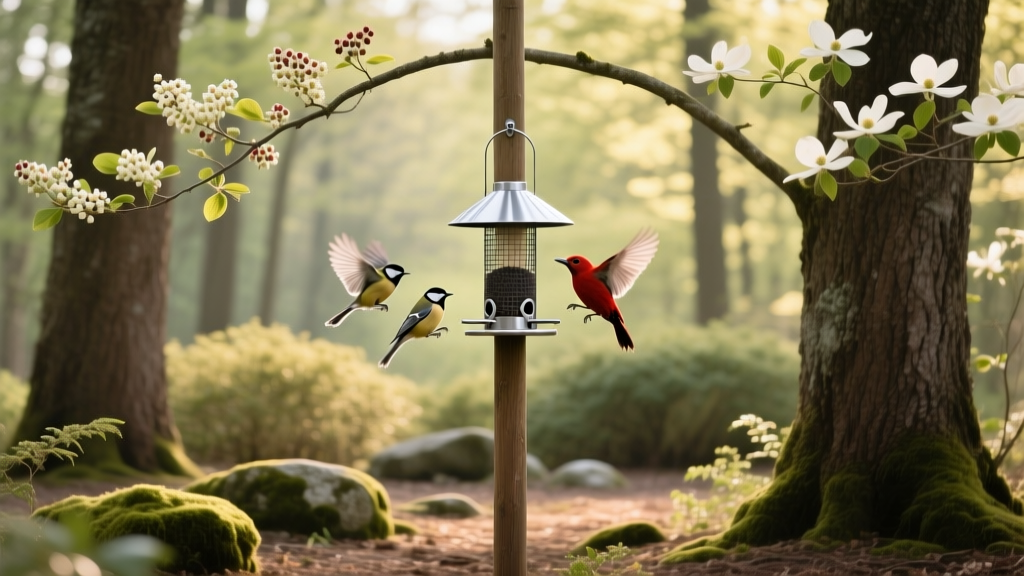
Best Trees To Plant Near Pole Bird Feeder Stations 2026
Lisa ThompsonPublished
Integrating Pole-Mount Bird Feeders into Your 2026 Landscape
As we navigate the 2026 gardening season, the modern backyard has evolved into a carefully curated ecosystem that seamlessly blends hardscaping with native softscaping. Among the most popular hardscape features for wildlife enthusiasts is the pole-mount bird feeder station equipped with a high-quality squirrel baffle. While these freestanding stations are incredibly effective at protecting expensive seed blends from foraging rodents, placing a bare metal pole in the center of an open lawn leaves visiting songbirds vulnerable to aerial predators like hawks, and exposes them to harsh weather. To create a truly thriving avian sanctuary, you must integrate your feeder station into the surrounding tree canopy. However, tree selection and placement require strategic planning to ensure your squirrel baffle remains effective.
The Geometry of Squirrel Baffles and Tree Canopies
Before digging any planting holes, it is vital to understand the physical capabilities of the Eastern Gray Squirrel and Fox Squirrel. According to wildlife data highlighted by Cornell Lab's Project FeederWatch, an adult squirrel can jump approximately 10 feet horizontally and 4 feet vertically from a standing position. If you plant a tree too close to your pole-mount station, its overhanging branches will inevitably serve as a launchpad, allowing squirrels to bypass your baffle entirely and raid the feeder.
To maintain a secure perimeter around your bird feeder station in 2026, you must adhere to the '10-and-5 Rule'. This means keeping all tree trunks at least 10 feet away from the pole horizontally, and ensuring that no tree branches hang within 5 feet vertically above the feeder or the top of the baffle. By selecting trees with predictable growth habits and manageable canopy spreads, you can provide essential cover for birds without compromising your squirrel-proof defenses.
Top Tree Selections for Bird Feeder Stations
When choosing trees to flank your pole-mount station, prioritize native species that offer natural food sources, dense protective cover, and structural forms that are easy to prune. Here are the top four tree species recommended for planting near bird feeding zones in 2026.
1. Serviceberry (Amelanchier arborea)
The Serviceberry is a standout multi-stemmed tree or large shrub that offers early spring white blossoms followed by edible, bird-attracting summer berries. Because its mature canopy spread typically maxes out between 15 and 20 feet, it is relatively easy to manage. Planting a Serviceberry exactly 12 feet from your feeder pole provides birds with a nearby staging area where they can survey the feeder for predators before darting in for a quick snack, while staying just outside the squirrel's horizontal jumping range.
2. Eastern Red Cedar (Juniperus virginiana)
Evergreen cover is critical for winter bird survival, and the Eastern Red Cedar is a native powerhouse. Its dense, conical shape provides excellent windbreaks and thermal cover for species like chickadees, nuthatches, and goldfinches. The lower branches of the Red Cedar can be easily 'limbed up' (pruned from the bottom up) to a height of 6 feet without ruining the tree's aesthetic. This vertical clearance ensures that even if a squirrel climbs the trunk, it cannot launch horizontally onto the feeder pole.
3. Flowering Dogwood (Cornus florida)
Renowned for its stunning spring bracts and vibrant fall foliage, the Flowering Dogwood also produces high-fat, bright red berries that are crucial for migrating birds and overwintering species. Dogwoods feature a distinctive horizontal branching structure. By selectively pruning the lowest tier of branches, you can maintain the necessary 5-foot vertical clearance from the ground while allowing the upper canopy to provide a beautiful, dappled-shade backdrop for your bird feeder station.
4. American Holly (Ilex opaca)
If predator protection is your primary concern, the American Holly is an exceptional choice. Its thick, leaves and somewhat prickly nature create a fortress that small songbirds can retreat into when a hawk circles overhead. Hollies are slow-growing and respond beautifully to pruning, allowing you to meticulously shape the canopy away from your pole-mount station's airspace. Furthermore, the persistent red winter berries provide a vital natural food source when feeder seeds run low.
Strategic Planting Layouts and Spacing Chart
Proper spacing is the cornerstone of a successful bird-friendly landscape that respects the boundaries of your squirrel baffle. Use the following chart as a quick reference when planning your 2026 garden layout.
| Tree Species | Mature Canopy Spread | Minimum Distance from Pole | Primary Bird Benefit |
|---|---|---|---|
| Serviceberry | 15 - 20 feet | 12 feet | Summer berries, staging cover |
| Eastern Red Cedar | 10 - 20 feet | 10 feet | Winter thermal cover, windbreak |
| Flowering Dogwood | 15 - 25 feet | 14 feet | High-fat fall berries, visual screen |
| American Holly | 15 - 25 feet | 14 feet | Dense predator protection, winter food |
2026 Best Practices for Planting and Soil Health
Planting trees near hardscape features like metal pole mounts requires careful attention to soil health and root development. According to planting guidelines published by the University of Minnesota Extension, the most common mistake homeowners make is planting trees too deeply. In 2026, arborists heavily emphasize the importance of exposing the 'root flare'—the area where the trunk expands at the base of the tree. Burying the root flare leads to girdling roots and premature tree decline.
When digging your planting hole, make it two to three times as wide as the root ball, but no deeper. Incorporate a native soil and compost mix, and consider adding mycorrhizal fungi inoculants to the root zone. These beneficial fungi form symbiotic relationships with tree roots, vastly improving water and nutrient uptake, which is especially important when trees are competing with nearby lawn grasses. After planting, apply a 2-to-3-inch layer of organic mulch in a wide ring around the tree, but keep the mulch pulled back several inches from the trunk to prevent rot.
Pruning to Maintain the Squirrel-Free Zone
Trees are living, growing organisms, and a canopy that clears your bird feeder station in 2026 might encroach upon it by 2028. Establishing a routine pruning schedule is mandatory. The National Audubon Society, via their extensive habitat guides on the Audubon website, notes that creating safe 'flight corridors' for birds requires maintaining open spaces between dense cover and food sources.
For your pole-mount station, focus on 'limbing up' the trees. Using sterilized, sharp bypass pruning shears or a pole saw, remove any branches that dip below the 5-foot mark or stretch horizontally toward the 10-foot boundary line. Always make clean cuts just outside the branch collar to promote rapid healing and prevent disease. By maintaining this invisible 10-foot cylinder of clear airspace around your feeder pole, you ensure that your torpedo or dome baffle functions exactly as engineered.
Mulching and Pole Base Maintenance
Finally, consider the intersection of your tree's root zone and the physical base of your pole-mount bird feeder station. Many homeowners extend their tree mulch rings to cover the base of the feeder pole. While this creates a unified visual aesthetic, piling moist wood mulch directly against a metal pole mount can trap moisture, accelerating rust and compromising the structural integrity of the station over time.
To mitigate this, use a physical barrier such as a ring of river rocks or pea gravel immediately surrounding the pole's ground spike or concrete footing. This creates a dry, well-draining buffer zone that protects the metal from constant moisture, while still allowing the outer edges of the rock ring to transition seamlessly into the organic mulch of your newly planted trees. By marrying thoughtful tree selection with precise spatial planning and diligent maintenance, your 2026 bird feeder station will become a vibrant, safe, and squirrel-free hub for local wildlife.
