
Home & Garden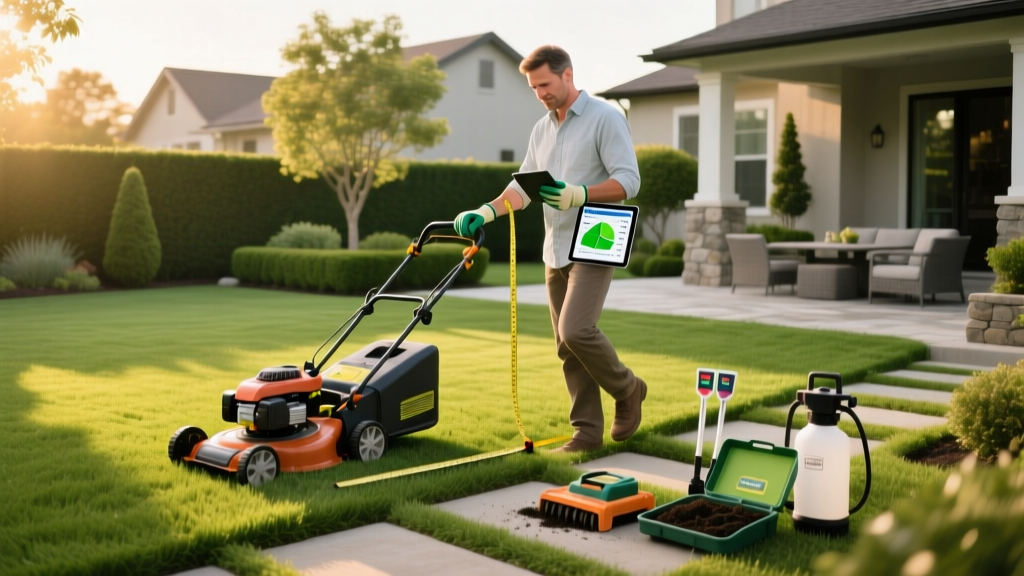
How Many Steps in a Yard to Calculate Fertilizer Coverage and Costs
The Dual Meaning: Pacing for Coverage vs. Hardscape Stairs
Determining how many steps in a yard serves two distinct purposes in outdoor home improvement. For lawn care professionals and DIY homeowners, "steps" refers to the pacing method used to estimate square footage for precise chemical and seed dosage. For landscapers dealing with sloped terrain, it refers to the physical hardscape stairs required to navigate elevation changes. This guide breaks down the exact mathematics, product coverage matrices, and 2026 cost data for both interpretations, ensuring you never overbuy fertilizer or underbudget for retaining wall blocks.
The Pacing Method: Translating Steps to Square Footage
The most reliable way to measure an irregular or large lawn without a commercial measuring wheel is the pacing method. The standard baseline for an adult stride is 2.5 feet per step. By walking the length and width of your property and counting your paces, you can calculate the total area to determine exact product dosage.
Calibration Tip: Before measuring your yard, calibrate your specific stride. Lay out a 25-foot tape measure. Walk it at a normal pace and count your steps. If it takes you 10 steps, your stride is exactly 2.5 feet. If it takes 12 steps, your stride is 2.08 feet. Use your calibrated number for the formulas below.
Step-to-Coverage Conversion Matrix
Assuming a calibrated 2.5-foot stride, use this matrix to convert your paced perimeter into square footage. Multiply your length steps by your width steps, then multiply that result by 6.25 (the square footage of one 2.5x2.5 foot pace).
| Length (Steps) | Width (Steps) | Dimensions (Feet) | Total Square Footage | Acreage Equivalent |
|---|---|---|---|---|
| 20 steps | 20 steps | 50' x 50' | 2,500 sq ft | 0.05 Acres |
| 40 steps | 30 steps | 100' x 75' | 7,500 sq ft | 0.17 Acres |
| 60 steps | 40 steps | 150' x 100' | 15,000 sq ft | 0.34 Acres |
| 80 steps | 60 steps | 200' x 150' | 30,000 sq ft | 0.68 Acres |
Dosage and Cost Guide for Lawn Products
Once you know how many steps in a yard equate to your total square footage, you can calculate exact product requirements. Over-applying nitrogen-based fertilizers leads to turf burn and groundwater contamination, a risk heavily documented by the EPA's guidelines on lawn and garden care. Under-applying results in thin, weed-prone turf.
2026 Fertilizer & Seed Coverage Pricing
The following data reflects current retail pricing for premium lawn care products. Note that rotary spreaders require a 20% overlap on each pass to prevent striping, meaning your effective coverage area per bag is slightly lower than the maximum stated yield if you are not highly precise.
| Product (2026 Models) | Bag Weight | Max Coverage | Avg. Cost | Cost per 1,000 sq ft |
|---|---|---|---|---|
| Scotts Turf Builder Winterguard | 14.06 lbs | 5,000 sq ft | $39.98 | $7.99 |
| Milorganite 6-4-0 Slow Release | 32 lbs | 2,500 sq ft | $24.50 | $9.80 |
| Pennington Smart Seed Tall Fescue | 3 lbs | 1,000 sq ft | $18.99 | $18.99 |
| Bayer Advanced Season Long Weed Control | 10 lbs | 10,000 sq ft | $42.00 | $4.20 |
Warning - The Spreader Edge Effect: When applying granular products near driveways or sidewalks, switch to a drop spreader or use a deflector shield on your rotary spreader. Pacing your yard and buying exact dosage will not save you money if 15% of your product bounces off concrete and into storm drains.
Hardscape Steps: Physical Stairs for Sloped Yards
If your search for how many steps in a yard relates to landscaping a sloped backyard, the calculation shifts from area to elevation. According to Penn State Extension's turfgrass and landscape management resources, managing slope erosion often requires terracing and physical staircases.
Calculating Physical Step Requirements
The standard rule of thumb for outdoor landscape stairs is a 6-inch to 7-inch rise per step, with a 12-inch to 16-inch tread depth. To determine how many physical steps you need:
- Measure the total vertical elevation change (the rise) in inches using a laser level or string line.
- Divide the total rise by 6.5 (the ideal average step height).
- Round to the nearest whole number to get your total step count.
Example: A 39-inch sloped hill divided by 6.5 inches equals exactly 6 physical steps.
Material Cost Breakdown for Landscape Stairs
Building physical steps requires specific retaining materials. The Scotts official product lineup and similar hardware suppliers offer various hardscape solutions, but dedicated masonry brands dominate this space. Below is the 2026 cost matrix for building a standard 4-foot wide staircase.
| Material Type | Cost Per Step (Materials) | Labor Cost Per Step | Lifespan & Notes |
|---|---|---|---|
| Pavestone Concrete Wall Blocks | $45 - $60 | $150 - $200 | 25+ years. Requires compacted gravel base. |
| Natural Flagstone (Bluestone) | $120 - $180 | $250 - $400 | 50+ years. Premium aesthetic, requires concrete footing. |
| Treated Timber (6x6) | $30 - $45 | $100 - $150 | 10-15 years. Prone to rot and heaving in freeze-thaw zones. |
| Poured Concrete with Stucco Finish | $90 - $130 | $300 - $500 | 40+ years. High labor cost due to forming and curing time. |
Common Coverage Miscalculations & Edge Cases
Even with perfect pacing, several variables can skew your dosage and coverage calculations. Professional turf managers account for these edge cases before purchasing materials:
"Homeowners frequently forget to subtract the square footage of their home's footprint, driveway, and large garden beds from their total paced yard size. If you pace a 10,000 sq ft lot, but the house and hardscape cover 4,000 sq ft, you only need enough fertilizer for 6,000 sq ft of actual turf. Buying for the gross lot size results in severe over-application."
Handling Irregular Shapes and Slopes
The pacing method assumes a perfect rectangle. For L-shaped or triangular yards, break the property into smaller rectangular grids. Pace each grid individually and sum the square footage. Furthermore, sloped terrain increases the actual surface area of the soil compared to a flat 2D map. For every 10 degrees of slope, add 5% to your total calculated square footage to ensure you have adequate seed and fertilizer coverage.
Summary Checklist for Your Next Hardware Store Run
- Calibrate: Measure your personal stride length over a known 25-foot distance.
- Pace: Walk the length and width of your turf areas (excluding hardscape and home footprint).
- Calculate: Multiply Length Steps x Width Steps x (Stride Length squared) to get exact square footage.
- Adjust: Add 5% to your total if your yard features significant slopes or hills.
- Purchase: Divide your total adjusted square footage by the coverage listed on the product bag to determine exactly how many units to buy.

