The Ultimate Fall Lawn Care Checklist and Winter Schedule
Why Fall is the Most Critical Season for Your Lawn
As the sweltering heat of summer fades, homeowners often mistakenly believe their lawn care duties are winding down. In reality, for cool-season grasses like Kentucky Bluegrass, Tall Fescue, and Perennial Ryegrass, fall is the most critical season of the entire year. While top growth slows down as air temperatures drop, soil temperatures remain warm enough to stimulate massive root development. The energy your grass stores during the autumn months will directly dictate its vigor, color, and disease resistance the following spring.
Bridging the gap between outdoor landscaping and indoor smart home management, a modern fall lawn care schedule goes far beyond simply raking leaves. It involves strategic soil preparation, precise nutrient application, and the proper winterization of smart irrigation systems to prevent costly freeze damage. According to turfgrass experts at Purdue University Turfgrass Science, lawns that receive proper fall maintenance recover from summer stress significantly faster and outcompete spring weed invasions. This comprehensive checklist will guide you through every essential step from late August through early winter.
The Ultimate Fall Lawn Care Checklist
Step 1: Soil Testing and Preparation (Late August)
Before applying any amendments, you must understand what your soil actually needs. A soil test measures pH levels and essential macronutrients like phosphorus and potassium. Cool-season grasses thrive in soil with a pH between 6.0 and 7.0. If your soil is too acidic, you will need to apply pelletized limestone; if it is too alkaline, elemental sulfur is required. Because lime takes several months to alter soil chemistry, applying it in late summer or early fall ensures it is fully integrated by the time spring growth begins.
- Action: Use a stainless steel soil probe to extract 5 to 10 core samples from various areas of your yard at a depth of 3 to 4 inches.
- Timing: Late August to early September.
- Cost: Basic DIY test kits cost around $15, while comprehensive lab tests via local university extension offices typically range from $20 to $30.
Step 2: Core Aeration and Overseeding (September)
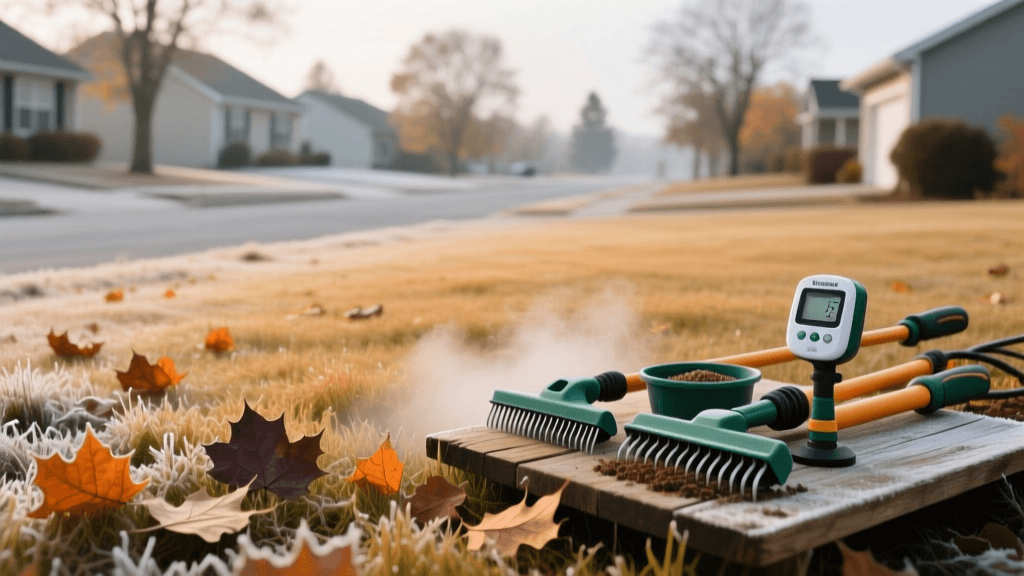
Summer foot traffic and heavy rains often lead to soil compaction, which chokes grassroots by preventing oxygen, water, and nutrients from penetrating the soil profile. Core aeration involves pulling small plugs of soil out of the ground to alleviate this compaction. Immediately following aeration is the ideal time to overseed. The aeration holes provide perfect, protected pockets for seed-to-soil contact, which is the single most important factor in seed germination.
- Aeration Depth: Ensure the aerator pulls plugs that are 2 to 3 inches deep and spaced 2 to 4 inches apart.
- Seeding Rates: Apply Tall Fescue at 4 to 6 pounds per 1,000 square feet, or Kentucky Bluegrass at 1 to 2 pounds per 1,000 square feet.
- Pro Tip: Use a starter fertilizer containing mesotrione. This unique active ingredient prevents weed seeds from germinating while being completely safe for your new grass seedlings.
Step 3: Fall Fertilization and Weed Control (October)
October is the time to apply a winterizer fertilizer. Unlike spring fertilizers that are high in nitrogen to promote rapid green blade growth, winterizers are formulated with higher levels of potassium (the third number on the fertilizer bag, representing K2O). Potassium acts like an antifreeze for your lawn, thickening cell walls and improving the grass's ability to withstand freezing temperatures, drought, and winter diseases.
This is also the optimal window for treating broadleaf weeds like dandelions, clover, and plantain. In the fall, weeds are actively pulling nutrients down into their root systems to store for winter. When you apply a selective broadleaf herbicide, the plant absorbs the chemical and pulls it directly into the roots, ensuring a complete kill rather than just burning off the top leaves.
Step 4: Leaf Mulching and Final Mowing (November)
Do not let a thick layer of fallen leaves smother your lawn over the winter, as this creates a breeding ground for snow mold and vole damage. Instead of bagging leaves, use your mower with a specialized mulching blade to chop them into dime-sized pieces. These fine leaf particles will filter down to the soil surface, where earthworms and microbes will break them down into free, nitrogen-rich organic matter. For the final mow of the season, drop your mower deck down to a height of 2 to 2.5 inches. Shorter grass entering the winter is less prone to matting down under heavy snow.
Smart Irrigation Winterization Schedule
If you have invested in a smart irrigation system with Wi-Fi-enabled controllers and soil moisture sensors, winterizing it properly is vital to protect your financial investment and your plumbing. The EPA WaterSense program emphasizes that proper seasonal maintenance of irrigation systems prevents catastrophic pipe bursts and extends the lifespan of your sprinkler heads.
1. Smart Controller Adjustments
Modern smart controllers like the Rachio 3 or Hunter Hydrawise feature automated seasonal adjustment tools. In late autumn, use the app to enable the 'Winterize' or 'Seasonal Shut-off' feature. This stops all scheduled watering but retains your zone configurations and historical data so you can easily reactivate them in the spring. Additionally, ensure your connected rain/freeze sensors are clean and free of debris so they do not send erroneous signals to your indoor smart home hub.
2. The Blow-Out Method
For regions where the ground freezes deeply, simply draining the pipes is not enough. You must use an air compressor to blow out the residual water. Connect the compressor to the system's mainline via a blow-out port. It is critical to use a compressor with a high CFM (Cubic Feet per Minute) rating, ideally between 10 and 25 CFM, while keeping the PSI (Pounds per Square Inch) strictly regulated. Never exceed 50 PSI for polyethylene (poly) pipes or 80 PSI for PVC pipes, as excessive pressure will shatter the pipes and destroy your sprinkler heads.
Month-by-Month Fall Lawn Care Schedule
| Month | Primary Tasks | Tools & Products Needed | Smart Home Integration |
|---|---|---|---|
| Late August | Soil testing, early grub control, initial mowing height reduction. | Soil probe, DIY test kit, grub preventative. | Calibrate smart soil moisture sensors. |
| September | Core aeration, overseeding, starter fertilizer application. | Core aerator, grass seed, starter fertilizer. | Adjust smart irrigation for frequent, shallow watering to support seed germination. |
| October | Broadleaf weed control, winterizer fertilizer, deep root watering. | Selective herbicide, high-potassium fertilizer. | Transition smart controller to deep, infrequent watering schedules. |
| November | Leaf mulching, final mowing, equipment winterization. | Mulching mower blade, fuel stabilizer. | Trigger system blow-out and activate winterize mode on smart controller. |
Essential Tools for the Modern Lawn Enthusiast
To execute this schedule efficiently, you need the right arsenal of tools. While you can rent heavy machinery like core aerators from local hardware stores for about $60 to $80 a day, investing in smart technology yields long-term dividends. A Wi-Fi-enabled smart sprinkler controller pays for itself in water savings within two seasons by utilizing local weather data to skip unnecessary watering cycles. Furthermore, integrating robotic lawnmowers into your fall schedule can save hours of manual labor; simply program the robotic mower to run daily in November to continuously mulch falling leaves into fine dust before the first snowfall.
Conclusion
A lush, vibrant, and resilient lawn is not an accident; it is the direct result of strategic, well-timed maintenance. By following this comprehensive fall lawn care checklist and winter schedule, you are setting the stage for a spectacular spring landscape. From the physical labor of core aeration to the digital convenience of smart irrigation winterization, bridging traditional horticulture with modern technology ensures your outdoor living space remains pristine, energy-efficient, and beautifully maintained year-round. Grab your soil probe, fire up the aerator, and prepare your lawn for its most important season of the year.