How to Identify and Eradicate Creeping Charlie Weed
Introduction to Creeping Charlie (Ground Ivy)
Creeping Charlie (Glechoma hederacea), also commonly referred to as ground ivy, gill-over-the-ground, or creeping Jenny, is a highly invasive perennial broadleaf weed. Originally introduced to North America by European settlers as a medicinal herb and a shade-tolerant ground cover, it has since become one of the most frustrating and persistent weeds for homeowners and landscape professionals alike. It thrives in moist, shady areas where turfgrass struggles to grow, but it will also aggressively invade sunny lawn areas if the grass is thin or poorly maintained.
Unlike annual weeds that die off with the first frost, Creeping Charlie is a perennial survivor. It forms dense, mat-like canopies that choke out desirable turfgrass and ornamental plants by competing for water, nutrients, and sunlight. To successfully reclaim your lawn and garden beds, you must understand how to accurately identify this weed, why it is so resilient, and the specific cultural, manual, and chemical strategies required to eradicate it.
How to Identify Creeping Charlie
Accurate identification is the critical first step in any weed management program. Misidentifying Creeping Charlie can lead to the application of ineffective herbicides or improper cultural practices. According to the University of Minnesota Extension, Creeping Charlie belongs to the mint family (Lamiaceae), which provides several distinct visual and olfactory clues for identification.
Leaf and Stem Characteristics
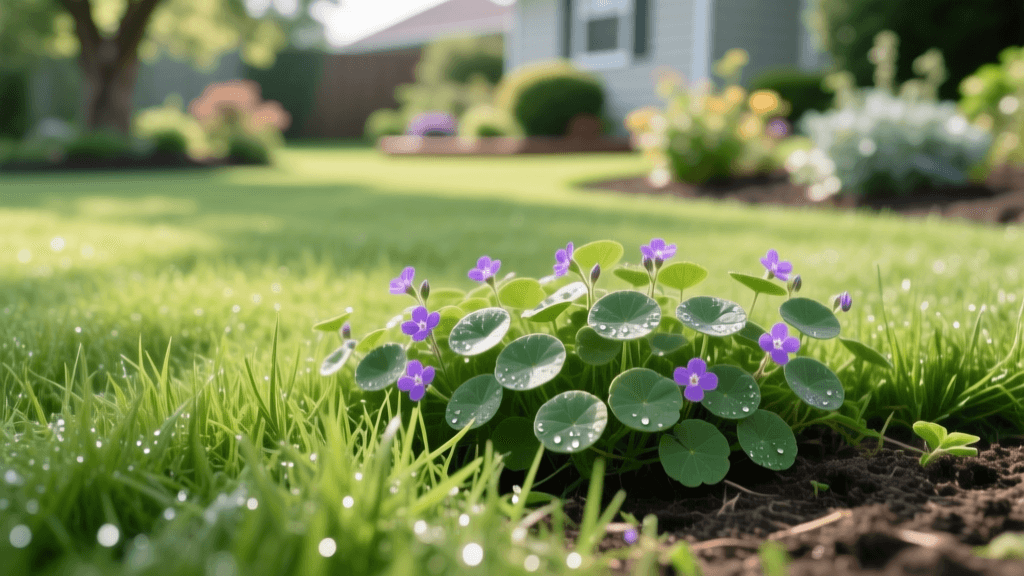
- Leaves: The leaves are round to kidney-shaped with scalloped (crenate) edges. They are typically bright to dark green, though they may take on a purplish hue in cooler weather or when exposed to direct sunlight.
- Stems: Like all mint family members, the stems are distinctly square-shaped when viewed in cross-section. These stems (stolons) creep along the ground and can grow several feet long.
- Rooting Nodes: As the stolons creep across the soil surface, they develop roots at each node (the point where leaves attach to the stem), anchoring the plant firmly into the earth.
- Flowers: In early to mid-spring, Creeping Charlie produces small, funnel-shaped flowers that range from pale blue to lavender. They typically appear in clusters of three near the leaf axils.
- Odor: When the leaves or stems are crushed or mowed, they emit a strong, pungent, minty or musky odor.
Creeping Charlie vs. Look-Alikes
Homeowners often confuse Creeping Charlie with other common broadleaf weeds. The table below highlights the key differences to ensure proper identification.
| Feature | Creeping Charlie (Ground Ivy) | Common Mallow | Speedwell |
|---|---|---|---|
| Leaf Shape | Round/kidney with scalloped edges | Rounded with deep lobes (geranium-like) | Small, oval to heart-shaped, smooth edges |
| Stem Type | Square, creeping stolons | Round, trailing or upright | Round, low-growing and branching |
| Flower Color | Blue-purple (spring) | Pink, white, or pale purple | Bright blue or white (tiny) |
| Distinctive Trait | Strong minty odor when crushed | Produces small, disc-shaped seed pods | Often has a single white eye in the center |
Why Creeping Charlie is So Difficult to Control
The resilience of Creeping Charlie lies in its aggressive reproductive biology. While it does produce seeds, its primary method of spreading is vegetative. The creeping stolons can grow rapidly, and every single node has the potential to take root and establish a new plant. If you attempt to pull the weed and leave even a tiny fragment of a rooted node behind in the soil, it will quickly regenerate.
Furthermore, the University of Wisconsin-Madison Extension notes that Creeping Charlie produces allelopathic chemicals—natural herbicides released into the soil that actively inhibit the growth of surrounding plants, giving it a distinct competitive advantage over your turfgrass.
'Because it thrives in shade and moist soils, Creeping Charlie is often a symptom of a larger lawn health issue, such as compacted soil, poor drainage, or excessive shade. Treating the weed without addressing the underlying environmental conditions will almost always result in its return.'
Manual and Cultural Removal Methods
For small, localized infestations or for homeowners who prefer organic lawn care practices, manual removal is a viable option. However, it requires patience, persistence, and impeccable timing.
Hand-Pulling and Dethatching
The best time to hand-pull Creeping Charlie is after a heavy rain or a deep watering session, when the soil is soft and pliable. Use a hand weeding tool or a dethatching rake to loosen the soil around the stolons. Carefully lift the mat of weeds, ensuring you extract every rooting node. Place the removed weeds in a sealed trash bag; do not add them to your home compost pile, as most residential compost bins do not reach the high temperatures required to kill the weed's roots and seeds.
Smothering and Solarization
If Creeping Charlie has completely overtaken a garden bed or a section of lawn that you intend to reseed, smothering is a highly effective, chemical-free eradication method. Mow the area as short as possible, cover it with overlapping layers of thick cardboard, and top it with 3 to 4 inches of organic mulch or compost. Leave the covering in place for an entire growing season (at least 3 to 6 months). The lack of sunlight will eventually starve the roots and kill the weed mat.
The Borax Myth
In the past, homemade borax solutions were widely recommended online for killing Creeping Charlie. However, horticultural experts now strongly advise against this. Boron, the active element in borax, does not break down easily in the soil. Repeated applications lead to boron toxicity, which will permanently sterilize the soil and prevent any future grass or ornamental plants from growing in that area.
Chemical Control: Herbicides That Actually Work
For widespread lawn infestations, chemical control is often the most practical and effective solution. When consulting the Environmental Protection Agency (EPA) guidelines on safe pest control, it is vital to select the correct active ingredient and apply it at the correct time of year to ensure the herbicide reaches the root system.
Selective Broadleaf Herbicides for Lawns
Standard broadleaf weed killers containing only 2,4-D are largely ineffective against mature Creeping Charlie. To achieve control, you must use a selective, post-emergent herbicide that contains triclopyr as the primary active ingredient. Triclopyr is highly effective on tough, woody, and viny broadleaf weeds while remaining safe for most cool-season and warm-season turfgrasses.
- Active Ingredients to Look For: Triclopyr, often combined with dicamba, 2,4-D, or quinclorac in commercial 'Triple Threat' or 'Four-Way' lawn weed killers.
- Optimal Timing: The absolute best time to apply herbicides for Creeping Charlie is in early autumn (late September to mid-October). During the fall, the plant is actively pulling nutrients (and the systemic herbicide) down into its root system to prepare for winter. Spring applications are less effective because the plant is pushing energy upward into new growth and flowers, meaning the roots may survive and resprout.
- Application Conditions: Apply when daytime temperatures are between 60°F and 70°F. Ensure no rain is forecast for at least 24 hours after application, and avoid spraying on windy days to prevent herbicide drift onto desirable garden plants.
Non-Selective Herbicides for Garden Beds
In garden beds, patios, or driveway cracks where there is no desirable turfgrass to protect, a non-selective herbicide containing glyphosate can be used. Because glyphosate will kill any plant it touches, it must be applied carefully using a shielded sprayer, a sponge applicator, or a precision gel wand to avoid damaging nearby ornamentals.
Preventing Future Outbreaks
Eradicating Creeping Charlie is only half the battle. If you do not alter the environmental conditions that allowed the weed to thrive in the first place, it will inevitably return. Implement the following lawn care practices to build a dense, vigorous turf that naturally resists weed invasion:
- Manage Shade and Moisture: Creeping Charlie loves damp shade. Prune lower tree branches to increase sunlight penetration and improve air circulation. If an area is too deeply shaded to support grass (less than 4 hours of direct sunlight), consider replacing the turf with shade-tolerant ground covers like pachysandra, hostas, or shade-tolerant mulch beds.
- Correct Soil Compaction: Perform core aeration annually in the fall to alleviate soil compaction, improve drainage, and allow oxygen and nutrients to reach the grass roots.
- Overseed Annually: After aerating and treating the weeds, overseed bare or thin patches with a high-quality, shade-tolerant turfgrass blend. A thick lawn is the best natural defense against weed encroachment.
- Adjust Mowing Height: Raise your mower deck to 3 or 4 inches. Taller grass develops deeper root systems and creates a thick canopy that shades the soil, preventing weed seeds from germinating.
- Fertilize Appropriately: Conduct a soil test and apply a balanced, slow-release nitrogen fertilizer based on the results. Creeping Charlie thrives in low-nitrogen soils; keeping your grass well-fed ensures it can outcompete the weeds.
Conclusion
Creeping Charlie is a formidable opponent, but it is not invincible. By accurately identifying the weed, understanding its aggressive stolon-based growth habit, and combining targeted fall herbicide applications with long-term cultural lawn improvements, you can successfully eradicate ground ivy. Consistency is key; monitor your lawn regularly, maintain a thick and healthy turf canopy, and address any new, isolated outbreaks immediately before they have the chance to spread.