How to Identify, Prevent, and Treat Brown Patch Disease
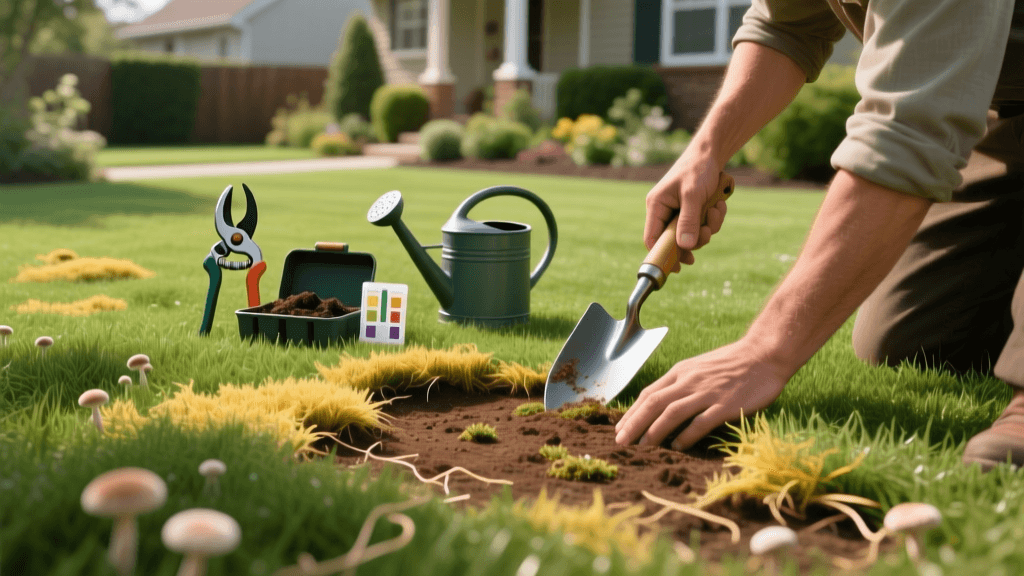
There is nothing more frustrating for a home gardener than watching a lush, vibrant lawn succumb to mysterious brown, dying patches just as the summer outdoor living season begins. Your patio furniture is ready, the garden-to-table herbs are thriving, but the centerpiece of your outdoor space—the turfgrass—is deteriorating. If you are noticing circular, discolored areas expanding across your yard, you are likely dealing with one of the most common and destructive turfgrass ailments: Brown Patch.
Understanding Brown Patch (Rhizoctonia solani)
Brown patch is a foliar disease caused by the soil-borne fungus Rhizoctonia solani. Unlike some lawn diseases that only target specific grass types, brown patch is an equal-opportunity destroyer. It heavily impacts cool-season grasses like tall fescue, perennial ryegrass, and Kentucky bluegrass, but it also wreaks havoc on warm-season grasses such as St. Augustine, Zoysia, and Bermuda grass during their transitional growing periods.
The fungus survives the winter in the soil and thatch layer as sclerotia (compact masses of fungal tissue). When environmental conditions become favorable, the sclerotia germinate, infecting the grass blades and sheaths. According to plant pathologists at Penn State Extension, brown patch does not typically kill the plant's crown or roots, meaning the lawn can recover if treated promptly and correctly. However, severe, untreated outbreaks can lead to secondary weed invasions and long-term aesthetic damage.
Identifying Brown Patch: Signs and Symptoms
Accurate identification is the critical first step before reaching for chemical treatments. Misdiagnosing drought stress or insect damage as a fungal disease will waste your time and money while the fungus continues to spread.
The "Smoke Ring" and Morning Mycelium
In the early stages, brown patch appears as circular or irregularly shaped patches of blighted grass, ranging from a few inches to several feet in diameter. The most telltale sign is the "smoke ring"—a dark, purplish-gray border at the outer edge of the patch that is visible in the early morning when the grass is wet with dew. This ring represents the active, advancing edge of the fungal infection.
If you inspect the lawn closely at dawn, you may also see mycelium—a white, cobweb-like fungal growth—on the surface of the grass blades. As the sun dries the dew, the mycelium disappears, and the smoke ring fades, leaving behind a patch of dead, tan-colored grass.
Differentiating Brown Patch from Drought Stress
Homeowners often confuse brown patch with drought stress or dull mower blade damage. Here is how to tell them apart:
- Drought Stress: Appears as uniform wilting, footprinting (grass doesn't bounce back when stepped on), and a bluish-gray hue before turning completely brown. It occurs across the entire lawn or in areas with poor soil retention, not in distinct circular patches.
- Mower Damage: Dull mower blades shred the tips of the grass, giving the entire lawn a whitish, frayed appearance. It does not create distinct dead rings.
- Brown Patch: Features distinct circular lesions, individual leaf lesions with tan centers and dark brown borders, and the presence of the morning smoke ring.
Environmental Triggers: Why Brown Patch Attacks
Rhizoctonia solani requires a very specific microclimate to thrive. The disease explodes when three conditions intersect:
- High Temperatures: Daytime temperatures consistently above 80°F (27°C) and, more importantly, nighttime temperatures that do not drop below 65°F (18°C).
- High Humidity: Prolonged periods of high relative humidity.
- Prolonged Leaf Wetness: Grass blades that remain wet for 10 to 12 consecutive hours. This is the most critical factor. Without extended leaf wetness, the fungal spores cannot germinate and penetrate the grass tissue.
Cultural Controls: Smart Irrigation and Lawn Care
Before applying fungicides, you must alter the environment to make it hostile to the fungus. Cultural practices are your first line of defense and are essential for long-term lawn health.
Integrating Smart Home Irrigation
Overwatering or watering at the wrong time of day is the primary catalyst for brown patch. Watering in the late afternoon or evening guarantees that the grass will remain wet all night, creating the perfect incubator for Rhizoctonia.
To combat this, integrate a smart Wi-Fi irrigation controller (such as Rachio or B-hyve) into your home's smart ecosystem. These devices connect to local weather stations and utilize Evapotranspiration (ET) data to adjust watering schedules automatically.
- Rain Delay & Soil Moisture Sensors: Configure your smart controller to skip scheduled watering if rain is in the forecast or if a wireless soil moisture sensor detects adequate hydration.
- Watering Windows: Program your system to water exclusively between 4:00 AM and 6:00 AM. This ensures the grass receives necessary hydration but dries quickly once the sun rises.
- Deep and Infrequent: Aim for 1 to 1.5 inches of water per week, applied in one or two deep sessions rather than daily light sprinklings.
Mowing and Nitrogen Management
The University of Minnesota Extension recommends maintaining proper mowing heights to reduce stress. Never scalp your lawn; keep cool-season grasses at 3 to 4 inches during the summer heat. Furthermore, avoid applying fast-release, high-nitrogen fertilizers in late spring and early summer. Excess nitrogen promotes rapid, succulent leaf growth that is highly susceptible to fungal penetration. Switch to slow-release, organic nitrogen sources during the peak summer months.
Chemical Controls: Fungicide Selection and Application
When cultural controls are not enough, or if you have a history of severe brown patch outbreaks, chemical intervention is necessary. Fungicides are most effective when used preventatively. Once the grass blade is dead, no fungicide can bring it back to life; curative applications only stop the spread to healthy tissue.
The Importance of FRAC Codes and Rotation
Fungi can quickly develop resistance to chemical treatments. To prevent this, you must rotate fungicides with different FRAC (Fungicide Resistance Action Committee) codes. For example, if you use an FRAC Group 11 fungicide in May, switch to an FRAC Group 3 or Group 12 fungicide in June. Research from NC State University indicates that rotating fungicide classes is the single most effective way to maintain long-term chemical efficacy and prevent the emergence of resistant fungal strains.
Fungicide Active Ingredients Comparison
The following table outlines the most effective active ingredients for brown patch control, including application rates and estimated costs for residential use.
| Active Ingredient | FRAC Code | Brand Examples | Application Rate (per 1,000 sq ft) | Action Type | Est. Cost (per 1k sq ft) |
|---|---|---|---|---|---|
| Azoxystrobin | Group 11 | Heritage G, Scotts DiseaseEX | 2.0 - 4.0 oz (liquid) / 2.0 lbs (granular) | Systemic / Preventative & Curative | $15 - $25 |
| Propiconazole | Group 3 | Honor Guard, Banner MAXX | 1.0 - 2.0 fl oz | Systemic / Curative & Protectant | $10 - $18 |
| Fludioxonil | Group 12 | Medallion | 0.5 - 1.0 oz | Contact / Preventative | $20 - $35 |
| Pyraclostrobin | Group 11 | Insignia, Headway | Varies by formulation | Systemic / Preventative | $18 - $28 |
Pro Tip for Application: Always apply liquid fungicides in the early evening or late afternoon when temperatures are cooler to prevent leaf burn. Use a hose-end or pump sprayer calibrated to deliver 2 gallons of water per 1,000 square feet to ensure the product coats the grass blades and reaches the lower sheath where the infection begins.
Long-Term Prevention and Lawn Recovery
If your lawn has already suffered damage from brown patch, recovery requires patience and targeted lawn care. Because Rhizoctonia solani primarily attacks the leaves and not the roots, the crown of the plant is often still alive.
Aeration and Thatch Management
The fungus overwinters in the thatch layer. If your thatch layer exceeds half an inch, it acts as a sponge, holding moisture against the soil surface and harboring fungal spores. Schedule core aeration in the early fall (for cool-season grasses) or late spring (for warm-season grasses) to relieve soil compaction, improve drainage, and accelerate thatch decomposition.
Overseeding with Resistant Cultivars
For lawns that suffer chronic, yearly brown patch outbreaks, consider overseeding with disease-resistant turfgrass cultivars. Many modern tall fescue and perennial ryegrass varieties have been specifically bred by university turfgrass programs to exhibit high resistance to Rhizoctonia solani. Check your local university extension's annual turfgrass performance trials to find the best resistant varieties for your specific USDA hardiness zone.
Conclusion
Brown patch disease can quickly turn a beautiful outdoor living space into an unsightly, patchy mess. However, by understanding the environmental triggers—specifically nighttime heat and prolonged leaf wetness—you can stay one step ahead of the fungus. Leverage smart home irrigation technology to eliminate unnecessary watering, maintain proper mowing heights, and utilize a strategic, FRAC-rotated fungicide program when necessary. With these proactive identification and treatment strategies, your lawn will remain a lush, green foundation for your garden and outdoor entertainment all summer long.