Landscaping
How to Identify and Eliminate Nutsedge in Your Landscape
Anna KowalskiPublished
The "Superweed" of Landscapes: Understanding Nutsedge
For homeowners and landscaping professionals alike, few weeds are as frustrating and persistent as nutsedge. Often mistakenly referred to as "nutgrass," this invasive plant is not a grass at all, but a sedge. It thrives in the warm, moist conditions of summer, rapidly outgrowing surrounding turfgrass and invading meticulously maintained landscape beds. Because of its unique biology and aggressive reproductive system, standard weed control methods often fail, leaving gardeners wondering why this pesky plant keeps returning season after season.
Successfully managing nutsedge requires a shift in strategy. You cannot treat it like crabgrass or dandelions. To reclaim your lawn and garden beds, you must first understand how to accurately identify it, comprehend its hidden underground network, and apply targeted cultural and chemical controls.
How to Identify Nutsedge: Grass vs. Sedge
The most common mistake in weed management is misidentification. Because nutsedge has long, slender, green leaves, it blends in with turfgrass from a distance. However, up close, the differences are stark. The old gardener's adage, "Sedges have edges, rushes are round, grasses are hollow right up to the ground," is your best tool for identification.
If you roll the stem of the plant between your thumb and index finger, a sedge will feel distinctly triangular or "V-shaped." Furthermore, nutsedge leaves are arranged in sets of three at the base, whereas grass leaves are arranged in sets of two. Nutsedge also grows significantly faster than most turfgrasses during the heat of summer, often sticking up above the lawn canopy just a few days after mowing.
Comparison Chart: Yellow Nutsedge vs. Purple Nutsedge vs. Turfgrass
| Feature | Yellow Nutsedge | Purple Nutsedge | Standard Turfgrass |
|---|---|---|---|
| Stem Cross-Section | Triangular (3-sided) | Triangular (3-sided) | Round or Hollow |
| Leaf Arrangement | Groups of 3 | Groups of 3 | Groups of 2 |
| Leaf Tip Shape | Long, tapering, pointed | Blunt or abruptly pointed | Varies (boat-shaped, pointed) |
| Seed Head Color | Golden-brown / Yellow | Dark purple / Bronze | Green, white, or brown |
| Root System | Rhizomes with single nutlets | Chains of multiple nutlets | Fibrous roots or stolons/rhizomes |
The Secret to Its Survival: Tubers and Rhizomes
Why is nutsedge so difficult to kill? The answer lies beneath the soil surface. Nutsedge reproduces primarily through small, underground tubers called "nutlets," as well as through an extensive network of rhizomes. According to weed scientists at the Penn State Extension, a single yellow nutsedge plant can produce hundreds of tubers in a single growing season. These tubers can remain dormant in the soil for up to three years, waiting for the right conditions to sprout.
When you casually pull a mature nutsedge plant from the ground, the brittle rhizome snaps off, leaving the tubers safely buried in the soil. Worse, the act of pulling the main plant removes its apical dominance, which actually stimulates the dormant buds on the remaining underground tubers to sprout. This means that improper manual removal can result in two or three new plants emerging exactly where you pulled one out.
Cultural and Mechanical Removal Strategies
Chemical herbicides are rarely a silver bullet for nutsedge. An integrated approach that includes cultural modifications is essential for long-term control in landscape beds and lawns.
1. Improve Soil Drainage
Nutsedge is a hydrophile; it absolutely thrives in waterlogged, poorly drained, and compacted soils. If you have a recurring nutsedge problem, your landscape is likely holding too much water. In lawn areas, perform annual core aeration to relieve soil compaction and allow water to penetrate deeply. In landscape beds, consider amending heavy clay soils with organic compost to improve percolation, or install French drains to redirect excess surface water away from the planting zones.
2. Manual Pulling (The Right Way)
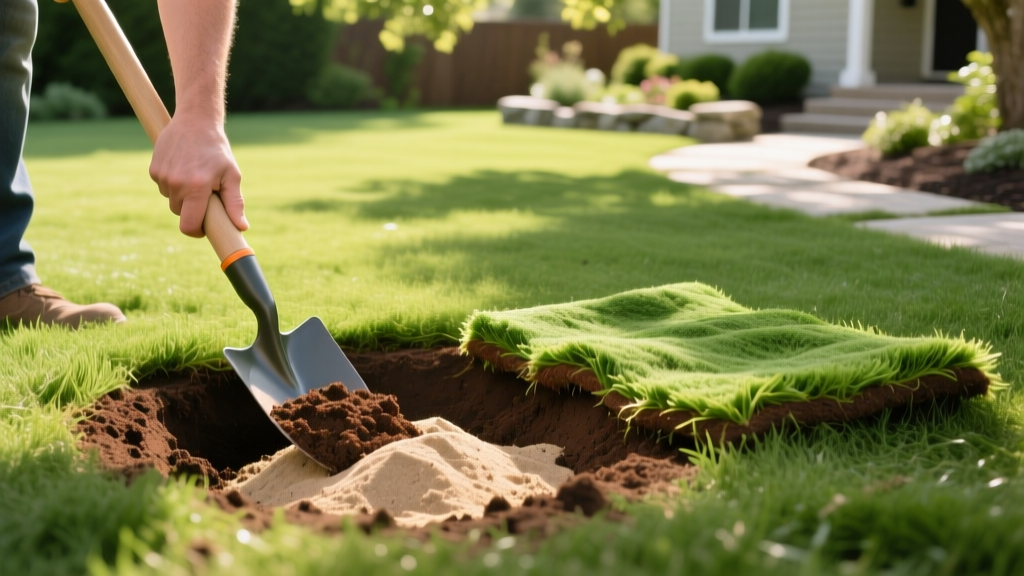
If you choose to pull nutsedge by hand, timing is everything. You must pull the plant when it is very young—ideally before it has developed five or six leaves. At this early stage, the plant has not yet begun forming new tubers or branching rhizomes. Use a narrow weeding tool or a hand trowel to dig at least 8 to 10 inches deep, ensuring you extract the entire root system and the mother tuber. Never use a rotary tiller on an area infested with nutsedge, as this will chop up the rhizomes and spread the tubers throughout your garden beds.
3. Mulching and Solarization
Standard woven landscape fabrics and thin black plastic weed barriers are virtually useless against nutsedge. The sharp, pointed shoots of the sedge will easily pierce right through these materials. To smother nutsedge in unplanted landscape beds, use a thick layer of overlapping corrugated cardboard, topped with at least 4 to 6 inches of heavy arborist wood chips. For severe infestations in empty beds during the peak of summer, soil solarization using clear, UV-resistant polyethylene plastic for 4 to 6 weeks can cook the tubers in the top few inches of soil.
Chemical Control Options for Landscape Beds
When cultural and mechanical methods are not enough, targeted herbicides are required. It is crucial to understand that standard broadleaf weed killers (like 2,4-D or dicamba) and standard grassy weed preventers will have absolutely no effect on nutsedge. You must use products specifically formulated for sedges.
Pre-emergent Herbicides
In lawns and established landscape beds, pre-emergent herbicides containing the active ingredient dimethenamid-P (such as Tower) or metolachlor can provide partial suppression of nutsedge emergence in the spring. However, pre-emergents will not kill existing tubers, making them only one piece of the puzzle.
Post-emergent Herbicides
For active outbreaks, systemic post-emergent herbicides are your best defense. The University of Minnesota Extension recommends products containing halosulfuron-methyl (commonly sold as SedgeHammer) or sulfentrazone (sold as Dismiss or Certainty). These chemicals are absorbed through the foliage and translocated down into the rhizomes and tubers, effectively destroying the plant's reproductive network.
- Application Timing: Apply post-emergent herbicides in early summer when the nutsedge is actively growing but before it has produced mature seed heads and new tubers (usually late May to early June).
- Landscape Bed Safety: Halosulfuron-methyl is generally safe to use as a directed spray around many established ornamental trees and shrubs, but you must avoid spraying the foliage of desirable plants. Always use a physical spray shield when treating weeds in tight landscape beds.
- Follow-up Treatments: Because tubers can be deep and dormant, a single application is rarely enough. Plan for a second application 4 to 6 weeks after the initial treatment to catch any secondary flushes of growth.
Frequently Asked Questions
Will household vinegar kill nutsedge?
No. While horticultural vinegar (20% to 30% acetic acid) can burn off the top growth of the plant, it is strictly a contact herbicide. It will not penetrate the soil or translocate to the underground tubers. The nutsedge will simply regrow from the roots within a matter of days, making vinegar an ineffective and temporary solution.
Is nutsedge a sign of poor soil health?
Nutsedge is primarily a bioindicator of excess moisture and soil compaction rather than poor nutrient levels. While it can grow in fertile soil, its presence in massive colonies almost always indicates that the area is overwatered, poorly graded, or suffering from a lack of soil aeration. Fixing the water management issue is the most effective long-term deterrent.
Conclusion
Eradicating nutsedge from your landscape is a test of patience and precision. By correctly identifying the weed, abandoning ineffective pulling and tilling methods, improving your soil's drainage, and utilizing sedge-specific systemic herbicides, you can break the reproductive cycle of the tubers. Consistent monitoring and early intervention each spring will eventually exhaust the tuber bank in your soil, returning your landscape beds and lawn to a pristine, weed-free state.