Tree Care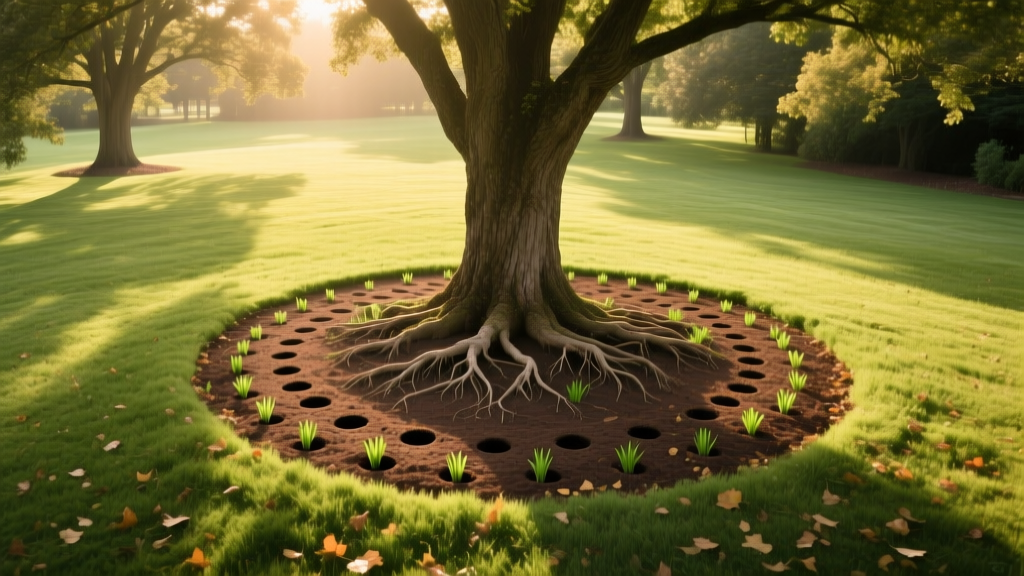
Aerating and Overseeding Lawns Around Mature Trees Safely
Sarah ChenPublished
The Intersection of Lawn Care and Tree Health
When homeowners think of lawn aeration and overseeding, they rarely consider the profound impact these processes have on the mature trees anchoring their landscape. Standard lawn care practices are designed for open, sun-drenched expanses of turfgrass. However, the environment beneath a mature tree canopy is an entirely different ecosystem. Here, turfgrass and tree roots engage in a fierce underground competition for water, oxygen, and essential nutrients. Applying standard aeration and overseeding techniques in the tree's drip line without understanding tree biology can lead to severe root damage, increased susceptibility to pests, and long-term decline of the tree. To maintain a lush lawn while preserving tree health, a specialized approach to aeration and overseeding is required.
Understanding the Critical Root Zone (CRZ)
The Critical Root Zone (CRZ) is the area of soil that contains the majority of a tree's fine, water-absorbing roots. Contrary to popular belief, a tree's root system does not mirror its canopy deep underground. Instead, roughly 80% to 90% of a tree's fine feeder roots are located in the top 6 to 12 inches of the soil profile. This is the exact same soil horizon where turfgrass roots establish themselves. Because both grass and tree roots occupy the same shallow layer, any mechanical intervention in the soil directly affects both organisms. The CRZ typically extends outward to the tree's drip line—the outer edge of the tree's canopy where rainwater naturally drips from the leaves. Protecting this zone during lawn renovations is paramount for sustained tree health.
Assessing Soil Compaction Under Trees
Soil compaction is one of the most common and insidious threats to urban and suburban trees. Foot traffic, heavy mowing equipment, and natural settling compress the soil particles, reducing the pore space necessary for oxygen and water infiltration. According to the Morton Arboretum's tree and plant advice resources, soil compaction in the root zone restricts gas exchange, essentially suffocating the fine feeder roots and leading to canopy dieback over time. While aeration is the logical solution to compaction, the method you choose beneath a tree canopy dictates whether you heal the soil or harm the tree.
The Dangers of Mechanical Core Aeration Near Trees
Standard mechanical core aeration involves pulling 2-to-3-inch plugs of soil from the ground using hollow metal tines. In an open lawn, this is an excellent practice. Under a mature tree, however, it is a high-risk activity. Because the critical structural and feeder roots of a tree are concentrated in those top few inches, mechanical tines will inevitably sever them. While cutting a tiny, hair-like feeder root is generally harmless, severing a structural root thicker than a pencil creates an open wound. These wounds serve as direct entry points for soil-borne decay fungi and vascular diseases, which can slowly hollow out the tree's root system over several years, eventually creating a hazardous, unstable tree.
Safe Alternatives: Liquid Aeration and Air Excavation
To alleviate compaction without wielding destructive metal tines, arborists and advanced lawn care professionals rely on two primary alternatives:
- Liquid Aeration: This technique involves applying a liquid solution containing humic acids, fulvic acids, and natural surfactants like yucca extract. These compounds work at a molecular level to break the ionic bonds between compacted clay particles, creating microscopic fissures that allow water and oxygen to penetrate the soil profile. Liquid aeration is entirely root-safe and can be applied directly over the CRZ without any risk of physical severing.
- Air Excavation (Air Spade): For severely compacted soils where liquid aeration is insufficient, professional arborists use an Air Spade. This pneumatic tool uses highly compressed air to safely fracture and move soil without damaging flexible tree roots. The exposed roots can then be treated with compost and mycorrhizal fungi before being gently reburied, a process known as radial trenching or root zone aeration.
Selecting Shade-Tolerant Grass for Overseeding
Overseeding under a tree canopy requires selecting grasses that can survive with limited photosynthesis and endure the aggressive resource competition from the tree above. Standard Kentucky Bluegrass or Perennial Ryegrass will quickly thin out and die in deep shade. Instead, you must utilize specialized shade-tolerant blends.
| Grass Type | Shade Tolerance | Seeding Rate (per 1000 sq ft) | Best Use Case in Tree Zones |
|---|---|---|---|
| Creeping Red Fescue | Excellent | 5 - 6 lbs | Dry, acidic shade under oaks and pines |
| Rough Bluegrass (Poa trivialis) | Very Good | 4 - 5 lbs | Damp, heavy shade areas with poor drainage |
| Hard Fescue | Good | 5 - 6 lbs | Low maintenance, poor soils, light foot traffic |
Step-by-Step Overseeding in the Drip Line
To successfully establish shade-tolerant grass beneath a mature tree, follow this specialized protocol:
- Crown Thinning: Before seeding, hire a certified arborist to perform a selective crown thinning. By carefully removing specific interior branches, you allow dappled sunlight to reach the soil surface, which is mandatory for grass seed germination.
- Gentle Raking: Use a flexible leaf rake to gently remove thatch and debris from the soil surface. Do not use aggressive power dethatchers, as these will rip through the shallow tree feeder roots.
- Apply Liquid Aeration: Treat the area with a high-quality liquid aerator to soften the soil and improve seed-to-soil contact.
- Sow the Seed: Broadcast your shade-tolerant fescue blend at the recommended rate.
- Micro-Topdressing: Apply a very thin layer (no more than 1/8 to 1/4 inch) of screened compost. Applying thick layers of topsoil will smother the tree's shallow roots, cutting off their oxygen supply and causing rapid decline.
The Watering Dilemma: Grass vs. Trees
One of the most challenging aspects of overseeding under trees is the conflicting watering requirements of the two plants. Newly sown grass seed requires frequent, shallow watering—typically two to three light sprinklings per day—to keep the top inch of soil consistently moist during the 14 to 21-day germination window. Mature trees, conversely, thrive on deep, infrequent watering that encourages roots to grow downward. The frequent shallow watering required for grass seed can lead to shallow, weak tree roots over time. To mitigate this, keep the germination watering cycles as brief as possible, and once the grass reaches two inches in height, immediately transition to a deep, infrequent watering schedule that satisfies the tree's needs while sustaining the established fescue.
When to Stop Overseeding and Start Mulching
Despite your best efforts, some tree environments are simply too hostile for turfgrass. If a tree casts deep, dense shade, or if its surface roots have heaved above the soil line, fighting nature is a losing battle. The University of Minnesota Extension strongly recommends replacing struggling grass in the tree's drip line with organic mulch. A 2-to-3-inch layer of shredded hardwood mulch eliminates the competition for water, prevents soil compaction from mowers, and mimics the natural forest floor environment that trees evolved to thrive in. When applying mulch, always keep it a few inches away from the trunk to prevent bark rot and rodent damage.
Conclusion
Balancing a pristine lawn with the health of mature shade trees requires a departure from standard landscaping practices. By abandoning mechanical core aeration in favor of liquid alternatives, selecting the correct fine fescue seed blends, and respecting the biological limits of the Critical Root Zone, you can cultivate a beautiful landscape where both the turf and the trees thrive. For more comprehensive guidance on maintaining tree vitality in residential landscapes, consult the Arbor Day Foundation's tree health guidelines to ensure your canopy remains robust for generations to come.
