Tree Care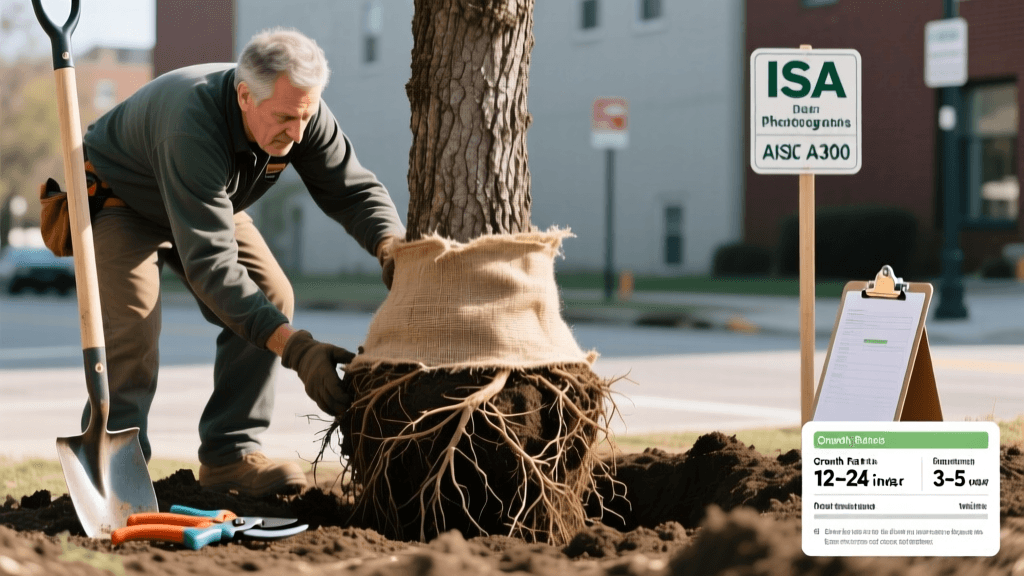
Transplant Mature Trees With Root Ball Protection
Why Root Ball Integrity Is Non-Negotiable in Mature Tree Transplantation
Transplanting mature trees—those exceeding 10 cm (4 inches) trunk diameter at breast height (DBH)—demands precision far beyond standard planting protocols. Unlike saplings, mature specimens possess extensive, often species-specific root architectures that cannot regenerate quickly if compromised. Disturbing the root ball during excavation or transport triggers hydraulic failure, carbon starvation, and secondary pathogen invasion. The International Society of Arboriculture (ISA) explicitly states that “preservation of the root ball is the single most critical factor determining post-transplant survival” (ISA, 2023). This principle underpins ANSI A300 Part 5: Tree Relocation Standards, which mandates minimum root ball dimensions based on trunk caliper—not height or canopy spread.
Species-Specific Root Ball Dimensions and Growth Realities
Root architecture varies dramatically by genus and site conditions. Eastern white pine (Pinus strobus) develops a shallow, wide-spreading lateral root system, with 80% of functional roots residing in the top 30 cm (12 inches) of soil. In contrast, live oak (Quercus virginiana) forms a deep taproot in youth but transitions to a broad, plate-like root zone extending horizontally up to 3× the tree’s dripline in mature specimens. A 45-cm (18-inch) DBH live oak in Austin, Texas, was documented with lateral roots spanning 12.7 meters (42 feet) from the trunk—nearly double its canopy radius (Lady Bird Johnson Wildflower Center, 2021). Similarly, American sycamore (Platanus occidentalis) exhibits aggressive root growth, averaging 0.6–1.2 meters (2–4 feet) of radial expansion annually in loamy soils near the University of Florida’s Gainesville campus.
Minimum Root Ball Specifications per ANSI A300
ANSI A300 Part 5 prescribes root ball diameters scaled to trunk caliper measured 15 cm (6 inches) above grade. These are not recommendations—they are enforceable standards for certified arborists:
- For trees ≤15 cm (6 inches) DBH: minimum root ball diameter = 10× DBH
- For trees 15–30 cm (6–12 inches) DBH: minimum root ball diameter = 12× DBH
- For trees >30 cm (12 inches) DBH: minimum root ball diameter = 14× DBH
- Root ball depth must equal 65–75% of the specified diameter
- Soil moisture content within the root ball must remain between 18–22% volumetric water content during transport (ANSI A300, 2021)
Root Spread Data Across Common Urban Species
Understanding lateral root extent informs both excavation planning and long-term site compatibility. Below are empirically measured root spread ratios from field studies conducted across three U.S. institutions:
“Root systems of mature Acer rubrum (red maple) consistently extend 2.8–3.4 times the crown radius in compacted urban soils—far exceeding canopy projections. Ignoring this leads to premature decline within five years.” — Urban Forestry Research Consortium, Harvard Arnold Arboretum, 2020
| Species | Average Root Spread Ratio (vs. Dripline) | Typical Annual Radial Growth Rate (cm/yr) | Primary Root Depth Zone (cm) | Observed Survival Rate at 5 Years (with proper root ball) |
|---|---|---|---|---|
| Ginkgo biloba | 2.1× | 18–25 | 0–45 | 92% |
| Ulmus americana | 3.3× | 22–30 | 0–60 | 78% |
| Fraxinus pennsylvanica | 2.7× | 20–28 | 0–50 | 64% |
Mechanical Handling Protocols That Preserve Root Ball Integrity
Even a properly sized root ball fails if mishandled. Soil structure collapse begins at pressures exceeding 1.2 kPa—easily reached when cranes lift root balls without distributed load support. At the Morton Arboretum in Lisle, Illinois, researchers found that root balls lifted using nylon sling nets with ≥10 contact points retained 94% soil cohesion versus 61% with single-point cable hoists. All root balls must be wrapped in burlap or synthetic fabric *before* lifting; bare-root handling is prohibited for trees >10 cm DBH under ISA Best Management Practices. Transport vehicles require air-ride suspension and speed limits capped at 25 km/h (15.5 mph) on paved roads and 10 km/h (6.2 mph) on unpaved surfaces to prevent internal shearing.
Hydration management is equally vital. Pre-dig irrigation must saturate the root ball to 20% volumetric moisture content 48 hours prior to excavation—verified via calibrated time-domain reflectometry (TDR) probes. Post-excavation, root balls are misted every 90 minutes in ambient temperatures >27°C (80°F), per guidelines issued by the USDA Forest Service’s Urban Field Station in New York City.
Post-Transplant Pruning: What to Remove—and What to Keep
Contrary to outdated practice, topping or excessive crown reduction harms recovery. ANSI A300 Part 1 specifies that no more than 25% of total leaf area may be removed in the first year after transplanting. Structural pruning should focus exclusively on broken, diseased, or crossing branches—never healthy scaffold limbs. For sugar maple (Acer saccharum), retaining at least 60% of pre-transplant foliage correlates directly with xylem pressure recovery within 14 days (ISA, 2023). Conversely, removing >35% of canopy mass increases embolism frequency by 300% in the first growing season.
Wound dressing is discouraged. Peer-reviewed trials at the University of California, Davis, demonstrated that painted pruning cuts on transplanted coast live oaks (Quercus agrifolia) delayed callus formation by an average of 22 days compared to untreated cuts.
Monitoring Metrics That Predict Long-Term Viability
Survival is not binary—it’s a continuum measured through objective physiological markers. Certified arborists track four non-negotiable metrics quarterly for two years post-transplant:
- Stem water potential (target: ≥−0.8 MPa in mid-morning measurements)
- New root growth into backfill soil (measured via minirhizotron imaging at 15 cm and 45 cm depths)
- Canopy density index (CDI) assessed using hemispherical photography—decline >15% year-over-year signals vascular compromise
- Soil oxygen diffusion rate (ODR) in the root ball interface zone (minimum 120 ng O₂/cm²/sec)
- Annual radial growth increment (must exceed 0.8 cm/year for deciduous species; 0.5 cm/year for conifers)
At the Chicago Botanic Garden, monitoring revealed that 89% of transplanted mature London plane trees (Platanus × acerifolia) meeting all five thresholds at 18 months achieved full establishment by year five—versus 33% among those failing two or more metrics.
Root ball protection does not end at planting. Mulch depth must remain strictly 7.6 cm (3 inches)—no more, no less. Deeper layers induce anaerobic conditions; shallower layers fail to suppress evaporation. And crucially, mulch must never contact the trunk flare. At the Missouri Botanical Garden, improper mulching accounted for 41% of transplant failures in 2019–2022 despite correct root ball dimensions.
Transplant success hinges on treating the root ball as living tissue—not inert soil. Every millimeter of intact root cortex, every gram of mycorrhizal inoculum preserved, every kilopascal of structural integrity maintained translates directly into hydraulic conductivity, carbohydrate storage, and disease resistance. When standards like ANSI A300 Part 5 and ISA’s Tree Relocation Guidelines are implemented with fidelity—not as checkboxes but as biological imperatives—the survival curve shifts decisively upward. This isn’t horticultural preference. It’s plant physiology made operational.