
Landscaping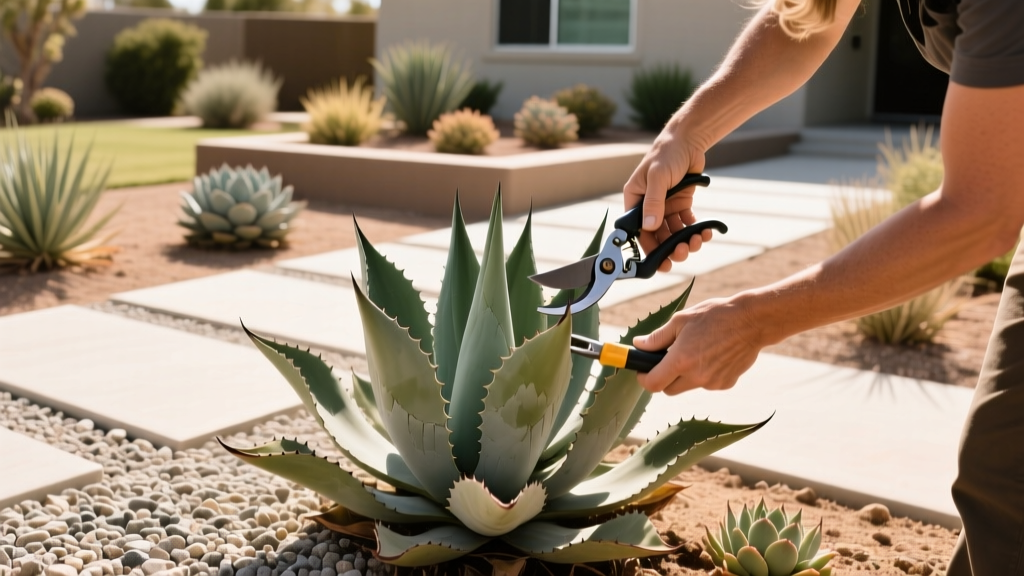
2026 Guide: Pruning Agave & Decomposed Granite Xeriscapes
James MillerPublished
The 2026 Xeriscape Paradigm: Beyond Zero-Maintenance
In 2026, the xeriscape front yard has evolved from a niche drought-response tactic into the premier standard for sustainable landscape design. Driven by municipal water conservation incentives and a desire for striking, architectural curb appeal, the combination of decomposed granite (DG) and agave specimens has become the gold standard for modern homeowners. However, a pervasive myth still lingers: the idea that xeriscapes are "zero-maintenance." While they drastically reduce the need for irrigation and mowing, these landscapes require highly specific, timed interventions to remain pristine.
According to EPA WaterSense, outdoor water use can account for up to 30% of a household's total water consumption, making the shift toward drought-tolerant designs critical. Yet, to keep an agave and DG landscape looking intentional rather than abandoned, homeowners must master the precise pruning methods for succulents and the seasonal surface grooming required for granite pathways. This guide breaks down the exact timing, tools, and techniques needed to maintain your xeriscape front yard this year.
Pruning Methods for Agave: The Art of Subtraction
Unlike traditional shrubs that require shaping and thinning, agaves are monocarpic rosette plants. Their pruning philosophy is strictly one of subtraction: removing only what is dead, diseased, or structurally compromised. Improper pruning can introduce bacterial soft rot or ruin the plant's natural symmetry.
1. Basal Leaf Removal (Skirting)
As an agave matures, the lowest tier of leaves will naturally age, dry out, and die. In a formal front yard xeriscape, leaving a "skirt" of dead foliage can harbor pests and look unkempt.
- Timing: Late winter to early spring (February to March), just before the active growing season begins.
- Tools: Long-handled ratcheting bypass loppers, a sterilized folding pruning saw, and heavy-duty leather gauntlets.
- Method: Grip the dead leaf near its base. Using the loppers, make a clean cut as close to the main trunk as possible without nicking the healthy tissue above it. Critical: Angle your cut slightly downward and away from the center of the rosette. This ensures that any rainwater or irrigation runoff drips away from the plant's core, preventing crown rot.
2. Managing Pups (Offsets)
Species like Agave americana and Agave parryi reproduce vegetatively by sending out underground stolons that produce "pups." In a minimalist DG front yard, unchecked pups can quickly ruin the geometric design intent.
- Timing: Mid-spring (April) or early fall (September) when temperatures are mild, reducing transplant shock if you plan to save them.
- Method: Do not simply pull the pup. Use a sharp, sterilized trenching shovel to sever the stolon connecting the pup to the mother plant. Dig a wide circle around the pup to preserve its root mass, then lift it out. If you do not want the pup, ensure the entire stolon is removed to prevent regrowth.
3. The Bloom Stalk (Quiote) Takedown
When an agave reaches the end of its life cycle, it sends up a massive flower stalk, or quiote, which can reach heights of 20 to 30 feet. Once it blooms, the mother plant will slowly die.
- Timing: Late summer or early fall, after the flowers have faded and the stalk begins to dry, but before it becomes brittle and risks dropping heavy debris on your DG pathways or rooflines.
- Method: Because of the immense weight and height, the stalk must be removed in sections. Use a reciprocating saw or a sharp hand saw to cut the stalk down in 3-foot segments, working from the top down. Do not cut it at the base in one go, as the falling weight will severely damage the remaining rosette and compact your surrounding decomposed granite.
Decomposed Granite: Surface Pruning and Grooming
While decomposed granite is a hardscape material, it behaves dynamically. Over time, foot traffic, wind, and rain cause DG to compact, develop a hardened crust, or become a breeding ground for opportunistic weeds. Maintaining DG requires a form of "surface pruning" and seasonal grooming to keep it permeable and visually uniform.
Scarification and Redistribution
In 2026, eco-friendly organic stabilizers (such as advanced plant-based psyllium binders) are frequently used to lock DG in place without sealing it like concrete. However, the top quarter-inch still requires periodic agitation.
- Timing: Bi-annually (Early Spring and Late Autumn).
- Method: Use a stiff-tined landscape rake or a specialized DG scarifier to break up the top crust. This "surface pruning" removes the compacted layer, restores the loose, natural crunch of the granite, and levels out any divots caused by animal traffic or heavy rains. Rake the material from the edges back toward the center to maintain a uniform 2-to-3-inch depth across the front yard.
Weed Extraction and Soil Microbiome Protection
Weeds in a DG xeriscape are not just an eyesore; their roots disrupt the stabilized base layer.
- Timing: As needed, but crucially in late spring before annual weeds set seed.
- Method: Hand-pull weeds, ensuring you extract the taproot. Avoid using broad-spectrum chemical herbicides on your DG. As noted by experts at the University of Arizona Cooperative Extension, harsh chemicals can degrade the organic stabilizers in your DG and harm the vital desert soil microbiome that supports your agave's root system. Instead, spot-treat with horticultural vinegar or use a targeted flame weeder for stubborn intruders.
Seasonal Timing Matrix for Xeriscape Care
To keep your front yard thriving, align your maintenance tasks with the natural cycles of the desert-adapted plants and the seasonal weather patterns. Use the following 2026 care matrix to schedule your weekends:
| Season | Agave Pruning Focus | DG Maintenance Focus | Estimated Time (per 500 sq ft) |
|---|---|---|---|
| Early Spring | Basal leaf removal (skirting); inspect for agave snout weevil damage. | Scarify top layer; rake to redistribute winter-displaced granite. | 2 - 3 Hours |
| Late Spring | Sever and remove unwanted basal pups; monitor new growth. | Aggressive weed pulling before seed set; check drainage channels. | 1.5 Hours |
| Summer | No pruning. Allow the plant to conserve energy and manage heat stress. | Spot-clean windblown debris; avoid heavy raking which exposes roots to sun. | 30 Minutes |
| Autumn | Takedown dried bloom stalks (quiotes); remove storm-damaged leaves. | Top-dress with fresh DG (1/2 inch) if base is thinning; re-compact. | 3 - 4 Hours |
| Winter | Dormancy period. No pruning to prevent frost damage to open wounds. | Clear fallen leaves from nearby deciduous trees to prevent DG staining. | 1 Hour |
Safety Protocols and Tool Sterilization
Pruning agave in a modern xeriscape requires strict adherence to safety protocols. The sap of many agave species contains calcium oxalate crystals, known as raphides. If the sap contacts your skin, it can cause severe, blistering contact dermatitis that mimics a chemical burn.
2026 PPE Standard: Never prune an agave in shorts or standard gardening gloves. Always wear heavy-duty, puncture-resistant leather gauntlets, Kevlar-lined sleeves, and protective eyewear to guard against the sharp, needle-like terminal spines and the microscopic sap aerosols created during sawing.
Furthermore, tool sterilization is non-negotiable. Bacterial soft rot (Erwinia carotovora) can devastate an agave population. Before moving from one plant to the next, wipe your loppers and saw blades with a 70% isopropyl alcohol solution or a 10% bleach solution. Allow the tools to air dry completely before making the next cut to ensure the sterilizing agent does not chemically burn the plant's fresh wound.
Conclusion
A xeriscape front yard featuring decomposed granite and agave is a masterclass in sustainable, water-wise landscaping. As highlighted by campaigns like Water Use It Wisely, transitioning to drought-tolerant designs is one of the most impactful choices a homeowner can make for local water conservation. However, the beauty of this design relies entirely on the discipline of its upkeep. By adhering to the precise pruning methods for your agave specimens and committing to the seasonal surface grooming of your decomposed granite, you will ensure your landscape remains a striking, architectural triumph in 2026 and for decades to come.

