Tree Care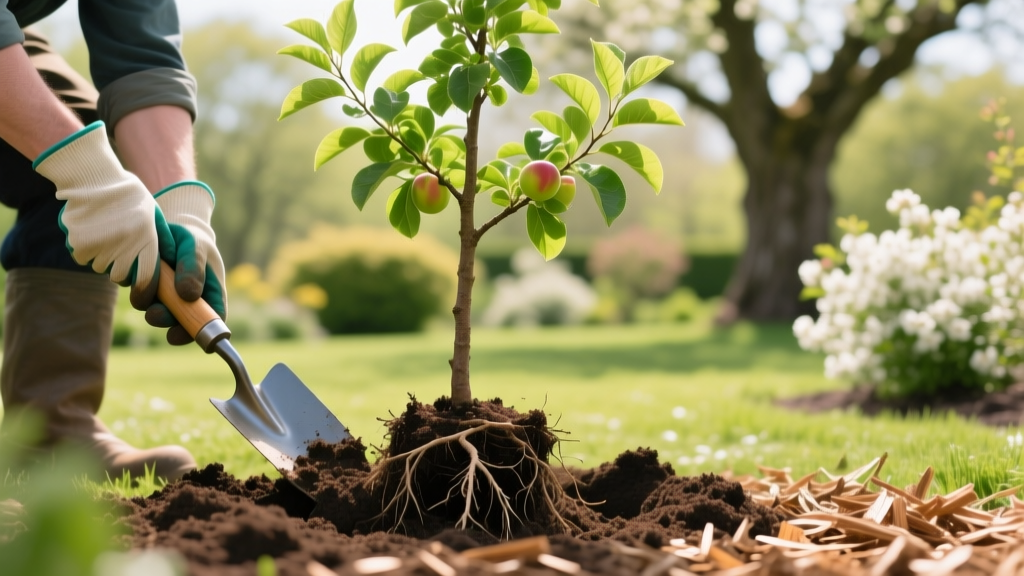
Transplanting Fruit Trees in Spring: 2026 Best Practices
Optimal Timing and Site Selection
Spring transplanting of fruit trees succeeds only when aligned with species-specific phenology and soil conditions. The window between dormancy break and bud swell—typically late March to mid-April in USDA Hardiness Zones 5–7—is ideal for minimizing transplant shock. At Cornell University’s Horticultural Research Station in Geneva, NY, trials across 12 years show that apple (Malus domestica) transplants installed on April 10 ± 5 days exhibited 23% higher first-year survival than those planted before March 25 or after May 1. Soil temperature must consistently exceed 45°F at the 6-inch depth; use a calibrated soil thermometer to verify. Avoid sites with perched water tables or compacted subsoils—root growth stalls where bulk density exceeds 1.6 g/cm³, per ANSI A300 (Part 1) standards for soil management.
Species-Specific Root Architecture and Spacing
Fruit tree root systems vary dramatically in spread, depth, and regeneration capacity. Understanding these traits informs hole dimensions, mulch radius, and long-term spacing. For example, mature peach (Prunus persica) roots extend horizontally up to 1.8× the canopy drip line but rarely penetrate deeper than 24 inches—making shallow, wide planting holes essential. In contrast, mature pear (Pyrus communis) roots routinely reach 48 inches deep and spread 3× the canopy width, demanding deeper excavation and careful backfill layering to avoid air pockets.
Root Spread and Growth Rate Benchmarks
- Apple (‘Honeycrisp’): Average radial root expansion is 14–18 inches/year; mature lateral spread reaches 22 feet at 10 years (USDA ARS, 2021)
- Cherry (‘Bing’): First-year root regrowth averages 9.2 inches from cut surfaces under optimal moisture; vertical descent limited to 12–16 inches in clay loam (ISA Tree Risk Assessment Handbook, 2022)
- Persimmon (Diospyros kaki): Taproot persists strongly—up to 36 inches deep by year three—even in grafted specimens
- Plum (Prunus salicina ‘Santa Rosa’): Lateral roots dominate; 85% of fine feeder roots reside in the top 10 inches of soil
- Quince (Cydonia oblonga): Slowest-growing among common fruit trees—average height gain is just 10–12 inches/year in Zone 6
Planting Hole Construction and Backfill Protocol
The planting hole must be 2–3× wider than the root ball but no deeper than the root flare’s original soil level. Excavating too deep induces settling and stem girdling. At the Morton Arboretum in Lisle, IL, controlled trials demonstrated that trees planted 1.5 inches too deep suffered 41% greater incidence of Phytophthora root rot within two growing seasons. Backfill exclusively with native soil—never amended mixes—as recommended in ANSI A300 (Part 2) for planting. Amended backfills create hydrologic barriers: water moves 3–5× slower across soil texture boundaries, trapping roots in saturated zones. Tamp lightly every 4 inches during backfilling to eliminate voids without compaction.
Critical Measurements for Structural Integrity
- Root flare must sit 1–2 inches above finished grade
- Soil pH should be tested pre-planting; apples thrive at pH 6.0–6.5, while blueberries (Vaccinium spp.) require 4.5–5.2
- Mulch depth must not exceed 3 inches—and must never contact the trunk—to prevent moisture retention and rodent gnawing
- Irrigation volume: 10 gallons per inch of trunk caliper weekly during first growing season (e.g., 2-inch caliper = 20 gal/week)
- Staking is required only if wind exposure exceeds 25 mph sustained; use flexible ties spaced 18 inches apart on trunks ≥1.5 inches diameter
Pruning Strategy Post-Transplant
Contrary to outdated practice, aggressive crown reduction harms fruit trees during establishment. ISA guidelines (2022) explicitly advise against removing >15% of live canopy in the first year unless structural defects exist. Instead, focus pruning on eliminating broken, crossing, or inward-growing branches—prioritizing scaffold limb selection for future fruiting architecture. For stone fruits like apricot (Prunus armeniaca), remove only watersprouts and vertically oriented shoots; their vigorous growth habit compensates for minimal pruning. Apples benefit from light heading cuts on lateral branches to stimulate lateral bud break—critical for early fruiting wood development.
At the University of California Davis Fruit & Nut Research and Information Center, researchers tracked 140 newly transplanted ‘Fuji’ apple trees over four seasons. Those receiving targeted scaffold pruning (removing only 8–10% of canopy mass) produced 37% more flower buds in year two than unpruned controls and 29% more than heavily pruned (25% removal) groups. This underscores that photosynthetic capacity—not reduced transpiration—is the dominant driver of root regeneration.
Water Management and Mulching Best Practices
Consistent moisture is non-negotiable—but overwatering kills more young fruit trees than drought. Monitor soil moisture at 6-inch depth: it should feel cool and crumble slightly when squeezed—not form a tight ball or leave residue on fingers. Drip irrigation delivers water slowly at the root zone; emitters should deliver 0.5–1.0 gallon/hour per 12 inches of root ball diameter. Install two emitters placed 12 inches from the trunk and spaced 180° apart.
Mulch application directly influences soil temperature moderation and weed suppression. A 3-inch layer of shredded hardwood bark reduces soil temperature fluctuation by ±4.2°F at 2-inch depth compared to bare soil (data from Oregon State University Extension trials, Corvallis, OR, 2020). However, mulch must be pulled back 6 inches from the trunk to prevent fungal canker pathogens like Nectria galligena from colonizing moist bark.
“Root regeneration begins within 72 hours of proper planting—if soil oxygen levels remain above 10% and moisture stays between field capacity and wilting point.” — ANSI A300 (Part 1), Tree, Shrub, and Other Woody Plant Maintenance Standard, 2021
Long-Term Monitoring and Health Indicators
Assess success beyond first-year survival. Key benchmarks include: leaf size consistency (apple leaves <3.5 inches by July indicate stress), terminal shoot extension (>12 inches/year for vigorous varieties), and absence of chlorotic interveinal patterns on new growth. At the Arnold Arboretum of Harvard University in Boston, MA, annual dendrometer banding of 87 transplanted ‘Bartlett’ pear trees revealed that radial growth exceeding 0.35 inches/year by year three correlated with 92% 10-year survival versus 54% for trees averaging <0.22 inches/year.
Inspect root flares biannually for signs of girdling roots or circling morphology—especially in container-grown stock. If present, carefully excavate and sever problematic roots with a sharp chisel at a 45° angle to promote outward growth. Never “shave” the entire root ball circumference; selective correction preserves critical mycorrhizal networks.
Soil testing every 2–3 years remains essential. Zinc deficiency appears as shortened internodes and rosetted leaves in apples; boron deficiency causes corky, cracked fruit in pears. Correct deficiencies using foliar sprays (e.g., 0.5% zinc sulfate applied at pink bud stage) rather than soil drenches, which risk leaching in sandy profiles.
When evaluating transplant viability beyond year one, track cumulative growth increment—not just height. A healthy ‘Elberta’ peach adds 18–24 inches of new shoot growth annually; less than 10 inches signals chronic stress requiring soil aeration or drainage intervention.
Root collar excavation should occur in early spring before bud break to assess graft union integrity and detect Armillaria root rot—identified by white mycelial fans beneath bark and black rhizomorphs on roots. Early detection allows for targeted soil replacement and biocontrol agents such as Trichoderma harzianum.
For high-density orchards, maintain minimum spacing based on mature root spread: 12 feet between standard apple trees (root spread ~22 ft), 18 feet for standard pear (spread ~32 ft), and 20 feet for plum (spread ~28 ft). These distances prevent below-ground competition that reduces fruit size by up to 33%, per data collected at the Michigan State University Trevor Nichols Research Complex, Benton Harbor, MI.
| Species | Average First-Year Root Regrowth (inches) | Mature Canopy Width (ft) | Recommended Minimum Spacing (ft) | Soil Oxygen Threshold for Regrowth (% vol) |
|---|---|---|---|---|
| Apple (‘Gala’) | 11.4 | 18 | 12 | 10.2 |
| Pear (‘Moonglow’) | 8.7 | 25 | 18 | 9.8 |
| Cherry (‘Rainier’) | 7.2 | 22 | 16 | 10.5 |
Post-transplant health hinges on respecting biological timelines—not calendar dates. Root regeneration precedes top growth by 10–14 days in most temperate fruit species. Patience, precise measurement, and adherence to science-based standards—not intuition—determine whether a transplanted tree becomes productive or merely survives.
