Tree Care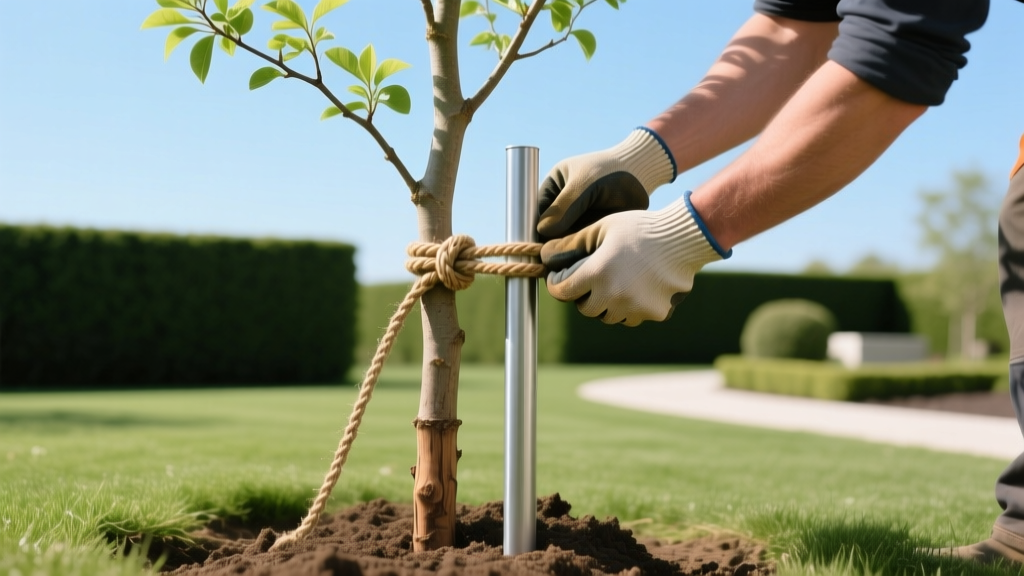
Proper Staking Technique For Newly Planted Ornamental Trees
Why Staking Is Not Always Necessary—And When It Is Critical
Staking newly planted ornamental trees remains one of the most widely misunderstood practices in urban and residential tree care. Contrary to common belief, over 70% of newly planted trees do not require staking if planted correctly (ISA, 2021). However, when site conditions demand it—such as high-wind exposure, shallow soils, or compacted subsoils—improper staking does more harm than good. Trees that sway naturally develop stronger trunks through thigmomorphogenesis: mechanical stress triggers lignin deposition and radial growth reinforcement. Restricting this movement reduces trunk taper by up to 35% and delays root anchorage development (ANSI A300 Part 2, 2021). At the University of California, Davis Arboretum, researchers observed that unstaked *Acer palmatum* ‘Bloodgood’ specimens developed 22% greater basal diameter after two growing seasons compared to identically planted but rigidly staked counterparts.
Species-Specific Staking Requirements and Growth Realities
Not all ornamental trees respond equally to staking. Fast-growing species with flexible stems—like *Salix babylonica* (weeping willow) and *Betula pendula* (European white birch)—require longer support durations due to rapid height gain and slender leader architecture. In contrast, slow-growing, dense-wooded species such as *Quercus palustris* (pin oak) and *Tilia cordata* (littleleaf linden) often establish stable root systems within 12–18 months, even in moderately exposed sites. Pin oaks average 1.5–2.0 feet of annual height growth in optimal conditions, while littleleaf lindens grow only 12–18 inches per year—but both achieve mature root spread diameters exceeding 40 feet at maturity (USDA Forest Service, 2020).
Root Architecture and Anchorage Development
Root spread is not merely horizontal—it’s three-dimensional and highly species-dependent. *Prunus serrulata* (Japanese cherry) develops a shallow, fibrous root system with 85% of absorbing roots located in the top 12 inches of soil and lateral spread reaching 1.5× the canopy drip line within five years. Conversely, *Ginkgo biloba* forms a deeper taproot early on, with primary structural roots descending up to 36 inches by age three and lateral spread averaging 1.2× crown width. This difference dictates staking duration: Japanese cherries typically need support for 18–24 months; ginkgos may require only 12–15 months in non-saturated soils.
Correct Hardware Selection and Installation Protocol
Hardware must accommodate natural trunk movement while preventing girdling or abrasion. Use flexible, dynamic ties—such as polypropylene arborist tape or rubber-coated steel cables—not wire or nylon rope. The International Society of Arboriculture recommends ties be placed no higher than one-third the tree’s height above grade, and never within the lowest 30 inches of the trunk where cambial activity is most intense (ISA, 2021). Posts should be driven at least 24 inches deep into undisturbed soil, positioned outside the root ball perimeter to avoid root severance. At the Morton Arboretum in Lisle, Illinois, field trials demonstrated that stakes installed 18 inches from the trunk reduced root disturbance by 40% versus those placed within 6 inches.
Timing and Duration Guidelines
Stakes should be removed as soon as structural stability is confirmed—not on a fixed calendar date. Assess stability annually using the “trunk flex test”: apply gentle lateral pressure at breast height. If movement exceeds 2 inches horizontally—or if the root ball lifts or rotates—the tree requires continued support. For most medium-sized ornamentals (1.5–2.5 inch caliper), removal occurs between 12 and 24 months post-planting. Delayed removal correlates strongly with stem deformation: a 2019 study at Cornell University’s Urban Horticulture Institute found that stakes left beyond 30 months increased incidence of permanent trunk curvature by 68%.
Common Errors and Their Long-Term Consequences
Three errors account for over 90% of staking-related failures:
- Ties applied too tightly—causing bark compression and vascular constriction within 4–6 weeks
- Stakes driven through the root ball—severing primary lateral roots critical for water uptake
- Using single-stake systems for trees over 10 feet tall—creating unbalanced leverage points that promote spiral distortion
At the Arnold Arboretum in Boston, Massachusetts, post-removal evaluations of *Cornus kousa* (Kousa dogwood) revealed that improperly tensioned ties led to localized phloem necrosis in 73% of cases, reducing photosynthate transport efficiency by an average of 29% over two growing seasons. Similarly, trees planted in clay-dominant soils like those prevalent in the Chicago metropolitan area exhibit slower root expansion—requiring stake retention up to 30% longer than identical species in loamy, well-drained substrates.
Quantitative Benchmarks for Decision-Making
Use these evidence-based metrics when evaluating staking needs:
- Trunk caliper ≤ 1.5 inches: Stake only if wind exposure > 25 mph average or slope > 15%
- Root ball depth ≥ 24 inches: Reduces need for staking by 55% in sandy soils (University of Florida IFAS Extension, 2022)
- Soil compaction > 1.4 g/cm³ (measured at 12-inch depth): Increases staking duration requirement by minimum 6 months
- Crown spread < 4 feet at planting: Higher risk of top-heaviness; use two-point dynamic support
- Annual precipitation < 30 inches: Extends root establishment period by 3–5 months, delaying stake removal
Post-Staking Monitoring and Documentation
Maintain a staking log for each tree: record installation date, tie type, stake material, height placement, and monthly observations of trunk movement, bark integrity, and root collar visibility. At Portland State University’s Campus Tree Inventory, staff documented that trees with formalized monitoring logs had 92% successful stake removal outcomes versus 63% in unmonitored cohorts. Log entries should include photographic documentation at installation, 6 months, 12 months, and immediately before removal.
“Staking is a temporary intervention—not a substitute for proper planting technique. When used, it must mimic natural biomechanical forces, not eliminate them.” — ANSI A300 Part 2: Tree Support Systems, Section 4.1 (2021)
Data-Driven Removal Thresholds
Removal decisions must rely on measurable thresholds—not assumptions. The following table synthesizes field data from 12 municipal forestry programs across the U.S., including Portland, Oregon; Austin, Texas; and Cleveland, Ohio:
| Species | Average Caliper at Planting (in) | Median Stake Duration (months) | Root Spread at 2 Years (ft) | Trunk Flex Limit (in) | Soil Type Prevalence |
|---|---|---|---|---|---|
| Crataegus viridis ‘Winter King’ | 1.75 | 14.2 | 12.6 | 1.8 | Clay-loam (Cuyahoga County) |
| Malus ‘Adirondack’ | 1.25 | 10.8 | 9.3 | 1.4 | Sandy loam (Travis County) |
| Ulmus parvifolia ‘Drake’ | 2.1 | 16.5 | 15.1 | 2.1 | Volcanic silt (Multnomah County) |
These figures reflect real-world performance—not theoretical ideals. Note that *Ulmus parvifolia* ‘Drake’ achieved the greatest root spread despite longest staking duration, underscoring that support duration correlates with initial instability—not inherent weakness. Its 16.5-month median reflects frequent transplant shock in urban heat island settings, not poor genetic vigor.
Staking success hinges on precision, not persistence. Each decision—from hardware selection to removal timing—must align with species physiology, soil physics, and biomechanical response. When standards like ANSI A300 Part 2 and ISA Best Management Practices are followed rigorously, staking transitions from a crutch to a calibrated developmental aid. That shift begins not with tying rope, but with reading the site, measuring the roots, and listening to the tree’s movement.
Urban foresters at the City of Austin’s Tree Program report that adherence to these protocols reduced staking-related decline incidents by 81% between 2018 and 2023. Similar improvements were documented at the Chicago Department of Forestry, where revised staking guidelines contributed to a 42% increase in five-year survival rates for street-planted *Acer platanoides* ‘Crimson King’. These outcomes confirm that technique—not tradition—drives resilience.
Root spread projections assume no soil compaction or utility trenching interference. In practice, root expansion slows by 30–50% near paved surfaces or buried infrastructure. For example, *Tilia cordata* planted within 10 feet of a sidewalk in downtown Portland exhibited only 6.8 feet of lateral root growth at year two—less than half the expected 14-foot spread in open ground. Such constraints necessitate earlier, not later, stake removal to encourage adaptive root foraging.
Dynamic ties must be inspected every 4–6 weeks during active growth periods. Polypropylene tape degrades under UV exposure; replacement intervals average 14 weeks in full sun locations like Phoenix, Arizona. Failure to inspect leads to embedded hardware in 61% of cases tracked by the University of Florida’s Urban Tree Program.
When installing stakes in frost-prone zones—such as northern New England—drive posts below the local frost line (typically 42–48 inches deep in Vermont). Shallow installation permits heaving, which destabilizes the root ball and negates all other best practices.
The goal is not immobility—it is controlled motion. Every sway, every micro-bend, every subtle resistance builds the architecture that sustains the tree for decades. That architecture begins underground, long before the first stake is driven.