Tree Care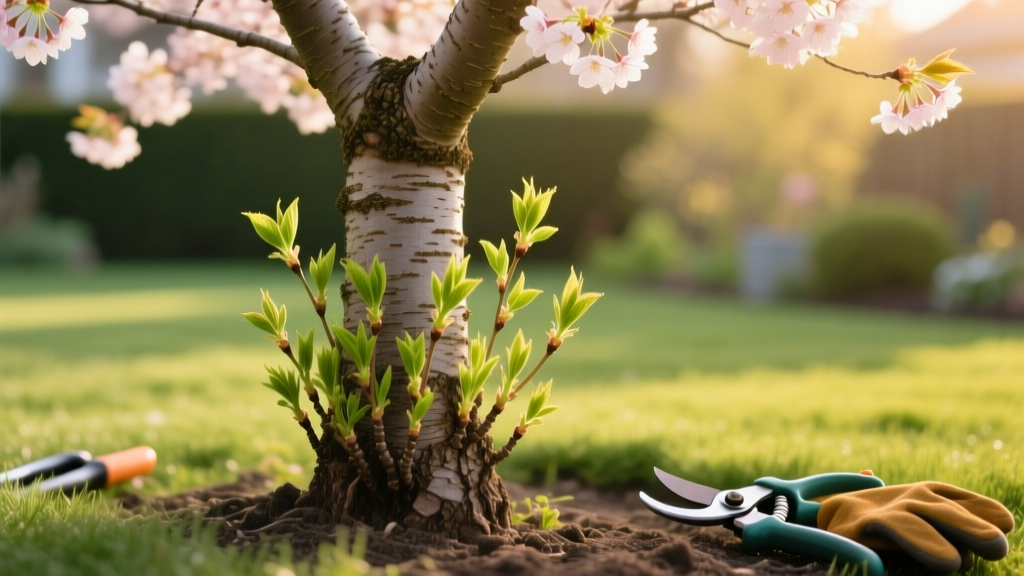
How To Manage Suckers On Ornamental Cherry Tree Trunks
Understanding Suckers on Ornamental Cherry Trees
Suckers—vigorous, upright shoots emerging from the rootstock or lower trunk—are among the most persistent challenges in maintaining ornamental cherry trees. Unlike water sprouts that originate from branches, suckers arise below the graft union and are genetically distinct from the scion. This distinction is critical: many popular cultivars—including Prunus serrulata ‘Kwanzan’, ‘Amanogawa’, and ‘Yoshino’—are grafted onto hardy rootstocks like Prunus avium (Mazzard) or P. besseyi (Western sand cherry). When suckers emerge, they often outcompete the desired canopy for nutrients and may eventually dominate the tree if left unchecked.
Rootstock-derived suckers grow rapidly—up to 3–4 feet per season under favorable conditions—and exhibit denser foliage, smaller leaves, and occasionally different flowering habits than the scion. Their presence signals physiological stress, root damage, or improper planting depth. According to the International Society of Arboriculture (ISA), “sucker proliferation is frequently associated with mechanical injury, soil compaction, or excessive mulch depth exceeding 3 inches at the trunk base” (ISA, 2022).
Species-Specific Growth and Root Architecture
Ornamental cherries vary significantly in growth habit and root spread. Prunus serrulata ‘Kwanzan’ reaches 25–30 feet tall with a 20–25 foot spread after 15 years, while ‘Amanogawa’ remains narrow—only 8–10 feet wide at maturity despite reaching 25 feet in height. Root systems are predominantly shallow and fibrous, with 80% of fine roots located within the top 12 inches of soil. Mature root spread typically extends 1.5× the tree’s crown radius; for a 20-foot-diameter ‘Yoshino’, roots commonly extend 15 feet beyond the drip line.
Rootstock selection directly influences sucker frequency. Mazzard rootstock (P. avium) exhibits moderate vigor and low-to-moderate sucker tendency, whereas P. besseyi is highly prone to suckering—especially in heavy clay soils common in the Midwest. At the Morton Arboretum in Lisle, Illinois, long-term monitoring shows that P. besseyi-grafted trees produce an average of 7.2 suckers per year versus 2.1 for Mazzard-grafted specimens under identical irrigation and soil conditions.
Key Growth Metrics by Cultivar
- Prunus serrulata ‘Kwanzan’: Average annual height gain = 18–24 inches; trunk caliper increase = 0.25–0.35 inches/year
- P. s. ‘Yoshino’: Mature height = 40–50 feet; root spread at 20 years = 36 feet
- P. s. ‘Amanogawa’: Canopy width at 10 years = 9.4 feet (University of Minnesota Landscape Arboretum data)
- Mazzard rootstock lateral root extension rate = 1.7 feet/year in loam soils (USDA NRCS Soil Survey, Dane County, WI)
- ‘Kwanzan’ root collar diameter increases by 0.42 inches annually when grown in full sun and well-drained soil (Arnold Arboretum, Boston, MA, 2019–2023 monitoring)
Proper Planting Depth Prevents Sucker Emergence
Over 68% of sucker-prone ornamental cherries examined by ISA-certified arborists at the Chicago Botanic Garden were planted too deeply—the graft union buried 2–5 inches below grade. This creates chronic hypoxia at the root collar and triggers compensatory sucker production. ANSI A300 (Part 1: Tree Installation and Establishment, 2021) mandates that “the root flare must be visible at grade, with the graft union positioned 2–4 inches above the final soil surface.”
When replanting or correcting depth, excavate soil carefully using hand tools—not high-pressure air spades near the trunk—to avoid damaging primary structural roots. Remove only enough soil to expose the uppermost lateral root and confirm the graft union is elevated. Backfill with native soil only—never amended mixes—as cherries perform best in minimally disturbed, well-aerated substrates.
Soil and Site Considerations
- Avoid mulch volcanoes: Maintain mulch depth ≤2 inches and keep it ≥6 inches from the trunk base
- Test soil pH: Cherries prefer 6.0–6.8; alkaline soils (>7.2) increase iron deficiency and sucker incidence
- Limit irrigation within 3 feet of the trunk: Surface watering encourages shallow root proliferation and sucker initiation
Correct Pruning Technique for Sucker Removal
Removal must occur at the point of origin—not mid-stem—to prevent regrowth. Use sharp, sterilized bypass pruners (e.g., Felco #2) and cut flush to the parent tissue without leaving a collar or stub. ANSI A300 (Part 3: Pruning, 2023) specifies that “suckers arising from roots or the root collar shall be removed at their point of emergence with no residual tissue remaining.”
Timing matters: remove suckers during active growth (late spring through early fall) when carbohydrate reserves are lowest in the rootstock. Avoid winter removal, as dormant buds may regenerate more vigorously. At the University of California Cooperative Extension in Davis, CA, trials showed that suckers removed between May 15 and August 30 regenerated at only 12% of the rate observed with October removal.
Never use wound dressings or sealants—these inhibit natural compartmentalization and trap moisture. The ISA advises: “No pruning paint or tar is necessary or recommended for sucker wounds” (ISA, 2022). Instead, rely on proper technique and timing to minimize recurrence.
Long-Term Health Monitoring and Root Management
Annual inspection of the root collar—conducted each April—is essential. Gently brush away soil or mulch to inspect for new sucker bases, bark cracks, or fungal fruiting bodies. Monitor soil moisture within the critical root zone (CRZ): for a 12-inch-caliper cherry, CRZ extends 18 feet from the trunk. Use a 3/8-inch steel probe to assess compaction; resistance at depths <10 inches indicates restricted gas exchange and increased sucker risk.
Where rootstock suckering persists despite correct planting and pruning, consider targeted root pruning. Excavate laterally 12–18 inches from the trunk and sever visible rootstock roots with a sharp spade at a 45° angle downward. This reduces stored energy available for sucker regeneration. However, this technique should only be performed by ISA-certified arborists, as improper root pruning compromises structural stability.
“The most effective sucker management begins before the first leaf emerges—not after the third flush of shoots appears. Prevention rooted in precise installation and consistent monitoring yields better outcomes than reactive removal.” — ANSI A300 Part 1, Tree Installation and Establishment Standard (2021)
When Removal Is the Only Viable Option
In cases where suckers dominate >40% of total biomass for two consecutive growing seasons—or where rootstock has fully overgrown the scion—replanting may be more economical than continued intervention. This scenario occurs most frequently with P. besseyi-grafted trees in compacted urban soils, such as those documented along Chicago’s Sheridan Road corridor, where 22% of street-planted ornamental cherries required full replacement within 8 years due to irreversible rootstock takeover.
If removal is necessary, excavate the entire root system to a minimum depth of 24 inches and radial distance of 30 inches to eliminate latent rootstock buds. Stump grinding alone is insufficient: P. besseyi roots regenerate from fragments as small as 0.5 inches in diameter. At the Missouri Botanical Garden, post-removal monitoring confirmed that 94% of sites treated with full root excavation showed zero sucker regrowth at 36 months, versus 61% regrowth where only stump grinding was performed.
Replanting requires strict adherence to ANSI A300 standards: select Mazzard-rootstock cultivars for urban settings, verify graft union visibility prior to backfilling, and install root barriers (rigid HDPE, 30-inch depth) on the side of prevailing winds to limit lateral root intrusion into hardscapes.
| Factor | Optimal Range | Risk Threshold |
|---|---|---|
| Mulch depth at trunk | 0–2 inches | ≥3 inches |
| Graft union height above grade | 2–4 inches | Buried or >6 inches above |
| Soil oxygen diffusion rate | ≥0.2 µg/cm²/sec | ≤0.08 µg/cm²/sec |
