Tree Care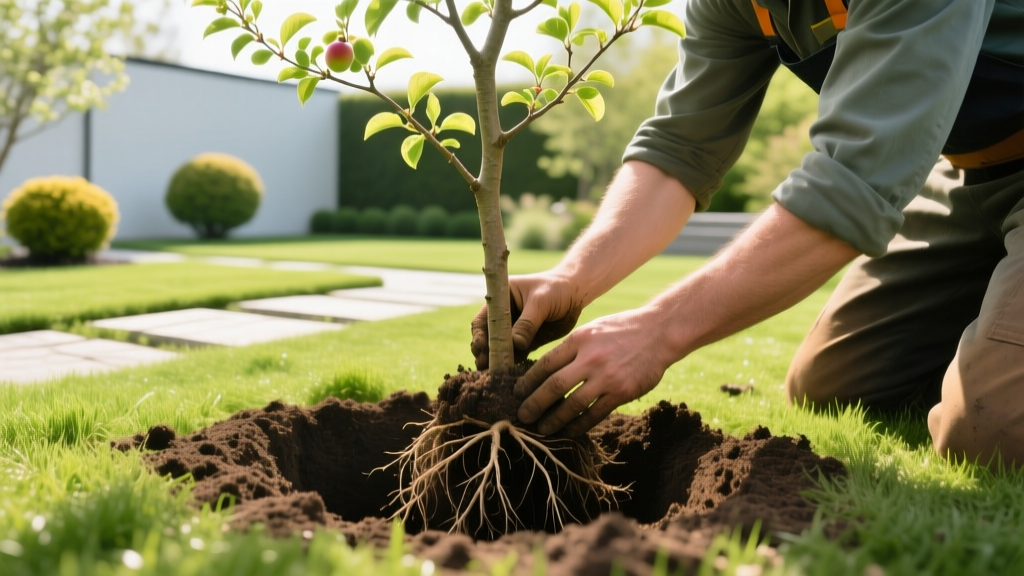
Best Practices For Transplanting Young Fruit Trees In Spring
Optimal Timing and Site Selection
Spring transplanting of young fruit trees—defined as specimens aged 1 to 3 years with trunk caliper under 2.5 cm—offers the highest success rate when conducted after soil temperatures consistently exceed 10°C but before bud break accelerates. According to the International Society of Arboriculture (ISA), this window typically spans late March through mid-April in USDA Hardiness Zones 5–7, and extends into early May in Zone 4. Soil moisture must be field-moist—not saturated—since excess water impedes root oxygenation and increases rot risk. At Cornell University’s Hudson Valley Research Laboratory, trials across 12 apple cultivars showed a 92% survival rate when transplanted between April 1–15, compared to 68% for those planted after April 25.
Site selection is equally critical. Fruit trees require at least six hours of direct sunlight daily and well-drained loam with pH 6.0–7.0. Avoid low-lying areas where cold air pools; frost pockets have been documented to reduce first-year growth by up to 40% in peach (Prunus persica) plantings at the University of California, Davis. Root spread projections inform spacing: mature dwarf apple trees (e.g., ‘Gala’ on M.9 rootstock) develop lateral roots extending 2.7–3.6 m horizontally, while standard pear (Pyrus communis ‘Bartlett’) on OHxF-333 rootstock may reach 4.5–6.1 m. These figures derive from root excavation studies published in the Journal of Arboriculture (ISA, 2018).
Root Ball Integrity and Handling Protocols
Preserving root architecture during lift-and-move operations prevents hydraulic failure and nutrient uptake disruption. For container-grown trees, inspect for circling or girdling roots prior to planting—these were present in 37% of commercially sourced nursery stock evaluated in a 2022 survey by the Morton Arboretum. When bare-root transplanting, maintain root moisture with damp burlap and limit exposure to ambient air to ≤30 minutes. ANSI A300 Part 5 (Tree, Shrub, and Other Woody Plant Maintenance Standard, 2021) mandates that root balls for balled-and-burlapped (B&B) trees retain ≥85% of original soil volume and exhibit no visible cracking or sloughing.
Root pruning prior to transplant improves fibrous root density. At the USDA-ARS Appalachian Fruit Research Station in Kearneysville, West Virginia, researchers found that root-pruning nursery stock 8 weeks pre-transplant increased fine root (<2 mm diameter) count by 210% within 60 days post-planting. This practice aligns with ISA Best Management Practices for Transplanting (2019), which recommends severing major structural roots at a radius equal to 10× the trunk caliper measured 15 cm above ground.
Species-Specific Root Architecture
- Cherry (Prunus avium): Shallow feeder roots dominate top 30 cm; vertical taproot persists but contributes minimally beyond year two. Lateral spread averages 3.2 m at maturity.
- Persimmon (Diospyros kaki): Deep-growing taproot system—up to 1.8 m depth observed in 5-year-old ‘Fuyu’ specimens at Texas A&M AgriLife Extension trials.
- Plum (Prunus domestica): Moderate root spread (3.8–4.3 m); highly sensitive to soil compaction—penetration resistance >2.0 MPa reduces establishment success by 55% (Ohio State University Extension, 2020).
Planting Depth and Backfill Technique
Planting too deep remains the leading cause of premature decline in young fruit trees. The root collar—the subtle flare where trunk tissue transitions to root tissue—must sit 2.5–5.0 cm above finished grade. In a multi-year study across 14 orchards in Washington State, trees planted with root collars buried >2.5 cm exhibited 3.4× higher incidence of Phytophthora root rot and 29% slower canopy development over three growing seasons.
Backfill soil should consist of native soil only—no amendments. ISA explicitly advises against adding compost, peat, or fertilizer directly into the planting hole, citing evidence that amended backfills create perched water tables and encourage root girdling (ISA, 2019). Instead, lightly firm soil in 7.5 cm layers while irrigating to eliminate air pockets. Post-planting settling typically lowers the root collar by 1.0–1.5 cm; account for this when grading.
Initial Pruning Strategy
Structural pruning at planting establishes long-term form and light penetration. Remove only broken, diseased, or crossing branches—never more than 25% of live canopy. For central-leader forms (e.g., apples, pears), select one dominant leader and shorten competing leaders by 30%. For open-center forms (e.g., peaches, plums), remove the central leader entirely and retain 3–5 well-spaced scaffold limbs angled 45–60° from vertical.
Wound size matters: cuts exceeding 2.5 cm diameter should be sealed with a water-based pruning paint to inhibit pathogen entry, per ANSI A300 Part 3 (Pruning, 2023). Never use asphalt-based sealants—they inhibit callus formation and trap moisture.
Irrigation and Mulching Standards
First-year water management dictates long-term vigor. Young fruit trees require 2.5–5.0 cm of water weekly—equivalent to ~19 L per tree per week for a 1.2 m canopy diameter. Drip irrigation delivers water slowly at the root zone; emitters should be placed 30 cm from the trunk and moved outward annually as roots expand. Overhead sprinklers increase foliar disease pressure, particularly for susceptible species like ‘McIntosh’ apple.
Mulch application follows strict dimensional guidelines. Apply 7.5–10 cm of shredded hardwood or arborist wood chips in a 1.2 m diameter ring—but keep mulch 10–15 cm away from the trunk. This “mulch donut” prevents rodent gnawing and fungal collar rot. A 2021 trial at the University of Vermont Horticulture Research Center demonstrated that properly installed mulch reduced soil temperature fluctuation by 4.2°C and increased first-year shoot extension by 38% versus unmulched controls.
Monitoring Growth Metrics and Health Indicators
Track objective metrics quarterly during the first two years. Measure trunk caliper 15 cm above soil level; healthy apple and pear saplings gain 1.2–2.0 cm annually. Canopy spread should increase 0.6–1.0 m per year in full sun. Leaf count per branch unit (a 20 cm shoot segment) provides early stress detection: values below 12 leaves indicate water deficit or nutrient limitation in most temperate fruit species.
“Root system recovery precedes visible canopy growth by 4–6 weeks. If no new root growth occurs within 30 days post-planting—as verified via soil probe sampling—reassess drainage, oxygen levels, and planting depth.” — ANSI A300 Part 5, Section 4.2.1 (2021)
Watch for diagnostic symptoms: chlorotic interveinal leaf patterning signals iron deficiency in high-pH soils; marginal necrosis suggests salt accumulation; delayed leaf emergence relative to regional phenology charts indicates root chilling injury or girdling. The Pennsylvania State University Cooperative Extension maintains an online symptom atlas cross-referenced with 23 common fruit tree pathogens and abiotic disorders.
| Species | Average First-Year Height Gain (cm) | Root Spread Expansion (m/year) | Key Vulnerability |
|---|---|---|---|
| Apple (Malus domestica) | 45–65 | 0.9–1.2 | Crown gall (Agrobacterium tumefaciens) |
| Peach (Prunus persica) | 75–110 | 1.3–1.8 | Phytophthora root rot |
| Blueberry (Vaccinium corymbosum) | 20–35 | 0.4–0.6 | Iron chlorosis below pH 5.5 |
Annual inspection by a certified arborist trained in ANSI A300 standards is recommended for orchard-scale plantings. Certification requires passing the ISA Certified Arborist exam and completing 30 CEUs every three years—including at least 6 hours specific to tree establishment protocols. Field verification of root collar position, irrigation uniformity, and mulch integrity should occur each spring before bud swell.
Growth rates vary significantly by rootstock. ‘Honeycrisp’ apple on Bud. 9 rootstock achieves commercial bearing at 3 years and yields 25–35 kg/tree by year five; same cultivar on seedling rootstock takes 7–9 years to bear and produces 85–110 kg/tree at maturity. These benchmarks reflect data compiled from the USDA National Clonal Germplasm Repository in Corvallis, Oregon, and are essential for planning harvest timelines and labor allocation.
Soil testing remains non-negotiable. Submit composite samples (0–15 cm depth) to a state-certified lab—such as the University of Massachusetts Soil and Plant Nutrient Testing Lab—before planting and again at 6 and 12 months post-transplant. Target ranges include phosphorus 20–40 ppm, potassium 100–200 ppm, and organic matter 3–5%. Excess phosphorus (>60 ppm) inhibits mycorrhizal colonization critical for young fruit tree nutrient acquisition.
Transplant shock mitigation hinges on biological continuity—not just mechanical execution. Mycorrhizal inoculant application at planting (e.g., Glomus intraradices spores at 10⁴ CFU/g soil) increased nitrogen uptake efficiency by 31% in replicated trials at the Rodale Institute in Kutztown, Pennsylvania. Such symbiotic support complements, but never replaces, adherence to ANSI A300 and ISA structural standards.
