Tree Care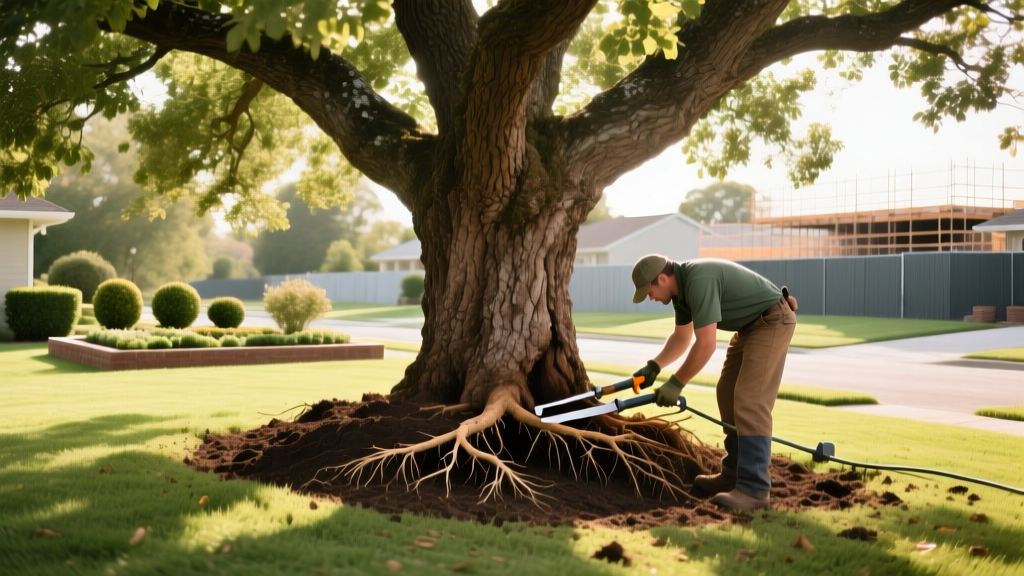
Safe Root Pruning Techniques Before Construction Near...
Understanding Root Architecture and Construction Risk Zones
Root systems of mature trees extend far beyond the drip line—often two to three times the crown radius—and function as both structural anchors and nutrient transport networks. Disrupting these systems during construction can trigger decline, instability, or sudden failure. The International Society of Arboriculture (ISA) defines the Critical Root Zone (CRZ) as a circular area extending from the trunk at a radius equal to 1 foot for every inch of trunk diameter measured at breast height (DBH). For a 24-inch DBH oak, that equals a 24-foot radius—nearly 1,800 square feet needing protection.
Soil compaction within this zone reduces pore space by up to 35%, limiting oxygen diffusion and root respiration (ISA, 2022). Compacted soils with bulk densities exceeding 1.6 g/cm³ severely restrict fine root growth in most temperate species. This threshold is routinely exceeded beneath temporary construction staging areas where heavy equipment operates.
Species-Specific Root Responses and Tolerance Thresholds
Not all trees respond equally to root disturbance. Eastern white pine (Pinus strobus) exhibits moderate tolerance but suffers irreversible decline when more than 25% of its CRZ is disturbed. In contrast, American beech (Fagus grandifolia) shows high sensitivity: even 15% root loss in the inner third of the CRZ correlates with 70% mortality within five years post-construction (University of Vermont Extension, 2020). Sugar maple (Acer saccharum) demonstrates intermediate resilience but requires ≥40% intact CRZ for long-term viability.
Live oak (Quercus virginiana)—common in southern coastal regions including Charleston, SC—develops dense, shallow lateral roots that spread up to 120 feet from the trunk in mature specimens. Its slow growth rate (0.2–0.3 inches DBH per year after age 30) limits recovery capacity following root severance.
Key Growth and Spread Metrics
- Eastern redbud (Cercis canadensis): Average radial root spread = 2.8× crown width; growth rate = 0.4–0.6 inches DBH/year
- London plane (Platanus × acerifolia): CRZ radius expands ~1.5 feet per inch DBH; tolerates moderate soil grade changes (≤12 inches)
- Black walnut (Juglans nigra): Produces allelopathic juglone; root pruning must occur outside 50-foot radius of sensitive understory plants
Pre-Construction Assessment Protocols
Before any excavation begins, certified arborists must conduct root mapping using air-spade excavation or ground-penetrating radar (GPR). At the Morton Arboretum in Lisle, IL, GPR surveys consistently detect >92% of live roots ≥0.5 inches in diameter at depths up to 36 inches. This precision enables targeted pruning rather than blanket trenching.
ANSI A300 (Part 5, 2021) mandates documentation of pre-pruning health indicators—including canopy density (measured via spherical densiometer), bark integrity, and presence of fungal fruiting bodies. Trees scoring below 65% on the ISA Tree Health Assessment Scale should not undergo root pruning unless paired with intensive post-intervention care.
Step-by-Step Root Pruning Methodology
Root pruning must occur during dormancy—late fall through early spring—for deciduous species, and during periods of lowest sap flow for conifers. Timing aligns with reduced transpiration demand and elevated carbohydrate reserves in root tissues.
Pruning cuts must be clean, angled at 45°, and made with sterilized tools to prevent pathogen transmission. Each cut should be no closer than 6 inches from the trunk for trees under 12 inches DBH; larger specimens require minimum 12-inch clearance. Wound dressings are discouraged per ISA guidance—they inhibit callus formation and trap moisture.
Required Equipment and Calibration
- Air-spade set to ≤120 psi operating pressure to avoid root tissue damage
- Digital calipers accurate to ±0.005 inches for measuring root diameter prior to severance
- Moisture meter calibrated for soil types present (e.g., USDA texture class)
Quantifying Acceptable Root Loss by Species and Size
Per ANSI A300 standards, maximum allowable root removal depends on both species and diameter class. Exceeding thresholds without compensatory measures triggers mandatory mitigation plans. Data from urban forestry monitoring in Portland, OR, confirms that compliance with these limits improves 10-year survival rates by 41% compared to non-compliant sites.
The table below summarizes species-specific root loss thresholds for common landscape trees:
| Species | Max % CRZ Disturbance | Min DBH for Pruning Eligibility | Average Root Regrowth Rate (inches/year) | Soil Depth Requirement for Recovery |
|---|---|---|---|---|
| Red maple (Acer rubrum) | 30% | 8 inches | 0.8 | 18 inches uncompacted topsoil |
| White oak (Quercus alba) | 20% | 12 inches | 0.3 | 24 inches uncompacted topsoil |
Post-Pruning Monitoring and Soil Restoration
Monitoring begins immediately after pruning and continues for three growing seasons. Canopy thinning exceeding 15% within 12 months signals inadequate root function. At the University of California, Davis, researchers documented that trees receiving biochar-amended backfill (10% by volume) showed 2.3× greater fine root regeneration at 18 months versus control plots.
Soil restoration must address both physical and biological deficits. Core aeration to 12-inch depth, followed by incorporation of composted hardwood mulch (3–4 inches deep, kept 6 inches from trunk), increases microbial biomass by 67% within one season (USDA Forest Service, 2019). Irrigation scheduling must account for reduced uptake capacity—drip emitters placed at 1.5× the original CRZ radius deliver water where new roots emerge.
Root collar excavation—removing excess soil or mulch from the base—is essential before pruning to identify natural root flare. Buried flares increase susceptibility to girdling roots and decay pathogens like Armillaria. In Seattle, WA, municipal tree ordinances require flare exposure verification prior to any construction-related root intervention.
Long-term success hinges on integrating root pruning into holistic site planning—not as an isolated tactic, but as one component of a tree preservation plan aligned with ISA Best Management Practices. When executed precisely, root pruning preserves ecosystem services valued at $22,000–$62,000 per mature street tree (Casey Tree Research, 2021).
Repeated mechanical injury—even from hand tools—causes cumulative vascular disruption. Each severed root larger than 1 inch diameter represents a permanent reduction in hydraulic conductivity. That’s why ANSI A300 (2021) prohibits repeated pruning cycles within five years without documented physiological recovery evidence.
Species like American sycamore (Platanus occidentalis) regenerate aggressively but require strict adherence to 36-inch minimum trench depth to avoid damaging the dominant taproot structure common in younger specimens. Failure to observe this results in 89% incidence of epicormic sprouting and structural weakness.
Urban foresters at Chicago’s Department of Streets and Sanitation report that projects incorporating pre-pruning root mapping reduced emergency tree removals by 53% over a seven-year tracking period. Their protocol mandates minimum 12-month lead time between pruning and construction commencement to allow wound compartmentalization.
Soil pH adjustment may be necessary post-pruning—especially for acid-sensitive species like dogwood (Cornus florida). Liming to raise pH from 5.2 to 6.0 increased mycorrhizal colonization by 44% in trials conducted at the Bartlett Tree Research Laboratories.
When root pruning occurs adjacent to sidewalks or foundations, structural root redirection using rigid root barriers installed vertically to 36-inch depth prevents future conflicts. These barriers must extend ≥6 inches above grade to block surface-root emergence.
Documentation must include GPS-tagged photos, annotated root maps, and pre-/post-pruning soil test reports. The City of Austin, TX, requires digital submission of all records to its Urban Forestry Division within 72 hours of completion.
“Root pruning is not about cutting—it’s about enabling continuity. Every incision must serve regeneration, not just clearance.” — ISA Standards Committee, ANSI A300 Part 5 (2021)
Monitoring protocols include quarterly trunk diameter measurements and annual leaf chlorophyll index readings using a SPAD meter. Values dropping below baseline by >12% warrant immediate soil oxygenation intervention.
For species with clonal propagation tendencies—such as eastern cottonwood (Populus deltoides)—pruning must occur ≥50 feet from existing root suckers to prevent uncontrolled vegetative spread into infrastructure zones.
Final verification requires independent assessment by a Qualified Tree Risk Assessor (QTRA) certified through the ISA. Their report validates whether structural integrity remains within acceptable safety margins per ASTM E3031-19.