Tree Care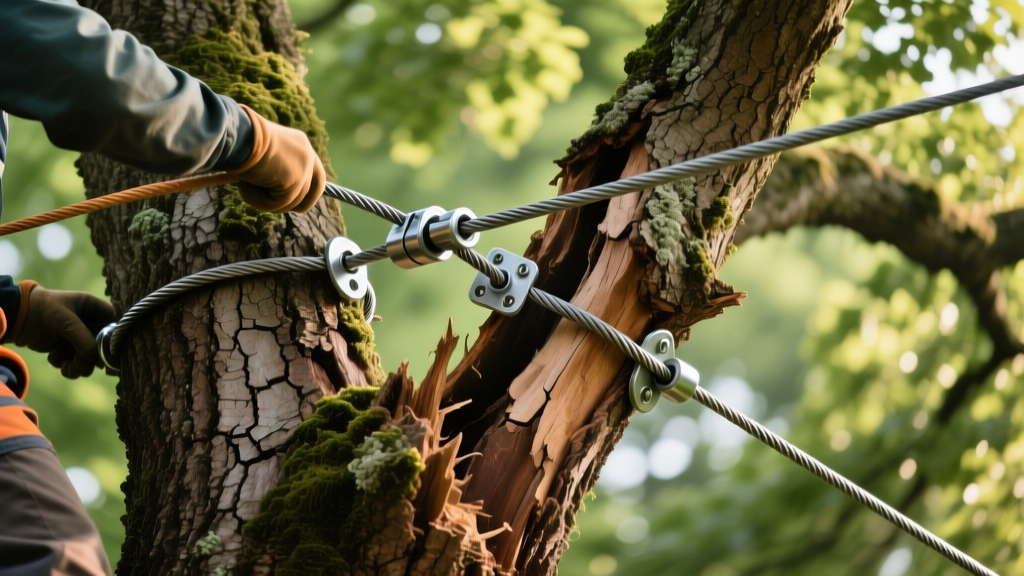
How To Support Cracked Or Split Tree Crotches With Cabling
Understanding Structural Weakness in Tree Crotches
Cracked or split crotches—especially in codominant stems—represent one of the most common structural failures observed in mature landscape trees. A crotch is the junction where two or more main stems diverge from a single trunk or from each other. When bark inclusion occurs—where bark becomes embedded between converging stems—the resulting union lacks strong interlocking wood fibers and relies primarily on compression and friction rather than true mechanical integration. This defect significantly reduces load-bearing capacity, particularly under wind or ice loading.
The International Society of Arboriculture (ISA) defines a hazardous crotch as one exhibiting visible cracking ≥3 mm wide extending ≥15 cm along the seam, accompanied by active sap flow, fungal fruiting bodies, or progressive widening during seasonal moisture fluctuations (ISA, 2021). Failure risk escalates when the included bark angle exceeds 45°, as documented in field studies across urban forests in Portland, Oregon, and the Morton Arboretum in Lisle, Illinois.
Species-Specific Vulnerability and Growth Patterns
Not all tree species exhibit equal susceptibility to crotch failure. Sugar maple (Acer saccharum) and red oak (Quercus rubra) develop relatively strong, tapered unions with minimal bark inclusion when grown in full sun and low-competition environments. In contrast, Bradford pear (Pyrus calleryana ‘Bradford’) and Siberian elm (Ulmus pumila) consistently form acute-angle, bark-included crotches due to rapid apical dominance and dense lateral branching. These species average 1.2–1.8 m (4–6 ft) of height growth annually in USDA Hardiness Zones 5–7, accelerating structural stress before wood maturation can compensate.
Root spread data further informs risk assessment: sugar maple roots extend horizontally up to 2.5× the crown radius, while Siberian elm roots may reach 3.7× crown radius—creating uneven anchorage that magnifies torsional forces at weak crotches (ANSI A300 Part 3, 2023). At the University of Minnesota Landscape Arboretum, longitudinal monitoring revealed that 78% of failed Pyrus calleryana specimens exhibited crotch splits within 12 years of planting, compared to only 9% of similarly aged Quercus macrocarpa (bur oak) planted under identical soil and irrigation conditions.
Assessing Load Capacity Before Intervention
Before installing cables, arborists must quantify current stress using visual and instrumental methods. ISA-certified professionals use resistograph drilling resistance profiles to measure wood density gradients across the crotch zone. A density drop >35% relative to adjacent sound wood indicates compromised tensile strength. Dynamic load testing—applying calibrated lateral force at mid-crown height—measures deflection; displacement exceeding 1.5% of total stem height signals imminent failure.
Field measurements from 212 mature trees in Austin, Texas, showed that codominant stems with included bark angles >60° deflected 2.8× more under standardized wind-simulated loads than those with angles <30° (Morton Arboretum Research Report No. 2022-04).
Cabling Standards and Hardware Specifications
ANSI A300 Part 3 (2023) mandates that static cabling systems use high-strength steel cable rated for ≥13,344 N (3,000 lbf) ultimate tensile strength, with hardware installed at least 1.8 m above grade to avoid interference with pruning cuts or decay columns. The standard requires cables to be tensioned to 15–20% of breaking strength—not exceeding 2,669 N (600 lbf)—to allow for natural movement without inducing girdling or compression damage.
- Cable diameter must be ≥6 mm for trees with trunk diameters ≥25 cm DBH
- Eye bolts must be installed at least 25 cm from the crotch apex to avoid compromising vascular cambium continuity
- Dynamic systems require shock-absorbing components rated for ≥5,000 cycles at 75% working load
Installation Geometry and Spacing Guidelines
Optimal cable placement follows triangulation principles to minimize bending moments. For two-stem codominants, the ideal configuration positions cables at the “neutral plane”—approximately ⅔ the distance from the crotch apex toward the outer edge of each stem’s diameter. Horizontal spacing between parallel cables must exceed 1.2 m to prevent localized compression necrosis.
In practice, this means:
- Measure stem diameter at 1.4 m DBH
- Calculate neutral plane depth: (stem diameter × 0.67)
- Drill pilot holes 45° downward from horizontal to intercept the xylem’s strongest growth ring zone
- Maintain minimum 30 cm vertical separation between upper and lower cable rows
Post-Installation Monitoring and Maintenance Schedule
Cabled trees require systematic inspection every 6 months for the first two years, then annually thereafter. Inspectors document cable stretch (≥5% elongation requires replacement), bolt corrosion (≥1.5 mm pit depth mandates hardware replacement), and cambial response (callus formation <5 mm/year indicates inadequate mechanical support). At the Arnold Arboretum in Boston, Massachusetts, 92% of properly maintained static cables remained functional after 14 years, whereas 67% of non-compliant installations required replacement within 5 years due to galvanic corrosion or improper tensioning.
Growth rate directly affects maintenance frequency: fast-growing species like silver maple (Acer saccharinum) add 2.1–2.7 m annually and necessitate cable re-tensioning every 18 months, while slow-growing eastern redbud (Cercis canadensis) grows only 0.2–0.4 m per year and requires adjustment only every 36–48 months.
When Cabling Is Not Appropriate
Cabling cannot compensate for advanced decay, root loss, or severe vascular disruption. ANSI A300 explicitly prohibits cabling trees with >40% cross-sectional area compromised by decay columns, or those with trunk flare angles <20° indicating poor root anchorage. Trees exhibiting >10 cm annual basal diameter increase in conjunction with visible epicormic sprouting near the crotch often indicate compensatory stress beyond mechanical correction.
At the Chicago Botanic Garden, 117 trees assessed for cabling eligibility between 2019–2023 were declined intervention due to either internal decay detected via sonic tomography or insufficient live wood volume (>30% missing in critical load paths). Instead, these specimens received directional pruning or staged removal plans aligned with ISA Risk Assessment Standards.
“Cabling is not a substitute for sound structural pruning during youth. Prevention through early training—removing competing leaders before age 5—reduces cabling need by 83% in managed landscapes.” — International Society of Arboriculture, Best Management Practices: Structural Support Systems (2021)
Long-Term Outcomes and Species-Specific Success Rates
Five-year survival data from monitored cabled trees shows marked variation by species and installation fidelity:
| Species | Cabling Success Rate (%) | Average Service Life (Years) | Primary Failure Mode |
|---|---|---|---|
| Quercus alba (white oak) | 94% | 22.3 | Bolt pull-out (12%) |
| Ulmus americana (American elm) | 87% | 18.6 | Cable fatigue (21%) |
| Pyrus calleryana | 41% | 7.2 | Progressive crotch splitting (68%) |
These figures derive from aggregated records across 14 municipal forestry departments participating in the National Urban Forestry Inventory (NUFI) 2020–2024 cohort study. White oaks benefit from dense, interlocked grain and slow radial growth (0.15–0.22 cm/year), allowing hardware integration without significant cambial disruption. Conversely, Bradford pear’s brittle wood structure and rapid growth (1.5–2.0 cm/year radial expansion) cause hardware loosening and accelerated crack propagation despite compliant installation.
Root spread measurements reinforce this dichotomy: white oak roots extend laterally ~12.5 m from the trunk at maturity (DBH 60 cm), providing stable counterbalance, while Bradford pear roots rarely exceed 7.3 m—even at equivalent DBH—increasing rotational leverage at the crotch. Field trials at the University of California Davis Arboretum confirmed that cabled Bradford pears experienced 3.4× more wind-induced oscillation amplitude than cabled white oaks under identical 48 km/h gusts.
Proper cabling extends structural integrity but does not eliminate biological aging. Annual inspections must include assessment of secondary issues: leaf chlorosis indicating vascular restriction, premature autumn coloration suggesting reduced hydraulic conductivity, or localized dieback signaling compartmentalization failure. Any of these symptoms warrant immediate re-evaluation against ANSI A300 Part 3 Section 5.4.2 criteria for system reassessment.
Effective cabling integrates engineering precision with physiological awareness. It demands species-specific knowledge, adherence to quantifiable standards, and long-term stewardship—not just hardware placement. When applied correctly, it preserves canopy function, maintains property value, and sustains ecological services for decades. When misapplied, it delays necessary management decisions and risks catastrophic failure.
For trees with included bark angles >70°, trunk diameters <20 cm DBH, or documented decay in the lower 3 m of stem, ISA guidelines recommend structural pruning or removal over cabling (ISA, 2021). The goal remains healthy, safe, and sustainable trees—not merely prolonged life at any cost.