Lawn Care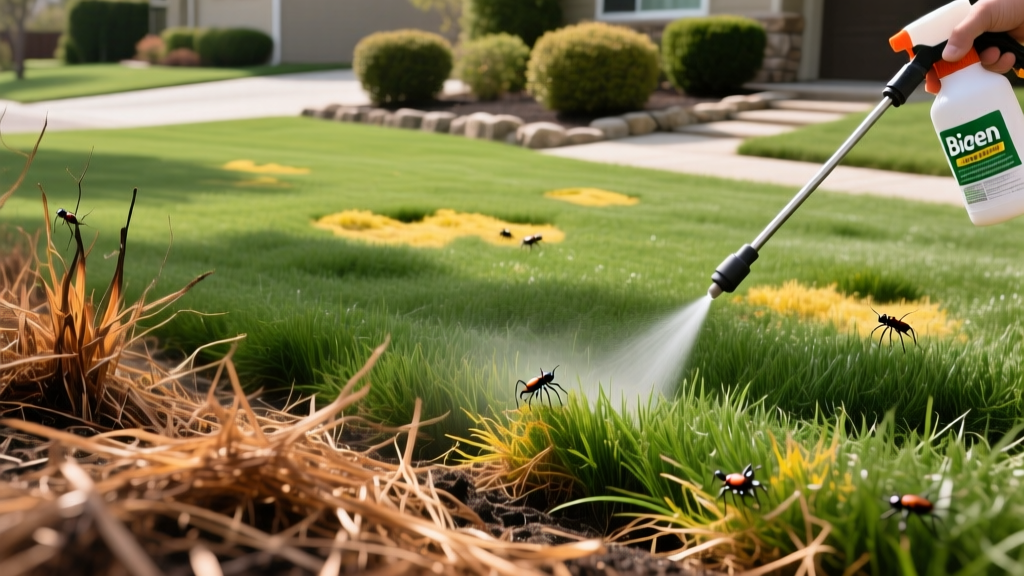
Chinch Bug Treatment With Bifen IT For Fire-Resistant Lawns 2026
Sarah ChenPublished
The Hidden Fire Hazard: Chinch Bugs in Defensible Space Zones
As we navigate the 2026 wildfire season, homeowners in the Wildland-Urban Interface (WUI) are increasingly focused on creating defensible space around their properties. While clearing brush and trimming tree canopies are standard practices, the condition of your turfgrass is an often-overlooked component of fire-resistant landscaping. A healthy, well-irrigated lawn acts as a natural firebreak, capable of stopping ground fires and extinguishing wind-blown embers. However, a severe chinch bug infestation can rapidly transform this protective green barrier into a bed of dry, highly flammable tinder.
Chinch bugs (primarily Blissus insularis in southern regions) feed on the crowns and stems of turfgrass, injecting a toxin that blocks water transport. The result is rapid, widespread turf death that mimics severe drought stress. In the context of fire-resistant landscaping, this dead thatch and brown grass represent a critical vulnerability in Zone 1 (the 0 to 30-foot perimeter immediately surrounding your home). To maintain a fire-safe landscape in 2026, rapid identification and targeted treatment using professional-grade solutions like Bifen IT (Bifenthrin 7.9%) is essential.
Identifying Chinch Bugs in 2026: Don't Mistake Pest Damage for Drought
One of the most common mistakes homeowners make is assuming their browning lawn is suffering from drought stress or a lack of irrigation. In fire-prone regions, watering restrictions or deliberate reduction in irrigation to conserve water can mask the early signs of a chinch bug invasion. By the time the damage is obvious, the turf is dead and poses a significant fire hazard.
Adult southern chinch bugs are small, roughly 1/8 to 1/5 of an inch long, with black bodies and frosty-white wings marked by a distinct black triangle. Nymphs are even smaller, ranging from bright red with a white dorsal band to darker shades as they mature. They thrive in hot, dry conditions—exactly the environment found in water-conserving, fire-resistant landscape zones.
The Flotation Test
To confirm an infestation before the turf becomes a fire risk, perform the classic "tin can" flotation test. Remove both ends of a metal coffee can, push it two inches into the soil at the margin of a damaged area, and fill it with water. Wait five minutes. If chinch bugs are present, they will float to the surface. Finding more than 20 to 25 chinch bugs per square foot warrants immediate chemical intervention to save your fire-resistant turf barrier.
Comparing Turf Stressors in Fire-Resistant Zones
| Symptom / Factor | Chinch Bug Damage | Drought Stress | Fungal Disease (Brown Patch) |
|---|---|---|---|
| Initial Appearance | Yellowing patches in hot, sunny areas near driveways or sidewalks | Uniform bluish-gray tint, footprints remain after walking | Circular brown rings with a dark, smoke-like border |
| Progression | Rapidly turns straw-brown and dies; spreads outward from epicenter | Grass goes dormant; recovers slowly with deep irrigation | Spreads during humid, wet conditions; rarely kills entire crown |
| Fire Risk Level | Extreme: Creates dense, dry, dead thatch highly susceptible to ember ignition | Moderate: Dormant grass is flammable but usually retains some root moisture | Low: Fungal areas often retain moisture and do not dry out completely |
| Presence of Insects | Adults and red nymphs visible at soil line or floating in water test | None | None (mycelium may be visible in morning dew) |
For more detailed biological information on this pest, the University of Florida Entomology Department provides an excellent, continuously updated profile on southern chinch bug behavior and life cycles.
Why Bifen IT is the 2026 Standard for Chinch Bug Eradication
When a chinch bug infestation threatens the defensible space around your home, you need a product that offers rapid knockdown and lasting residual control. Bifen IT, which contains 7.9% Bifenthrin as its active ingredient, remains a top-tier choice for turf managers and homeowners in 2026. Bifenthrin is a synthetic pyrethroid that disrupts the nervous system of insects upon contact and ingestion.
According to the Environmental Protection Agency (EPA), bifenthrin is highly effective against a broad spectrum of turf-destroying insects while exhibiting low mobility in soil, meaning it stays in the target zone where chinch bugs reside rather than leaching into groundwater. This localized action is ideal for maintaining the precise ecological balance required in fire-resistant landscaping, where protecting the immediate perimeter of the home is the priority.
Furthermore, Bifen IT provides a residual barrier of up to 30 days. In fire-prone areas, this means you can secure your Zone 1 turf against re-infestation during the peak heat of late summer, ensuring your lawn remains a green, hydrated, and fire-retardant shield.
Step-by-Step Bifen IT Application for Fire-Resistant Turf
Applying Bifen IT correctly is crucial not only for pest eradication but also for maintaining the health and hydration of your fire-resistant lawn. Follow these steps for optimal results:
Step 1: Mow and Dethatch (Fire Fuel Reduction)
Before applying any chemical treatment, mow the lawn to its recommended height and aggressively dethatch the area. Thatch—a layer of dead and living organic matter between the soil and the grass blades—is a primary harbor for chinch bugs. More importantly, in a fire-resistant landscape, thick thatch is a severe fire hazard. It acts as highly combustible kindling that can catch wind-blown embers. Removing thatch eliminates the pest's hiding spot, allows the Bifen IT to reach the soil crown, and drastically reduces your property's fire fuel load.
Step 2: Mix the Solution
For active chinch bug infestations, the standard 2026 application rate for Bifen IT is 0.5 to 1.0 fluid ounces per 1,000 square feet. Mix the product with water in a pump sprayer or hose-end sprayer. Using roughly 1 to 2 gallons of water per 1,000 square feet ensures adequate coverage to penetrate the turf canopy and reach the soil surface where the nymphs feed.
Step 3: Apply to the Perimeter and Hotspots
Focus your application on the sun-baked areas near sidewalks, driveways, and the foundation of your home. These are the exact areas where chinch bugs thrive, and coincidentally, they are the most critical zones for ember-resistant landscaping. Apply the spray evenly, ensuring the grass blades and soil surface are thoroughly coated.
Step 4: Water In and Hydrate for Fire Defense
Immediately after the application dries (usually within 1 to 2 hours), irrigate the lawn with roughly 0.25 inches of water. This serves a dual purpose: it washes the Bifen IT off the grass blades and into the soil crown where it is most effective against root-feeding pests, and it rehydrates the turf. In fire-resistant landscaping, maintaining high moisture content in your Zone 1 vegetation is the primary mechanism for preventing ignition. A well-watered lawn simply will not burn easily.
Integrating Pest Control with Fire-Resistant Landscaping Principles
Treating chinch bugs with Bifen IT is a reactive measure; true fire-resistant landscaping requires a proactive, holistic approach to turf management. As outlined by CAL FIRE's Defensible Space guidelines, the goal of Zone 1 is to create an ember-resistant area that prevents fire from spreading to the structure. Your lawn care practices must align with this goal.
Irrigation Strategies for Fire Safety
While drought-tolerant grasses are popular in water-conscious regions, a completely dormant, brown lawn offers little fire resistance. If you live in a high-fire-risk area, allocate your water budget to keep the turf within 30 feet of your home actively green and hydrated. Use smart irrigation controllers that adjust based on local evapotranspiration rates to keep the grass alive without wasting water.
Chemical Storage in the WUI
When storing Bifen IT and other lawn care chemicals, fire safety must be considered. Many pesticide formulations are packaged in plastics or contain inert ingredients that can melt, off-gas, or contribute to toxic smoke during a structural or wildland fire. Store all lawn chemicals in a detached, fire-rated shed or a metal, fire-resistant cabinet away from the main residence. Ensure your chemical storage area is clear of dry weeds, dead leaves, and other combustible materials.
Post-Treatment Turf Recovery for Fire Defense
If the chinch bug infestation was severe and left large patches of dead, straw-colored grass, you must address the bare spots immediately. Dead grass is a flash fuel. Rake out the dead material, amend the soil, and overseed or lay new sod. For 2026 fire-resistant landscapes, consider transitioning damaged areas to low-growing, high-moisture ground covers or fire-resistant turf cultivars like UC Verde Buffalo grass or hybrid Bermuda varieties that recover quickly from stress and maintain a high moisture content with minimal water input.
Conclusion
In 2026, maintaining a fire-resistant landscape requires looking beyond the trees and shrubs to the very ground beneath your feet. Chinch bugs pose a severe threat to the integrity of your defensible space by converting healthy, fire-retardant turf into dry, flammable thatch. By mastering the identification of these pests and utilizing targeted, residual treatments like Bifen IT, you can protect your lawn's health and, by extension, the safety of your home. Combine chemical control with rigorous thatch management and strategic irrigation, and your lawn will remain a beautiful, functional, and fire-safe asset all season long.