Tree Care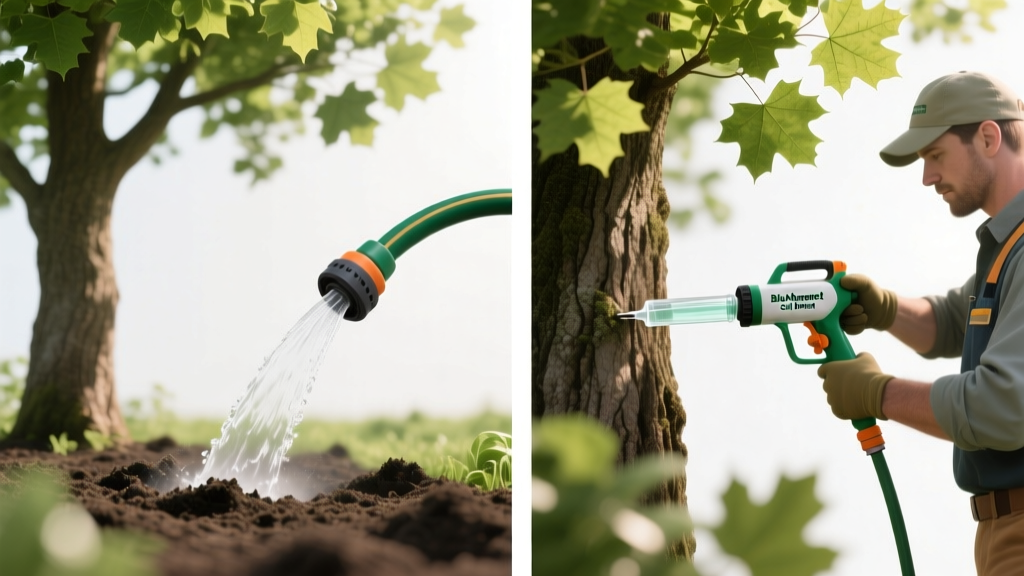
BioAdvanced vs Arborjet: Systemic Tree Insecticides Compared
Anna KowalskiPublished
Introduction to Systemic Tree Insecticides
When it comes to protecting your landscape trees from devastating pests like the Emerald Ash Borer (EAB), aphids, and bark beetles, topical sprays often fall short. The canopy is simply too high, and wood-boring insects spend the majority of their life cycles hidden deep beneath the bark where contact killers cannot reach. This is where systemic tree insecticides become an essential tool in modern arboriculture. Unlike contact sprays, systemics are absorbed by the tree and translocated through its vascular system, effectively turning the tree itself into a targeted pest-control delivery mechanism.
In the professional and advanced DIY tree care market, two products dominate the conversation: BioAdvanced 12 Month Tree & Shrub Protect & Feed (an imidacloprid-based soil drench) and Arborjet TREE-äge (an emamectin benzoate trunk injection). But which one is right for your specific situation? This comprehensive comparison breaks down the science, cost, environmental impact, and efficacy of Product A vs. Product B to help you make the best decision for your landscape.
Understanding Systemic Movement in Trees
Before comparing products, it is vital to understand how trees transport chemicals. Trees have two primary vascular tissues: the xylem (which moves water and nutrients up from the roots to the leaves) and the phloem (which moves sugars down from the leaves to the roots). Most systemic insecticides, including both imidacloprid and emamectin benzoate, are xylem-mobile. This means they must be introduced to the root system or the active sapwood so the tree's natural transpiration process can pull the chemical upward into the canopy. The speed and uniformity of this movement dictate how quickly the product works and how well it protects the entire tree.
Product A: BioAdvanced 12 Month Tree & Shrub (Imidacloprid)
BioAdvanced (formerly Bayer Advanced) relies on Imidacloprid, a widely used neonicotinoid insecticide. It is formulated as a liquid concentrate that you mix with water and pour around the base of the tree as a soil drench.
How It Works and Application
The active ingredient is absorbed by the fine feeder roots and slowly translocated upward over several weeks. Many BioAdvanced formulas also include NPK fertilizers to give the tree a nutritional boost while the insecticide takes effect. To apply, you simply measure the trunk circumference, calculate the required fluid ounces, mix it in a bucket with water, and pour it in a circle around the tree's drip line.
Pros and Cons
- Pros: Highly accessible, relatively inexpensive, requires no specialized equipment, and provides a full year of control against soft-bodied insects (like aphids and adelgids) and early-stage borers.
- Cons: Extremely slow to act. It can take 30 to 60 days for the chemical to reach the upper canopy. Furthermore, it is highly dependent on soil moisture and temperature; it will not work effectively in frozen or severely drought-stricken soil.
Product B: Arborjet TREE-äge (Emamectin Benzoate)
Arborjet TREE-äge utilizes Emamectin Benzoate, an avermectin derivative. It is applied directly into the tree's xylem via trunk injection, typically using Arborjet's specialized QUIK-jet or TREE I.V. systems.
How It Works and Application
By drilling small holes into the sapwood at the base of the trunk and injecting the chemical under pressure, you bypass the soil entirely. The tree's transpiration stream immediately grabs the emamectin benzoate and distributes it throughout the canopy. Application requires a drill, specialized injection tees, a mallet, and the pressurized injection device.
Pros and Cons
- Pros: Lightning-fast efficacy (often within 7 to 14 days), completely independent of soil conditions, and provides an industry-leading two years of residual control. It is the undisputed champion for active Emerald Ash Borer infestations.
- Cons: Significantly more expensive, requires drilling into the tree (which creates minor physical wounds that the tree must compartmentalize), and demands specialized injection equipment that is often best handled by a certified arborist.
Head-to-Head Comparison Chart
| Feature | BioAdvanced (Imidacloprid) | Arborjet TREE-äge (Emamectin) |
|---|---|---|
| Active Ingredient | Imidacloprid (Neonicotinoid) | Emamectin Benzoate (Avermectin) |
| Application Method | Soil Drench | Trunk Injection |
| Time to Efficacy | 30 - 60 Days | 7 - 14 Days |
| Duration of Control | 12 Months | 24 Months |
| Target Pests | Aphids, Borers, Adelgids, Scale | EAB, Borers, Caterpillars, Weevils |
| Environmental Risk | Moderate to High (Soil/Runoff) | Very Low (Contained in Xylem) |
| Best Application Timing | Early Spring or Late Fall | Late Spring to Early Summer |
Efficacy Against the Emerald Ash Borer (EAB)
The true test of any systemic insecticide in modern arboriculture is its performance against the Emerald Ash Borer. According to the USDA APHIS, EAB has killed hundreds of millions of ash trees across North America, making it one of the most destructive forest pests in history.
Imidacloprid (BioAdvanced) is strictly a preventative measure. The Michigan State University Extension notes that imidacloprid is only effective on trees with less than 20% canopy decline. If a tree is already heavily infested, the vascular system is too damaged by larval galleries to pull the soil drench up to the canopy, rendering the treatment useless.
Conversely, Emamectin Benzoate (Arborjet) is both preventative and curative. Because it is injected directly into the active sapwood under pressure, it can successfully treat and save ash trees with up to 50% canopy decline. For high-value ash trees in known EAB zones, Arborjet is the undisputed gold standard.
Environmental Impact and Pollinator Safety
The environmental footprint of these two products is vastly different. Imidacloprid is a neonicotinoid, a class of chemicals that has drawn intense scrutiny for its impact on pollinators. The Environmental Protection Agency (EPA) highlights that imidacloprid is highly toxic to bees on an acute contact basis. When applied as a soil drench, there is a risk of the chemical leaching into groundwater, running off into storm drains, or being taken up by nearby flowering weeds, potentially exposing foraging bees to toxic nectar and pollen.
Trunk injection with Arborjet virtually eliminates this environmental drift. The chemical is sealed entirely inside the tree's xylem. There is no soil residue, no runoff, and studies show that emamectin benzoate does not translocate into pollen or nectar in quantities that pose a risk to pollinators. If your property is near waterways, community gardens, or pollinator habitats, trunk injection is the ecologically responsible choice.
Cost Analysis and Application Realities
Cost is often the deciding factor for homeowners. Let us break down the economics for a medium-sized tree with a 20-inch circumference (roughly 6.3 inches in diameter).
- BioAdvanced Soil Drench: A bottle costs around $30 to $40 and treats multiple trees depending on their size. The cost per tree is roughly $5 to $10. The application takes 10 minutes with a bucket and water.
- Arborjet Trunk Injection: The chemical itself is expensive, and you must purchase or rent the injection tees and drill. If you hire a certified arborist, expect to pay $10 to $15 per inch of trunk diameter. For our 6.3-inch tree, professional treatment will cost between $65 and $95, but remember this treatment lasts for two full years, balancing the annualized cost.
Pro Tip: While DIY trunk injection kits are available online, improper drilling angles or failing to seal the injection sites can introduce secondary fungal pathogens. For trees over 15 inches in circumference, hiring an ISA Certified Arborist is highly recommended to ensure the health and structural integrity of the tree.
Seasonal Timing: When to Apply
Timing is everything when dealing with systemics. For BioAdvanced, you must apply the soil drench when the soil is moist and the roots are actively taking up water. Early spring (just before bud break) or early fall are the ideal windows. Avoid applying during peak summer droughts, as the tree's roots will be dormant and the chemical will simply sit in the dry soil, risking degradation.
For Arborjet TREE-äge, the ideal application window is late spring to early summer. You want the tree to be fully leafed out so that transpiration rates (the evaporation of water from the leaves) are at their highest. This rapid transpiration acts like a vacuum, pulling the injected emamectin benzoate up into the canopy in a matter of hours rather than days.
Final Verdict: Which Should You Choose?
The choice between BioAdvanced and Arborjet ultimately depends on your specific pest pressure, the value of the tree, and your environmental concerns.
Choose BioAdvanced (Imidacloprid) if you are looking for an affordable, easy-to-apply preventative treatment for soft-bodied insects like aphids, scale, and adelgids on smaller or younger trees. It is an excellent maintenance product for general landscape health when applied correctly and responsibly.
Choose Arborjet TREE-äge (Emamectin Benzoate) if you are protecting high-value ash trees from the Emerald Ash Borer, dealing with an active borer infestation, or treating trees in environmentally sensitive areas near water or pollinator gardens. While the upfront cost and application complexity are higher, the unparalleled efficacy, two-year residual, and ecological safety make it the superior choice for serious tree preservation.