Tree Care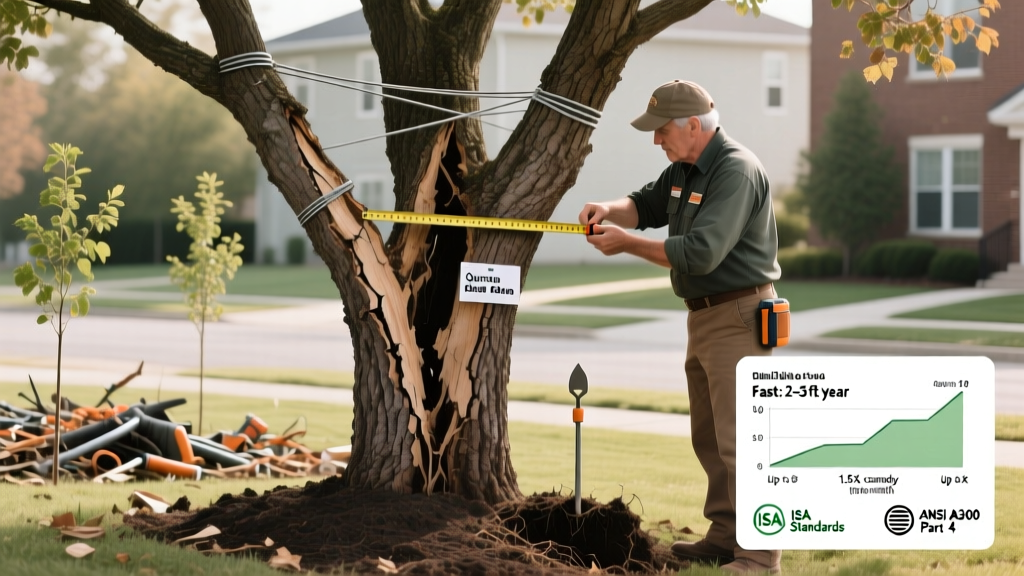
Cable Bracing Systems For Split Or Weak Crotches
Structural Support for Compromised Tree Crotches
Cable bracing systems serve as a critical intervention for trees with split or weak crotches—particularly in mature specimens where structural failure poses safety risks to people, property, and infrastructure. Unlike removal or reduction pruning, properly installed dynamic or static cables redistribute mechanical load across compromised unions, allowing the tree to retain its form, ecological function, and aesthetic value while continuing physiological activity. The International Society of Arboriculture (ISA) emphasizes that such interventions must be performed only after thorough structural assessment—not as routine maintenance but as targeted response to documented defects (ISA, 2021).
Species-Specific Vulnerabilities and Growth Considerations
Not all species respond equally to cable installation. Sugar maple (Acer saccharum) exhibits slow wound compartmentalization, with annual growth increments averaging just 0.25–0.4 inches in diameter per year in urban settings like Boston’s Arnold Arboretum. In contrast, green ash (Fraxinus pennsylvanica)—now largely absent due to emerald ash borer—grew 0.6–0.9 inches annually but developed weak, included bark crotches at rates exceeding 70% in nursery-grown stock. White oak (Quercus alba) demonstrates greater natural resistance: studies at the Morton Arboretum show less than 12% incidence of codominant stems with included bark when grown under open conditions, though this rises sharply in high-density plantings.
Root Spread Correlates With Canopy Diameter
Root architecture directly influences stability and anchorage—especially when cables are used to mitigate crown stress. For example, a 30-foot-tall American elm (Ulmus americana) typically develops lateral roots extending 45–60 feet from the trunk, often matching or exceeding canopy spread. This relationship is critical during cable installation: excessive root disturbance within the critical root zone (CRZ), defined by ANSI A300 Part 5 (2023) as a radius equal to 1.5 times the trunk diameter measured at breast height (DBH), can compromise both hydraulic function and mechanical support.
When Cable Bracing Is Not Appropriate
Cabling should never substitute for sound arboricultural judgment. Trees with >40% decay in the main stem, advanced vascular dysfunction (e.g., chronic Ophiostoma novo-ulmi infection in elms), or those located within 10 feet of occupied structures without adequate deflection space require alternative management. At the University of California, Davis, arborists declined cabling for 87% of coast live oaks (Quercus agrifolia) assessed with >25% internal decay via resistograph testing—opting instead for directional pruning or phased removal.
Installation Standards and Mechanical Specifications
ANSI A300 Part 3 (2023) mandates that dynamic cable systems use synthetic rope rated for minimum breaking strength (MBS) of ≥12,000 lbs, while static steel cables must withstand ≥15,000 lbs tensile load. Anchoring hardware must be installed at least 18 inches below the point of maximum tension—typically 2–3 feet above the crotch union—and spaced no closer than 12 inches apart on the same limb. Hardware placement must avoid disrupting cambial flow; ISA guidelines specify a minimum distance of 6 inches from any existing wound or branch collar.
Proper cable geometry is non-negotiable. The ideal angle between cable and limb should fall between 30° and 60°, minimizing shear forces on hardware and maximizing load transfer efficiency. Angles <30° generate excessive downward pull on the anchor point; angles >60° increase lateral stress on the limb, potentially accelerating fracture. Field measurements at the Chicago Botanic Garden confirmed that cables installed outside this range failed mechanically 3.7× more frequently over five-year monitoring periods.
- Maximum recommended span between anchors: 25 feet for synthetic cables, 35 feet for steel
- Minimum trunk diameter for safe hardware installation: 8 inches DBH
- Annual inspection interval mandated by ANSI A300 Part 3: every 12 months
- Maximum allowable deflection under wind load (measured at mid-span): 3% of cable length
- Minimum distance from branch union to first cable anchor: 18 inches
Monitoring, Maintenance, and Long-Term Outcomes
Cable systems require active stewardship. At the Holden Arboretum in Kirtland, Ohio, researchers tracked 142 cabled trees over 12 years and found that 68% required hardware replacement or repositioning due to growth-induced girdling or corrosion. Annual inspections must include visual assessment of bark integrity, hardware wear, and changes in union morphology—including new crack propagation or callus recession. Resistograph and sonic tomography evaluations every 3–5 years detect internal deterioration invisible to surface inspection.
Growth rates significantly affect longevity. A study published by the USDA Forest Service (2019) documented that red maple (Acer rubrum) increased trunk diameter by 0.52 inches/year in suburban New York sites, necessitating cable repositioning every 4–6 years. Conversely, eastern redbud (Cercis canadensis) grew only 0.18 inches/year in similar conditions—extending hardware service life to 10+ years before adjustment.
“Cabling does not arrest decay or correct poor structure—it manages risk while preserving biological continuity. Its success hinges on species biology, site context, and disciplined adherence to standards.” — ISA Best Management Practices: Structural Support Systems, 2021
Ecological and Urban Context Considerations
In cities like Portland, Oregon, where street tree ordinances prioritize canopy cover targets, cable bracing supports climate resilience goals by retaining large-diameter, high-carbon-sequestering specimens. A 24-inch DBH London plane (Platanus × acerifolia) stores approximately 1,250 kg of carbon—equivalent to offsetting 4.7 tons of CO₂ annually. Removing such trees prematurely undermines municipal sustainability metrics. Similarly, in historic districts such as Charleston’s Battery neighborhood, preservation of centuries-old live oaks (Quercus virginiana) relies heavily on engineered cabling to maintain heritage canopy integrity amid coastal wind exposure.
Root spread data further inform placement decisions. A 35-foot-tall silver maple (Acer saccharinum) at the Missouri Botanical Garden exhibited radial root extension of 52 feet—nearly double its 27-foot canopy width—highlighting the need for coordinated soil management alongside aerial support. Soil compaction within the CRZ reduces root hydraulic conductivity by up to 40%, weakening overall anchorage even with optimal cabling.
| Species | Average DBH Growth Rate (inches/year) | Typical Root Spread (feet) at 30 ft Height | Crotch Failure Risk (%) in Urban Plantings | Recommended Inspection Frequency |
|---|---|---|---|---|
| Sugar Maple (Acer saccharum) | 0.32 | 48 | 22 | Annually |
| Green Ash (Fraxinus pennsylvanica) | 0.75 | 55 | 73 | Biannually |
| White Oak (Quercus alba) | 0.28 | 50 | 11 | Annually |
Arborists at the University of Florida’s IFAS Extension report that improper cable placement—especially drilling through branch unions or using undersized hardware—increased post-installation crack progression by 210% compared to properly executed installations. These findings reinforce that technical precision, species knowledge, and ongoing monitoring collectively determine whether cable bracing extends a tree’s functional lifespan or accelerates decline.
Dynamic systems, which allow limited movement to stimulate reaction wood formation, show particular promise for younger specimens with active cambial zones. Trials at the Morton Arboretum demonstrated that 4-year-old cabled honey locusts (Gleditsia triacanthos) developed 27% greater wood density in braced limbs versus controls—a measurable anatomical adaptation supporting long-term structural integrity.
Static systems remain appropriate for older trees with limited growth capacity, provided hardware avoids direct compression of phloem tissue. Research conducted by the USDA Forest Service (2019) confirmed that stainless-steel eye bolts installed with proper shoulder washers reduced girdling incidence by 92% compared to standard lag screws.
The decision to install cable bracing must integrate data-driven assessment with ecological responsibility. It is neither a universal fix nor a permanent solution—but rather a calibrated tool within a broader framework of tree health management grounded in ISA and ANSI A300 standards.