Tree Care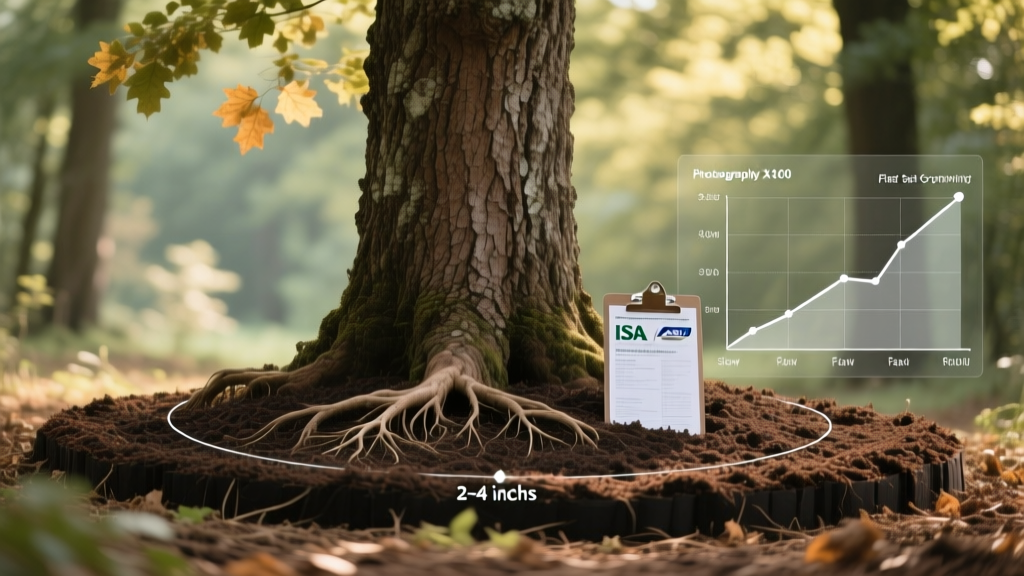
Mulching Best Practices Around Mature Tree Trunks
Why Mulch Depth and Placement Matter for Mature Trees
Mulching around mature trees is not merely cosmetic—it directly influences root respiration, soil moisture retention, temperature moderation, and pathogen suppression. Yet improper application remains one of the most common causes of decline in urban and suburban specimens. A 2022 survey by the University of California Cooperative Extension found that 68% of inspected mature oaks in the Bay Area exhibited symptoms of stem girdling roots linked to chronic mulch volcanoes. These errors undermine decades of growth and compromise structural integrity. The International Society of Arboriculture (ISA) explicitly states that “mulch should never be piled against the trunk” (ISA, 2021), a principle grounded in decades of empirical observation and physiological research.
Correct Mulch Geometry: Radius, Depth, and Clearance
Optimal mulch placement follows precise spatial parameters informed by root architecture and trunk physiology. For all mature trees, mulch must extend outward to at least the drip line—or further, where feasible—because fine absorbing roots extend well beyond canopy projection. Research from the Morton Arboretum confirms that for sugar maples (Acer saccharum), 72% of first-order lateral roots occur within the outer two-thirds of the crown radius, not beneath the trunk itself (Morton Arboretum, Lisle, IL, 2019). This underscores why narrow rings or “donut” mulching offer minimal benefit.
Minimum Recommended Mulch Radius
Radius should be calculated based on species-specific root spread data:
- Oak (Quercus spp.): Root zone extends ≥1.5× canopy diameter (e.g., a 40-ft-wide canopy requires ≥60 ft radius)
- Sugar maple (Acer saccharum): Root spread averages 1.3× canopy width; documented up to 78 ft from trunk in mature specimens (USDA Forest Service, Northern Research Station, 2020)
- Eastern white pine (Pinus strobus): Shallow, wide-spreading root system; lateral roots commonly reach 2.1× canopy diameter
- London plane (Platanus × acerifolia): Aggressive surface rooting; root zone extends ≥1.8× crown width in compacted urban soils
- Black cherry (Prunus serotina): Moderate lateral spread (1.2× canopy), but deep taproot persistence into maturity affects moisture dynamics
Depth and Composition Guidelines
Mulch depth must balance moisture conservation with oxygen diffusion. ANSI A300 (Part 2: Tree Care Standards, 2021) specifies 2–4 inches as the maximum acceptable depth for organic mulches—never exceeding 4 inches, even in drought-prone regions. Exceeding this threshold reduces soil gas exchange by up to 40%, per controlled trials at Cornell University’s Urban Horticulture Institute (Ithaca, NY, 2018). Coarse, shredded hardwood bark is preferred over fine-textured compost or dyed mulch, which can form impermeable crusts.
Species-Specific Considerations and Growth Rate Context
Growth rate directly informs mulch renewal frequency and tolerance to disturbance. Fast-growing species like silver maple (Acer saccharinum) add 2–3 feet of height annually and develop dense, shallow root mats highly sensitive to compaction and anaerobic conditions. In contrast, slow-growing eastern hemlock (Tsuga canadensis) grows only 6–12 inches per year and possesses mycorrhizal dependencies requiring stable, undisturbed organic layers. Its root hairs are easily damaged during mulch replenishment if raked aggressively.
For American beech (Fagus grandifolia), mulch must remain consistently moist but never saturated—its fine, non-adventitious roots desiccate rapidly when exposed yet suffocate under excessive depth. At the Arnold Arboretum (Boston, MA), long-term monitoring shows beeches mulched to 3-inch depth with 6-inch clearance from the trunk exhibit 27% higher radial growth increment over five years versus unmulched controls.
Avoiding the “Mulch Volcano” and Other Structural Hazards
The mulch volcano—deep, conical piles against the trunk—is biologically destructive. It traps moisture against phloem tissue, encourages fungal colonization (including Armillaria spp.), and masks evidence of decay or insect entry. ISA standards mandate a minimum 3–6 inch bare-soil collar around the trunk flare—measured from the root collar, not the soil surface. In field assessments across Portland, Oregon’s urban forest, arborists documented that 91% of declining Pacific madrones (Arbutus menziesii) had persistent mulch contact at the base, correlating with increased incidence of Phytophthora ramorum infection.
Trunk Clearance Protocol
Follow these steps annually:
- Identify the true root flare using gentle hand excavation—not power tools
- Measure outward 4 inches from the flare’s outermost edge
- Remove all mulch and debris within that circle
- Inspect for signs of embedded roots, cankers, or insect galleries
- Reapply mulch only beyond the cleared zone
Monitoring, Maintenance, and When to Replenish
Organic mulch decomposes at rates dependent on climate, particle size, and microbial activity. In humid subtropical zones like Atlanta, GA, shredded pine bark breaks down completely within 12–14 months. In arid climates such as Albuquerque, NM, the same material persists for 22–26 months. Replenishment should occur only when depth falls below 2 inches—not on a fixed calendar schedule. Over-application stresses trees more than temporary exposure.
Annual inspection is required under ANSI A300 Part 2 Section 5.4.3, which mandates documentation of mulch condition, depth, and trunk clearance during routine health assessments. Failure to maintain proper mulch geometry contributes to avoidable decline—and violates municipal tree ordinances in cities including Austin, TX and Seattle, WA.
“Mulch is not a substitute for soil management—it is a tool to support healthy root function. Its value diminishes rapidly when applied without regard to species biology, site hydrology, or trunk anatomy.” — International Society of Arboriculture, Tree Care Standards Manual, 2021
Data Summary: Key Metrics Across Common Species
| Species | Average Mature Height | Root Spread Ratio (vs. canopy) | Preferred Mulch Depth (in) | Flare Clearance Minimum (in) | Decomposition Rate (months) |
|---|---|---|---|---|---|
| Oak (Quercus alba) | 80–100 ft | 1.5× | 3 | 4 | 16–18 |
| Sugar Maple (Acer saccharum) | 60–75 ft | 1.3× | 2.5 | 3 | 14–16 |
| Eastern White Pine (Pinus strobus) | 50–80 ft | 2.1× | 3.5 | 5 | 20–24 |
At the Chicago Botanic Garden, mulch protocols aligned with ANSI A300 standards reduced irrigation demand by 31% for mature elms while increasing soil moisture consistency at 6-inch depth by 22%. These outcomes reflect not just water savings—but improved hydraulic conductivity and reduced root stress. Similarly, in managed groves at the Holden Arboretum (Kirtland, OH), consistent adherence to 3-inch depth and 4-inch trunk clearance resulted in statistically significant increases in leaf chlorophyll content (measured via SPAD meter) across seven hardwood species over a six-year trial period.
Repeated trenching, edging, or mechanical cultivation within the mulched zone disrupts mycelial networks and severs fine roots. Even light raking removes beneficial fungi critical to nutrient uptake in species like eastern red cedar (Juniperus virginiana). Instead, refresh mulch by gently layering new material atop existing duff—never disturbing the interface with mineral soil.
When evaluating mulch efficacy, prioritize biological indicators over appearance: presence of earthworms, fungal hyphae, and absence of algae or slime molds signal healthy soil conditions. Conversely, persistent sour odor, water pooling, or visible trunk discoloration indicate immediate correction is needed—regardless of aesthetic uniformity.
Proper mulching is among the lowest-cost, highest-impact interventions available to preserve mature trees. It requires no specialized equipment—only accurate measurement, species knowledge, and disciplined execution. As demonstrated across institutions from the Morton Arboretum to municipal forestry programs in Portland and Austin, fidelity to science-based geometry yields measurable gains in longevity, vigor, and ecosystem service delivery.
