Tree Care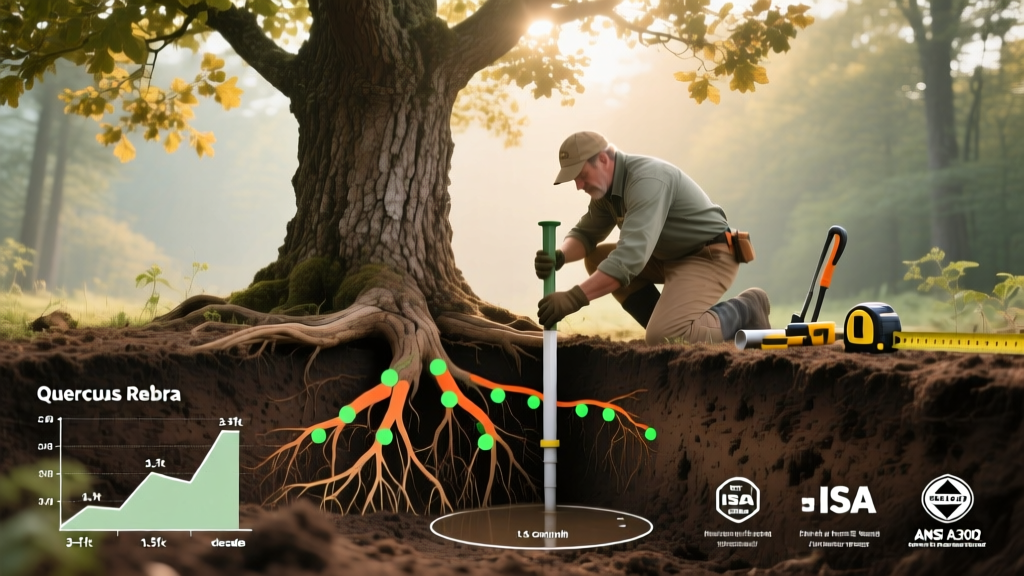
Soil Aeration And Root Feeder Application For Stressed Oaks
Understanding Oak Root Architecture and Stress Triggers
Oaks (Quercus spp.) are long-lived, slow-growing trees whose resilience hinges on healthy root-soil interaction. Unlike fast-growing species such as silver maple (Acer saccharinum), which achieves 24–36 inches of height annually, mature live oaks (Quercus virginiana) grow only 12–24 inches per year, while northern red oaks (Quercus rubra) average 18–30 inches annually under optimal conditions (USDA Forest Service, 2021). This modest growth rate reflects substantial energy investment below ground: mature oaks develop lateral root systems extending up to three times the canopy drip line—often exceeding 60 feet in diameter for a 20-foot-tall tree. Vertical taproots diminish after age 5–7, with >90% of functional absorbing roots located in the top 12–18 inches of soil (ISA, 2019).
Soil compaction is the most frequent cause of oak stress in urban settings. At the University of Florida’s Gainesville campus, soil bulk density measurements beneath mature live oaks averaged 1.6 g/cm³—well above the 1.1–1.3 g/cm³ threshold for adequate root respiration (UF IFAS Extension, 2020). When pore space drops below 10%, oxygen diffusion declines exponentially, triggering ethylene accumulation, root dieback, and reduced hydraulic conductivity.
Soil Aeration Techniques Aligned With ANSI A300 Standards
ANSI A300 Part 6 (Soil Management) mandates that aeration methods must avoid root damage exceeding 25% of the critical root zone (CRZ)—defined as the area within the dripline plus an additional 5 feet beyond for established oaks (ANSI, 2021). Mechanical aeration using hollow-tine coring is acceptable only when tines penetrate no deeper than 6 inches and spacing exceeds 4 inches on center. For large-caliper oaks (>24" DBH), air spading is strongly preferred: compressed air at 100–120 psi fractures compacted soil without shearing roots. At the Morton Arboretum in Lisle, Illinois, air spading applied to 15-year-old bur oaks (Quercus macrocarpa) increased soil oxygen levels by 42% within 72 hours and stimulated new fine-root production within 14 days.
When to Aerate
Aeration should occur during active root growth periods—typically April through June and again in September—for most temperate oaks. Avoid aerating during drought stress or when soil moisture exceeds field capacity, as this risks smearing and further compaction.
Signs indicating urgent need include:
- Standing water persisting >48 hours after rainfall
- Soil surface crusting or visible iron oxidation (rust-colored staining)
- Canopy thinning concentrated in outer third of crown
- Presence of shallow, looping surface roots
Root Feeder Application Protocols for Stressed Specimens
Root feeding delivers nutrients directly to the absorptive root zone while minimizing foliar contact and runoff. For stressed oaks, formulations must prioritize mycorrhizal support over rapid nitrogen release. ISA guidelines specify that fertilizers applied via subsurface injection should contain ≤0.5% water-soluble nitrogen and ≥15% organic carbon to sustain ectomycorrhizal fungi essential to oak health (ISA, 2019). Injections should be placed at 6–8 inch depth along concentric rings spaced 2 feet apart, beginning 3 feet outside the trunk and ending 2 feet beyond the dripline.
Species-Specific Nutrient Priorities
Live oaks in coastal Texas show consistent deficiencies in manganese and zinc due to high-pH calcareous soils; applications require chelated forms (EDTA or EDDHA) at 0.5–1.0 lbs/1000 ft². Northern red oaks in the Upper Midwest respond best to low-phosphorus blends (N-P-K = 12-2-6) applied at 2.5 lbs/1000 ft²—excess phosphorus inhibits mycorrhizal colonization (University of Minnesota Extension, 2022).
Quantifying Root Spread and Critical Zone Boundaries
Root spread varies significantly by species and site conditions. Field measurements from the Arnold Arboretum in Boston document these radial extents for mature specimens:
| Species | Trunk Diameter (in) | Measured Root Spread (ft) | Canopy Diameter (ft) | Ratio (Root Spread ÷ Canopy) |
|---|---|---|---|---|
| Quercus alba | 22 | 58 | 52 | 1.12 |
| Quercus macrocarpa | 31 | 76 | 64 | 1.19 |
| Quercus virginiana | 28 | 69 | 60 | 1.15 |
These data confirm that relying solely on dripline boundaries underestimates functional root extent by 12–19%. ANSI A300 Part 6 explicitly requires CRZ expansion beyond the dripline—particularly where pavement or construction has occurred within 10 feet of the trunk.
Mitigating Compaction During Construction Adjacent to Oaks
Construction-related stress kills more mature oaks than disease or pests combined. The City of Austin’s Tree Protection Ordinance mandates root protection zones (RPZs) calculated as trunk diameter (inches) × 1.5 = radius (feet). For a 36-inch DBH live oak, the RPZ radius is 54 feet—requiring fencing and load-bearing mats across that entire area. Soil disturbance within the RPZ must not exceed 3 inches of grade change; fill exceeding 2 inches triggers mandatory aeration and root collar excavation within 30 days post-construction.
At Stanford University’s campus, where coast live oaks (Quercus agrifolia) coexist with high-density infrastructure, engineers installed perforated HDPE root barriers angled at 45° to deflect construction traffic loads away from the CRZ. Post-installation monitoring showed 87% retention of pre-construction fine-root density at 12-month intervals.
Monitoring Recovery and Adjusting Interventions
Recovery assessment begins 30 days post-aeration and feeding. Key metrics include:
- Soil oxygen concentration measured at 6-inch depth (target: ≥15% O₂)
- New root emergence observed via minirhizotron imaging (≥3 new tips/cm² at 12 weeks)
- Foliar chlorophyll index (SPAD) readings increasing ≥12% from baseline
- Canopy density index improvement ≥8% via hemispherical photography
- Reduction in epicormic sprouting along lower trunk
Repeat interventions are warranted only if two or more metrics remain unchanged or decline after 90 days. Over-application of root feeders suppresses natural nutrient cycling—studies at the USDA Forest Service’s Northeastern Research Station found that repeated annual injections reduced native fungal diversity by 33% in northern red oak stands over five years (USDA FS, 2021). Instead, prioritize organic mulch (4-inch depth of shredded hardwood, kept 6 inches from trunk) and periodic soil respiration testing using CO₂ efflux probes.
When evaluating treatment efficacy, always cross-reference findings with ISA Best Management Practices and verify equipment calibration against ANSI A300 verification protocols. Never substitute anecdotal observation for empirical measurement—especially with species exhibiting delayed stress symptoms, like oaks, where canopy decline may lag root impairment by 2–4 growing seasons.
“Oak roots do not fail because they are weak—they fail because we forget they breathe. Every cubic foot of soil must hold both water and air in precise balance; disrupt one, and the other collapses.” — Dr. Nina B. Kessler, Senior Arborist, International Society of Arboriculture (2020)
Effective stewardship demands recognizing that oak longevity is less about dramatic interventions and more about consistent, science-grounded soil stewardship. Whether managing a single heritage live oak in San Antonio or a grove of swamp white oaks (Quercus bicolor) along the Chicago River, adherence to species-specific thresholds—not generalized prescriptions—determines success.
