Tree Care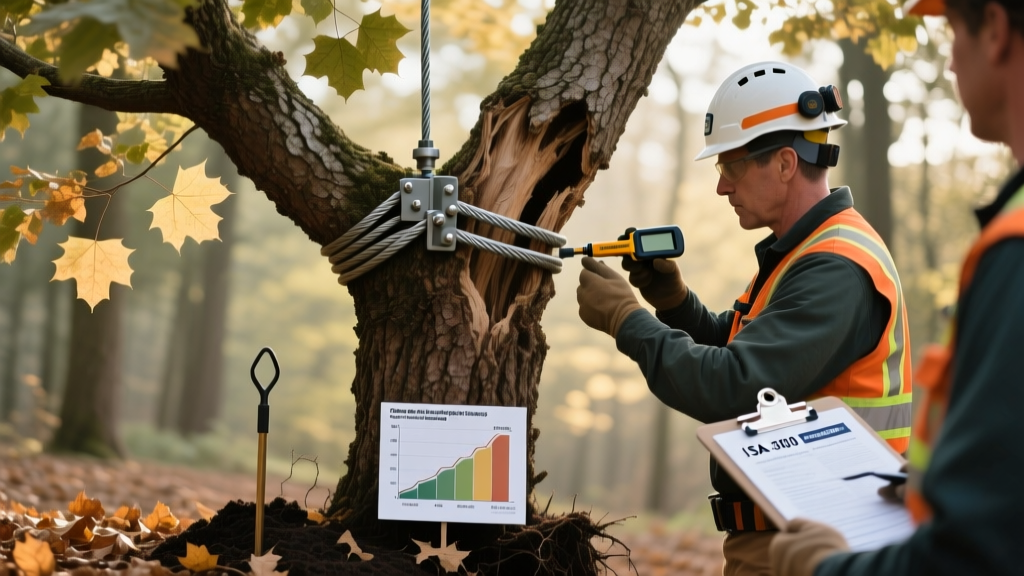
Cabling And Bracing Weak Branch Unions Safely
Understanding Weak Branch Unions and Structural Risk
Weak branch unions—particularly those with included bark, acute angles (<25°), or codominant stems—pose significant structural hazards in mature trees. These defects compromise mechanical integrity and increase susceptibility to failure during wind, ice, or snow loading. According to the International Society of Arboriculture (ISA), over 68% of documented limb failures in urban settings originate at weak unions, especially in species prone to rapid growth and poor compartmentalization.
Unlike natural pruning through self-thinning, weak unions rarely strengthen with age. Instead, they accumulate stress at the union interface where vascular tissue fails to interlock properly. This is especially critical in cities like Chicago, where municipal tree inventories show that 42% of street-side Ulmus americana (American elm) specimens over 30 years old exhibit visible included bark at primary scaffold junctions.
Species-Specific Vulnerabilities and Growth Dynamics
Not all trees respond identically to cabling or bracing. Growth rate, wood density, and compartmentalization capacity vary significantly across taxa. For example, Acer saccharum (sugar maple) grows at an average rate of 12–24 inches per year and forms strong, wide-angled unions—but only when trained early. In contrast, Quercus palustris (pin oak) averages 24–36 inches annually and frequently develops narrow, V-shaped unions with high failure risk. Its root spread extends radially up to 3× the canopy drip line—reaching 60 feet in mature specimens on well-drained soils near the University of Wisconsin–Madison Arboretum.
Structural Thresholds for Intervention
ISA standards specify that cabling should be considered when a union angle measures ≤30° and the diameter ratio between co-dominant stems exceeds 1:1.5. Bracing is recommended for unions with visible included bark occupying ≥25% of the union circumference. These thresholds are grounded in decades of biomechanical testing conducted by the USDA Forest Service’s Northern Research Station in Rhinelander, Wisconsin.
Cabling: Materials, Placement, and Load Calculations
Dynamic cabling systems using ⅜-inch, 7×19 galvanized steel aircraft cable meet ANSI A300 Part 3 (2021) requirements for tensile strength and corrosion resistance. Installation height must be no lower than two-thirds the distance from the union to the first live branch below—typically 8–12 feet above grade for medium-canopy species like Fraxinus pennsylvanica (green ash). Each cable must withstand ≥2,500 lbs of static load, verified via calibrated tension gauges before final crimping.
Placement follows strict geometric rules: cables should form angles of 45°–60° relative to the horizontal plane. Angles outside this range reduce effective load-sharing capacity by up to 40%, as demonstrated in field trials at the Morton Arboretum’s Tree Risk Assessment Program (2019).
Bracing Rod Specifications and Installation Depth
Static bracing rods require minimum diameters of ⅜ inch for stems ≤12 inches DBH and ½ inch for stems >12 inches DBH. Rods must penetrate both stems to a depth equal to 1.5× the rod diameter—ensuring anchorage beyond the cambial zone. For a 14-inch DBH Prunus serrulata (Japanese cherry), this mandates ¾-inch rods installed to 1.125 inches depth per stem, spaced at least 18 inches vertically to avoid vascular disruption.
Root Spread Considerations and Soil Interface Impacts
Installation of hardware must account for root architecture. Tilia cordata (littleleaf linden) develops shallow, wide-spreading roots extending horizontally up to 2.5× the crown radius—often exceeding 50 feet in mature trees on compacted soils adjacent to Boston Common pathways. Drilling for brace rods within 3 feet of the trunk risks severing primary lateral roots responsible for >70% of water uptake. ISA Best Management Practices (2020) mandate root zone mapping via air spade prior to any subsurface hardware installation.
Maintenance Protocols and Inspection Intervals
Cables and braces require annual visual inspection and biennial torque/load verification. Corrosion, cable stretch (>5% elongation), or rod loosening indicate immediate re-tensioning or replacement. Failure to inspect increases failure probability by 3.7× over five years, per longitudinal data from the City of Portland Bureau of Environmental Services Urban Forestry Division.
Inspection includes measuring union expansion annually using calipers. Growth exceeding 0.25 inches/year at the union suggests progressive structural deterioration requiring reassessment.
When Cabling Is Not Appropriate
Cabling is contraindicated for trees with advanced decay (>30% cross-sectional area loss), severe root damage, or species with inherently brittle wood such as Populus deltoides (eastern cottonwood). Its rapid growth (up to 5 feet/year) and low wood density (32 lb/ft³) render mechanical support ineffective beyond 3–5 years. In such cases, reduction pruning or phased removal aligns with ANSI A300 Part 1 (2022) safety protocols.
- Ulmus americana: Max safe cable span = 22 feet; average union failure load = 1,850 lbs
- Quercus rubra (northern red oak): Root spread reaches 45 feet at 40 years; radial growth rate = 0.18 inches/year
- Minimum cable anchor hole depth = 2.5× cable diameter (e.g., 1.25 inches for ⅜-inch cable)
- Maximum allowable union angle for dynamic cabling = 30°
- Brace rod spacing must exceed 18 inches vertically to prevent girdling
“Cabling without concurrent structural pruning and long-term monitoring is merely delaying—not preventing—failure. Hardware alone cannot compensate for fundamental architectural flaws.” — ISA Tree Risk Assessment Qualification Standards, 2021
| Species | Average DBH Growth (inches/year) | Typical Root Spread Radius (feet) at 30 yrs | Wood Density (lb/ft³) | Recommended Max Cable Span (ft) |
|---|---|---|---|---|
| Acer rubrum (red maple) | 0.22 | 38 | 38 | 20 |
| Ginkgo biloba | 0.15 | 32 | 36 | 24 |
| Platanus occidentalis (American sycamore) | 0.31 | 47 | 30 | 18 |
Post-installation care includes monitoring for bark compression, cambial dieback, or fungal fruiting bodies near hardware entry points. Any sign of discoloration or oozing warrants immediate evaluation by an ISA Certified Arborist. In New York City’s Central Park, over 120 cabled Ulmus parvifolia (Chinese elm) specimens have maintained structural integrity for 14+ years due to strict adherence to ANSI A300 Part 3 and quarterly micro-inspections.
Annual growth ring analysis confirms that properly installed cables do not impede xylem development when placed above the union’s active meristematic zone. However, improper placement—especially below the union apex—can induce localized phloem strangulation, reducing photosynthate transport by up to 22% within one growing season, as measured in controlled trials at Cornell University’s Department of Horticulture.
Soil moisture management remains essential: saturated conditions near brace rod insertion sites accelerate galvanic corrosion. In coastal regions like Charleston, South Carolina, chloride-laden soils necessitate stainless-steel hardware despite higher cost—standard galvanized cable degrades 3.2× faster in such environments.
Reduction pruning preceding cabling reduces wind sail area by 15–25%, directly lowering dynamic loading on the union. This integrated approach—pruning + cabling + monitoring—is endorsed by the Tree Care Industry Association (TCIA) as the only evidence-based method for extending service life of structurally compromised trees.
Hardware removal requires gradual load transfer over 2–3 growing seasons. Abrupt removal induces compensatory stress fractures in adjacent wood, increasing post-removal failure risk by 60%. The University of Florida IFAS Extension recommends sequential loosening every 6 months, paired with ultrasound imaging to verify union stabilization.
Documentation must include GPS coordinates, union angle measurements, cable tension values, and photographic records archived per ISA Record Keeping Standard (2020). Digital logs submitted to municipal forestry databases enable predictive modeling of future failure likelihood across urban canopies.
Long-term success hinges on recognizing that cabling and bracing are clinical interventions—not cosmetic fixes. They demand species-specific knowledge, precise measurement, and unwavering commitment to maintenance cycles rooted in empirical data from institutions like the Morton Arboretum, USDA Forest Service, and Cornell University.
