Gardening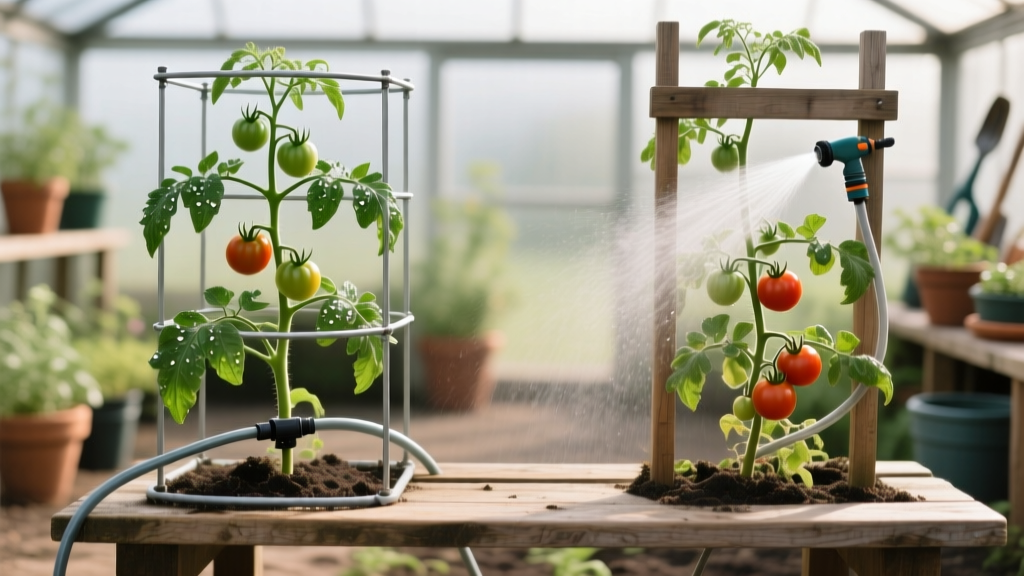
Tomato Cage Vs Trellis: 2026 Irrigation Setup Guide
Robert HayesPublished
The Intersection of Plant Architecture and Hydrology in 2026
As we navigate the 2026 gardening season, water conservation and precision irrigation have moved from commercial agriculture into the home backyard. With municipal water restrictions tightening and smart home ecosystems evolving, how you support your tomato plants fundamentally dictates how you must water them. The debate between tomato cages and trellises is usually framed around aesthetics, harvest ease, or space constraints. However, from an irrigation perspective, your choice of support structure alters sprinkler throw patterns, drip line placement, soil moisture retention, and disease vulnerability.
According to the EPA WaterSense program, outdoor water use accounts for nearly a third of all residential water consumption, making efficient delivery systems critical. Whether you are utilizing overhead rotary sprinklers, subsurface drip lines, or smart soil-moisture sensors, understanding the fluid dynamics of your plant canopy is essential. This comprehensive guide compares tomato cages and trellis systems strictly through the lens of modern irrigation efficiency, helping you design a watering strategy that saves time, conserves water, and maximizes your 2026 yield.
Tomato Cages: Navigating Irrigation Obstacles
Traditional wire tomato cages are the default choice for many home gardeners, but they present unique challenges for both overhead sprinklers and ground-level drip systems. When evaluating cages for your 2026 garden, you must account for the physical barrier the wire creates between your water source and the plant's root zone.
The 'Rain Shadow' Effect with Overhead Sprinklers
If you rely on oscillating or rotary sprinklers, tomato cages create a significant problem known as the 'rain shadow' effect. As the tomato plant grows and fills out the cage, the dense foliage and wire grid block overhead water droplets. The outer leaves become saturated—which promotes fungal diseases—while the soil directly at the base of the stem remains surprisingly dry. To combat this, gardeners often overwater the zone, leading to runoff and wasted resources. If you must use sprinklers around cages, elevating the sprinkler head above the canopy or using low-angle rotary nozzles that shoot beneath the foliage is mandatory.
Drip Irrigation and Bubbler Emitters
For drip irrigation, cages require circular or spiral tubing layouts. Wrapping 1/4-inch soaker hoses or drip rings around the base of a cage is tedious and prone to displacement when you are tying up heavy, fruit-laden branches. A superior 2026 solution for caged tomatoes is the use of shrub adapters with adjustable bubbler emitters connected to a main 1/2-inch poly line. By staking a bubbler emitter directly into the center of the cage near the main stem, you bypass the tangled outer roots and deliver water exactly where the primary taproot requires it.
Trellis Systems: Linear Irrigation Efficiency
Trellising methods—such as the Florida Weave, cattle panel arches, or vertical string training—create a linear, organized canopy. From an irrigation engineering standpoint, trellises are vastly superior for targeted water delivery and system automation.
Inline Drip Tape Integration
Because trellised tomatoes are planted in straight, uniform rows, they are perfectly suited for inline drip tubing. Products featuring integrated pressure-compensating emitters spaced every 12 inches can be laid in a single, continuous line directly beneath the plant stems. This ensures uniform moisture distribution across the entire row without the need to coil, splice, or secure individual drip rings. The linear layout also makes winterizing and spring maintenance significantly faster, as you can easily pull up a single line of drip tape rather than untangling a web of micro-tubing from dozens of wire cages.
Sprinkler Compatibility and Airflow
If overhead watering is your only option, trellised rows allow you to align your sprinkler zones parallel to the plants. By positioning rotary sprinklers at the ends of the rows, water can travel down the linear corridors with minimal foliage interference. Furthermore, trellised plants benefit from superior airflow. When overhead water does land on the leaves, the increased wind penetration dries the foliage much faster than it would inside the humid microclimate of a wire cage.
2026 Support and Irrigation Comparison Matrix
| Feature | Wire Tomato Cages | Linear Trellis Systems |
|---|---|---|
| Drip Line Layout | Circular / Spiral (High labor) | Straight Inline (Low labor) |
| Sprinkler Interference | High (Creates rain shadows) | Low (Allows parallel corridors) |
| Soil Sensor Placement | Inconsistent (Scattered zones) | Uniform (Representative row data) |
| Foliage Drying Time | Slow (Trapped humidity) | Fast (Optimal cross-breeze) |
| Mulch Application | Difficult around wire base | Easy along linear drip line |
Smart Controllers and Soil Moisture Sensors
The 2026 gardening market is dominated by smart irrigation controllers that rely on real-time data. Systems like the Rachio 4 or B-hyve smart timers integrate with wireless soil moisture sensors to trigger watering only when the root zone drops below a specific volumetric water content (VWC). Trellis systems provide a massive advantage here. Because trellised plants share a uniform root zone environment along a single drip line, a single soil moisture sensor placed in the middle of the row provides highly accurate, representative data for the entire zone.
Conversely, scattered tomato cages create microclimates. A cage near a fence may dry out faster than a cage in the open yard, rendering a single soil sensor inaccurate for the whole garden bed. If you commit to cages, you may need to invest in multiple moisture sensors to prevent your smart controller from overwatering shaded plants while underwatering exposed ones.
Disease Management Through Targeted Watering
Watering efficiency is not just about conservation; it is the primary defense against devastating crop diseases. The University of Minnesota Extension emphasizes that keeping tomato foliage dry is the most effective cultural practice for preventing early blight, late blight, and septoria leaf spot. These fungal pathogens require prolonged periods of leaf wetness to germinate and infect plant tissue.
Trellising paired with subsurface or ground-level drip irrigation is the gold standard for disease prevention. By keeping the canopy elevated and the water restricted to the soil line, you eliminate the splash-back effect where soil-borne spores are propelled onto the lower leaves by rain or overhead sprinklers. While you can use drip irrigation with cages, the dense, bushy growth habit that cages encourage often leads to lower branches touching the wet mulch or soil, negating the benefits of the drip system. Trellising allows you to aggressively prune the bottom 12 inches of suckers and branches, creating a physical gap between the wet soil and the lowest foliage.
Mulching Strategies for Evaporation Control
No irrigation discussion is complete without addressing evaporation. According to The Old Farmer's Almanac, applying a thick layer of organic mulch is essential for retaining soil moisture and regulating root temperatures. The physical footprint of your support system dictates how you mulch.
- Cages: The wide, flared base of standard wire cages makes laying down large sheets of cardboard or landscape fabric difficult. You are often forced to use loose straw or wood chips, which can blow away or wash out during heavy irrigation cycles, exposing the soil and increasing evaporation rates.
- Trellises: Linear trellis rows allow you to unroll continuous sheets of biodegradable weed mat or lay down overlapping cardboard easily. You can then cover this with a uniform layer of arborist wood chips. This continuous mulch blanket works synergistically with inline drip tubing, trapping the moisture in the soil and reducing your overall irrigation runtimes by up to 30 percent.
Final Verdict for the 2026 Season
If your primary goal is to maximize irrigation efficiency, minimize water waste, and integrate seamlessly with modern smart drip systems, the trellis is the undisputed winner for 2026. Trellises respect the geometry of linear drip tape, promote rapid foliage drying, and allow for accurate soil moisture monitoring. Tomato cages, while convenient for small-scale container gardening or indeterminate cherry tomatoes, act as physical barriers to overhead sprinklers and complicate ground-level drip maintenance. By aligning your plant support method with your irrigation infrastructure, you will cultivate a healthier, more resilient, and highly productive tomato harvest this season.
