Pest Control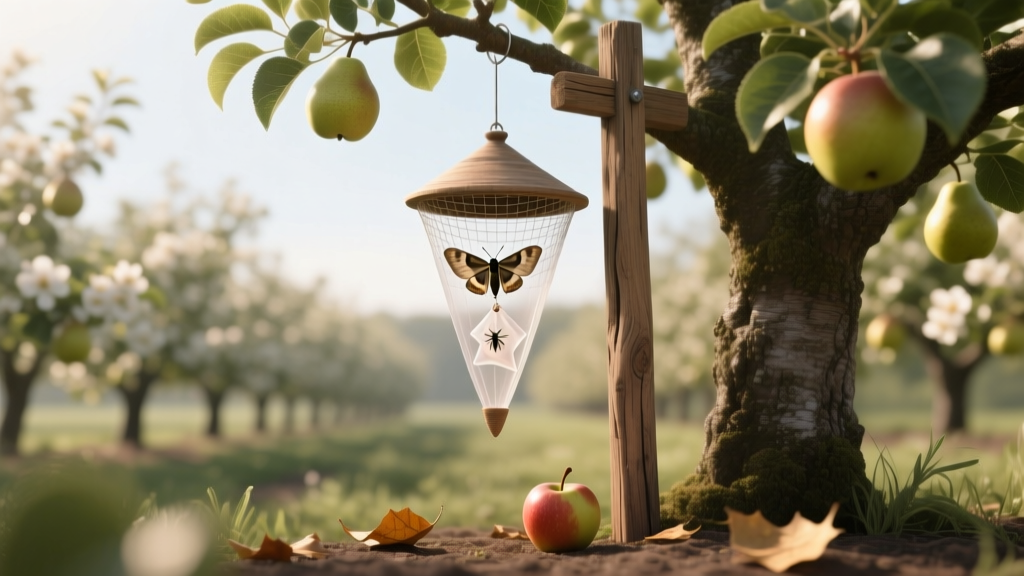
Codling Moth Pheromone Traps 2026: Bio-Control Timing Guide
Emily WatsonPublished
The Shift to Precision Bio-Control in 2026
For decades, home orchardists and commercial growers alike have battled the codling moth (Cydia pomonella), the notorious pest responsible for the classic 'worm in the apple.' Historically, the response to this pest was a calendar-based regimen of broad-spectrum insecticides. However, as we navigate the 2026 growing season, the paradigm has firmly shifted toward Integrated Pest Management (IPM) and bio-control. Broad-spectrum sprays not only disrupt local ecosystems but also decimate the very beneficial insects that help keep secondary pests—like aphids and spider mites—in check.
To protect your apple, pear, and walnut trees without sacrificing your garden's beneficial insect populations, precision is key. This is where pheromone trap monitoring becomes the cornerstone of your orchard's defense strategy. By tracking the exact flight patterns of male codling moths, you can accurately time the release of biological control agents, ensuring maximum efficacy while minimizing environmental impact.
Why Pheromone Monitoring is Crucial for Beneficial Insects
Pheromone traps do not control the pest population; they are purely monitoring tools. These traps utilize codlemone, a synthetic version of the female codling moth's sex pheromone, to lure and capture male moths. By counting the captured males weekly, you establish a 'biofix'—the first date of sustained moth flight. This biofix is the starting line for calculating degree days, a heat-accumulation model that predicts the exact timing of egg-laying and hatching.
Why does this matter for bio-control? Biological agents are highly targeted and often have narrow windows of effectiveness. For instance, Trichogramma wasps must be released precisely when codling moth eggs are laid so the wasps can parasitize them. If you release them too early, they die before finding host eggs; too late, and the caterpillars have already hatched and bored into your fruit. Pheromone monitoring removes the guesswork, allowing you to deploy beneficials exactly when nature requires them.
Setting Up Your Delta Trap: 2026 Best Practices
In 2026, the market offers highly efficient, weather-resistant delta traps and wing traps equipped with extended-release meso-lures that last up to 90 days, reducing the need for frequent replacements. Here is how to properly deploy your monitoring station:
- Timing: Hang your traps in early spring, just as the apple tree buds begin to show pink (typically late March to mid-April, depending on your hardiness zone).
- Placement: Position the trap at eye level (about 5 to 6 feet high) in the outer canopy of the tree, preferably on the south or west side where afternoon winds will carry the pheromone plume.
- Density: For a home orchard, one trap per 5 acres is sufficient for detection. If you have a dense backyard planting of 3 to 5 trees, a single centrally located trap will adequately monitor the local airspace.
- Maintenance: Check the trap every 3 to 4 days. Use a small brush or tweezers to remove moths and debris from the sticky liner. Replace the sticky liner when it becomes coated with dust or non-target insects, and replace the pheromone lure according to the manufacturer's 2026 specifications (usually every 60 to 90 days).
Understanding Degree Days and Biofix
Once you catch your first moth, you must record the date as your 'biofix.' From this date forward, you will track daily high and low temperatures to calculate degree days (DD). The codling moth development model uses a lower threshold of 50°F (10°C) and an upper threshold of 88°F (31°C). Most local university extension offices and 2026 smart-weather garden apps automatically calculate these degree days for you based on your zip code.
According to the University of California Integrated Pest Management (UC IPM) program, tracking degree days allows growers to anticipate the vulnerable life stages of the codling moth. This predictive power is what makes organic and bio-control methods viable on a commercial and home-orchard scale.
Timing Bio-Control Interventions
Once your degree days begin accumulating past the biofix, you can initiate your bio-control strategy. Below is a structured timeline for deploying biological agents based on trap monitoring and heat accumulation.
| Degree Days (DD) After Biofix | Pest Life Stage | Bio-Control Action Required |
|---|---|---|
| 100 - 200 DD | Peak moth flight and mating | Deploy mating disruption dispensers if not already active. Ensure beneficial insect habitats (yarrow, dill, alyssum) are blooming to support generalist predators. |
| 250 - 300 DD | Egg laying begins | Release Trichogramma parasitic wasps. These microscopic wasps will seek out and parasitize codling moth eggs on the leaves and fruit. |
| 300 - 350 DD | First egg hatch (larvae emerge) | Apply Codling Moth Granulovirus (CpGV) or organic Spinosad. CpGV is a highly specific virus that only targets codling moth larvae, leaving all beneficial insects completely unharmed. |
| 1060 DD | Second generation flight begins | Reset monitoring. Prepare for a second release of Trichogramma and a second targeted application of CpGV if trap counts exceed the economic threshold. |
| Post-Harvest / Late Autumn | Larvae seeking overwintering sites | Apply beneficial nematodes (Steinernema feltiae) to tree trunks and soil base to infect overwintering pupae. |
Deploying Key Bio-Control Agents
Trichogramma Wasps
Trichogramma are minute, stingless wasps that parasitize the eggs of over 200 species of moths and butterflies. When monitoring indicates that egg-laying is imminent (around 250 DD), you can order Trichogramma cards from biological suppliers. These cards contain thousands of parasitized host eggs ready to hatch. Simply staple the cards to the shaded interior leaves of your fruit trees. The emerging wasps will immediately begin hunting codling moth eggs, effectively stopping the pest before it can damage the fruit.
Codling Moth Granulovirus (CpGV)
CpGV is a naturally occurring, host-specific virus that acts as a powerful bio-insecticide. When newly hatched larvae ingest the virus while chewing through the apple skin, it replicates within their gut, killing them within 3 to 5 days. Because it is entirely specific to the codling moth, it poses zero risk to bees, ladybugs, lacewings, or the Trichogramma wasps you just released. The Washington State University Tree Fruit Extension highly recommends CpGV as a cornerstone of organic codling moth management programs.
Beneficial Nematodes
Codling moth larvae overwinter as pupae in the bark crevices of the tree trunk and in the soil litter directly beneath the canopy. In early spring (before the biofix) and again in late autumn, apply the beneficial nematode Steinernema feltiae. Mix the nematodes with water and spray them directly onto the trunk, major scaffold branches, and the soil within a 3-foot radius of the tree. The nematodes actively seek out the pupae, entering their bodies and releasing bacteria that kill the pest within 48 hours.
Integrating Mating Disruption and Sanitation
Pheromone monitoring also tells you when it is safe to rely on mating disruption. Mating disruption involves hanging hundreds of pheromone dispensers throughout the orchard, flooding the air with synthetic female scent so that males become confused and cannot locate real females to mate. However, mating disruption is most effective when the initial population is already low. If your delta trap catches more than 5 to 10 moths per week in early spring, you may need to use targeted organic sprays or beneficial nematodes to knock the population down before relying solely on mating disruption.
Finally, no bio-control program is complete without rigorous orchard sanitation. Throughout the summer, pick up and destroy any dropped, infested fruit. In late May, wrap bands of corrugated cardboard around the lower trunks of your trees. The larvae will naturally seek out these dark, fluted crevices to pupate. Every two weeks, remove the cardboard bands and destroy them, physically removing thousands of pests from your orchard without ever reaching for a chemical spray.
Conclusion
Mastering pheromone trap monitoring transforms you from a reactive sprayer into a proactive orchard manager. By leveraging the data provided by delta traps and degree-day models in 2026, you can orchestrate a symphony of biological controls—from Trichogramma wasps and beneficial nematodes to highly targeted granuloviruses. This precision not only guarantees a harvest of pristine, worm-free apples and pears but also preserves the rich, beneficial insect biodiversity that keeps your entire garden ecosystem thriving.