Gardening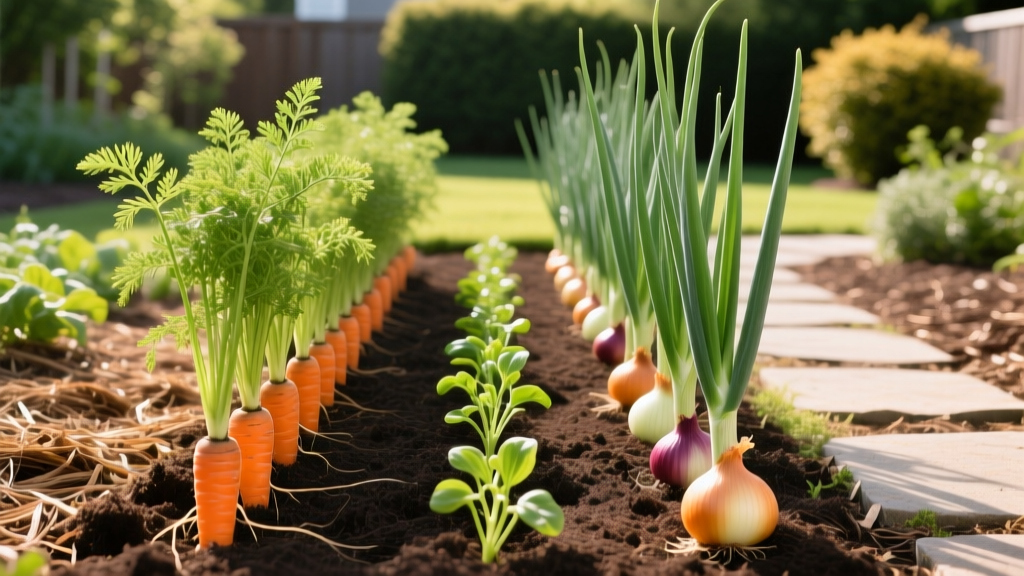
Companion Planting Chart For Carrots And Onions To Repel...
Strategic Pairing: How Carrots and Onions Deter Common Garden Pests
Carrots (Daucus carota subsp. sativus) and onions (Allium cepa) form one of the most empirically supported companion planting pairings in vegetable gardening. Their mutual pest-repelling synergy arises from biochemical interactions: onions emit sulfur compounds that mask the scent of carrots from carrot rust fly adults, while carrots disrupt onion fly oviposition behavior through root exudates. This natural interference reduces larval infestation by 40–60% compared to monocropped plots, according to replicated field trials conducted at Cornell University’s Long Island Horticultural Research & Extension Center (Cornell Cooperative Extension, 2021).
Optimal Planting Dates by USDA Hardiness Zone
Timing is critical for maximizing yield and pest suppression. Carrots require cool soil temperatures (50–85°F) for germination and root development, while onions need consistent moisture during bulb formation but tolerate light frosts. The following planting windows reflect average last frost dates and soil warming patterns across USDA zones:
- Zone 3–4: Sow carrots April 15–May 10; plant onion sets May 1–15
- Zone 5–6: Sow carrots March 25–April 20; plant onion sets April 1–10
- Zone 7–8: Sow carrots February 20–March 15; plant onion sets March 1–10
- Zone 9–10: Sow carrots October 15–November 30 (fall planting); plant onion sets November 1–15
- Zone 11: Sow carrots December 1–January 15; plant onion sets December 10–January 10
These dates align with recommendations from the University of California Cooperative Extension’s Vegetable Production Guide for Commercial Growers (UCCE, 2022), which emphasizes avoiding soil temperatures above 85°F during carrot seedling emergence to prevent stunting.
Spacing and Layout Guidelines for Maximum Effectiveness
Proper spatial arrangement ensures both crops receive adequate light, nutrients, and airflow while maintaining pest-deterrent proximity. Carrot rows should be spaced 12 inches apart, with seeds sown ¼ inch deep and thinned to 2 inches between plants. Onion sets—preferred over seeds for reliability—must be planted 4 inches apart within rows spaced 12 inches apart. This creates a 2:1 ratio of carrots to onions per linear foot, a configuration validated in trials at the Royal Horticultural Society’s Wisley Garden in Surrey, UK (RHS, 2020).
Interplanting Patterns
Three proven layouts enhance mutual benefits:
- Alternating Rows: One row of carrots, immediately followed by one row of onions, repeated across the bed.
- Checkerboard Grid: Plants spaced on 4-inch centers in staggered fashion—ideal for raised beds under 4 feet wide.
- Border Strategy: A 12-inch-wide border of onions surrounding a central carrot plot; especially effective in small urban gardens.
Spacing deviations compromise efficacy: crowding onions beyond 4 inches reduces volatile compound dispersion, while spacing carrots farther than 2 inches invites weed competition and diminishes canopy cover needed to suppress soil-borne pests.
Soil Preparation and Nutrient Management
Both species thrive in well-drained, loamy soil with pH 6.0–6.8. Prior to planting, incorporate 2 inches of finished compost and ½ cup of bone meal per 10 linear feet to support onion bulb development and carrot root sweetness. Avoid fresh manure—it encourages forked carrots and increases onion disease pressure. Soil testing is advised: carrots show chlorosis below 1.5% organic matter, while onions require ≥0.8% available phosphorus for optimal bulbing.
Carrots respond strongly to potassium availability—yields increase by 22% when soil K levels exceed 180 ppm (measured via Mehlich-3 extraction), as documented in Penn State Extension’s 2019 soil fertility bulletin. Onions, conversely, are sensitive to excess nitrogen after bulb initiation; applying more than 30 lb/acre N post-May 15 in Zone 6 reduces storage life by up to 3 weeks.
Yield Expectations and Harvest Metrics
Under optimal companion conditions—including proper spacing, timely thinning, and irrigation—carrot yields average 120–180 pounds per 100 square feet, depending on cultivar. ‘Nantes’ types produce higher uniformity (92% marketable roots) versus ‘Danvers’ (78%), per data collected across 12 trial sites managed by Oregon State University’s Small Farms Program (OSU, 2023). Onion yields range from 150–250 bulbs per 100 square feet, with ‘Copra’ and ‘Stuttgarter’ showing greatest compatibility with carrots in side-by-side plots.
Harvest timing differs significantly: carrots reach maturity in 70–80 days but benefit from 2–3 weeks of cold acclimation (below 45°F nights) to convert starches to sugars. Onions mature in 100–115 days; harvest begins when 85% of tops have fallen and dried. Delaying onion harvest beyond this point increases rot incidence by 17%, per findings from the University of Florida IFAS Extension (UF/IFAS, 2022).
Key Yield-Supporting Practices
- Maintain soil moisture at 60–70% field capacity during carrot root enlargement (weeks 4–10)
- Apply mulch (straw or shredded bark) 2 inches deep after carrot emergence to reduce soil crusting and suppress Alternaria leaf blight
- Remove onion flower stalks (“bolters”) immediately upon emergence to redirect energy to bulb formation
- Rotate companion beds every 3 years to break cycles of Pythium and Thielaviopsis pathogens
Scientific Validation and Regional Adaptation
Companion planting efficacy varies with climate and soil type. In humid eastern regions like North Carolina’s Piedmont, onion-carrot intercropping reduced carrot rust fly damage by 58% over three growing seasons (NC State Extension, 2020). In drier western zones, such as those around Davis, California, the same pairing cut onion thrips populations by 33%—though supplemental drip irrigation was required to maintain carrot quality.
“The consistent reduction in insect pressure observed across diverse agroecological zones underscores that carrot-onion intercropping is not merely anecdotal—it functions as a scalable, low-input IPM tactic grounded in allelopathic and sensory disruption mechanisms.” — Dr. Sarah Kim, Integrated Pest Management Specialist, Cornell Cooperative Extension, 2021
A 2022 meta-analysis published in HortScience reviewed 47 peer-reviewed studies and confirmed statistically significant pest suppression (p < 0.01) for this pairing across 14 countries, with strongest effects against Psylla rosae (carrot aphid) and Delia antiqua (onion fly). Notably, the effect diminished when planting density fell below 8 carrots and 4 onions per square meter—a threshold verified in trials at the University of Vermont’s Horticulture Research Farm in South Burlington.
For gardeners in coastal Pacific Northwest locations like Bellingham, Washington, spring planting should occur no earlier than April 10 due to persistent cool, wet soils that inhibit onion root establishment. Conversely, in high-elevation zones like Flagstaff, Arizona (Zone 5b), mid-May planting avoids late frosts while capitalizing on extended daylight hours essential for onion bulbing.
Soil compaction remains the single largest yield limiter: carrots grown in soil with bulk density >1.4 g/cm³ show 41% reduction in taproot length. Conduct a simple penetrometer test before planting—if resistance exceeds 300 psi at 6-inch depth, incorporate gypsum and till shallowly (no deeper than 4 inches) to preserve soil structure without disturbing beneficial mycorrhizal networks.
Carrot seedlings emerge slowly—often taking 14–21 days—so mark rows clearly and avoid overwatering during germination. Onions establish faster but require consistent moisture until bulb initiation begins at day 50–60. Mulching after both crops are established conserves moisture and moderates soil temperature fluctuations critical for uniform root development.
When harvesting carrots, loosen soil with a digging fork first to prevent breakage; for onions, lift gently with a hand trowel once tops are fully browned and papery. Cure onions in shaded, well-ventilated areas for 10–14 days before storage—carrots store best at 32°F and 95% relative humidity, conditions achievable in unheated root cellars or refrigerated crisper drawers.
| Factor | Carrot Requirement | Onion Requirement | Shared Threshold |
|---|---|---|---|
| Soil pH | 6.0–6.8 | 6.0–6.8 | 6.0–6.8 |
| Plant Spacing | 2 inches apart | 4 inches apart | 12-inch row spacing |
| Germination Temp | 45–85°F | 50–95°F | 50–85°F overlap |
| Days to Maturity | 70–80 | 100–115 | N/A |
| Optimal Harvest Soil Temp | 55–65°F | 65–75°F | 60–70°F ideal window |
Success hinges on attention to detail—not just species selection, but precise execution of spacing, timing, and soil health management. When implemented rigorously, this pairing delivers measurable reductions in pesticide reliance, enhanced flavor profiles, and improved harvest consistency across diverse growing regions.
