Lawn Care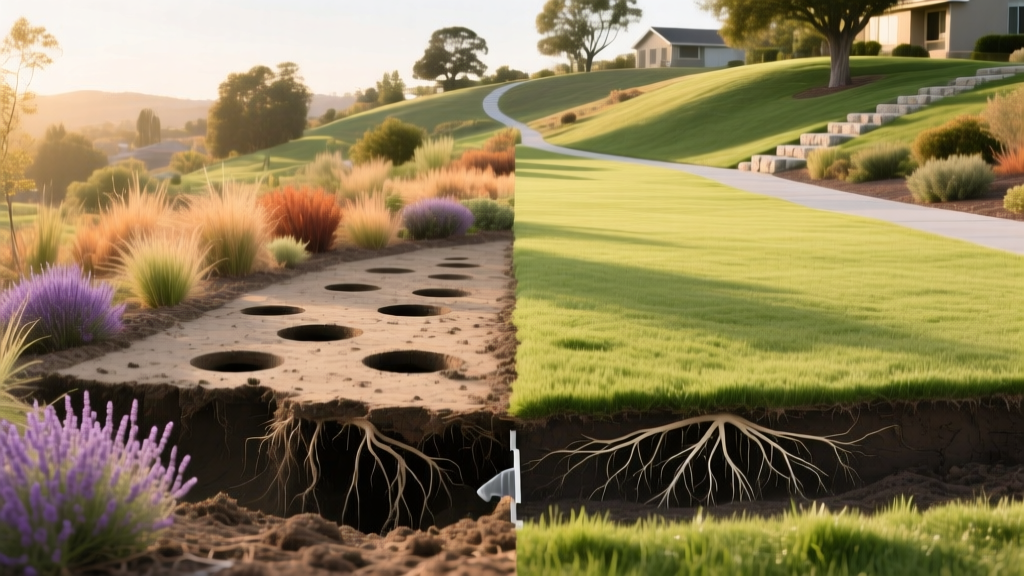
Core vs Liquid Aeration for Fire-Safe Lawns in 2026
Sarah ChenPublished
Introduction to Fire-Resistant Landscaping in 2026
As we navigate the 2026 fire season, homeowners in wildfire-prone regions are increasingly recognizing that a lush, well-hydrated lawn is one of the most effective natural firebreaks available. Fire-resistant landscaping is no longer just about choosing the right hardscaping materials or planting succulents; it is fundamentally about creating a 'defensible space' that can halt the spread of radiant heat and catching wind-blown embers. At the heart of this strategy lies soil health and turf hydration. However, a critical debate continues to dominate the lawn care industry this year: when it comes to maintaining a fire-safe greenbelt, which method is truly more effective—traditional core aeration or modern liquid aeration?
In this comprehensive guide, we will break down the science, costs, and practical applications of both aeration methods specifically through the lens of fire-resistant landscaping. By understanding how soil structure impacts water retention and thatch accumulation, you can make an informed decision to protect your property in 2026 and beyond.
The Role of the Lawn in Defensible Space
According to FEMA's Ready.gov wildfire preparedness guidelines, creating defensible space around your home is critical for giving firefighters a safe area to defend your property and for slowing the advance of a wildfire. Zone 0 (the immediate 0-5 foot perimeter) and Zone 1 (5-30 feet from the home) require careful vegetation management.
A healthy, actively growing, and well-watered lawn acts as a non-combustible carpet. Unlike dry shrubs or wooden mulch, a hydrated turfgrass canopy has a high moisture content that absorbs radiant heat and extinguishes airborne embers. However, a lawn can only serve this protective function if its root system is deep enough to access subsurface moisture during drought conditions, and if the surface is completely free of dry, dead organic matter. This is where aeration becomes a vital fire-safety practice.
Compacted soil prevents water from penetrating deeply, leading to shallow root systems that dry out rapidly in the summer heat. Furthermore, compacted lawns often develop thick layers of thatch—a matted layer of dead stems and roots that sits between the soil and the green grass. In a fire-prone environment, dry thatch is essentially kindling. If an ember lands in a thick thatch layer, it can smolder and ignite, turning your firebreak into a fuel source.
Core Aeration: The Mechanical Advantage for Fire Safety
Core aeration is the physical process of using a machine to pull small plugs of soil and thatch (typically 2 to 3 inches deep) out of the lawn. This leaves the plugs on the surface to break down and opens up physical channels in the earth.
Why Core Aeration Excels in Fire-Prone Zones
- Thatch Eradication: Because the hollow tines of a core aerator physically punch through the thatch layer and pull it up, this method actively reduces the thatch buildup. Removing this dry fuel source is paramount for fire-resistant landscaping.
- Deep Water Infiltration: The physical holes created allow irrigation water and rainfall to reach deep into the subsoil. This encourages turf roots to grow downward, creating a drought-tolerant lawn that stays green and hydrated even during 2026's peak summer heat and water restriction periods.
- Soil Decompaction: Heavy foot traffic and clay soils compress the earth, suffocating roots. Core aeration relieves this pressure, allowing oxygen to reach the root zone.
2026 Core Aeration Considerations
Renting a commercial-grade core aerator in 2026 typically costs between $90 and $150 for a half-day, while professional lawn care services charge an average of $15 to $25 per 1,000 square feet. The primary drawback is the physical labor required and the temporary unsightliness of soil plugs left on the lawn, which take about two weeks to break down.
Liquid Aeration: The Surfactant Approach
Liquid aeration has surged in popularity over the last few years, with 2026 formulations like N-EXT Air-8 and Simple Lawn Solutions' Liquid Aerating Soil Loosener leading the market. These products rely on advanced surfactants (such as ammonium lauryl sulfate) combined with humic and fulvic acids.
How Liquid Aeration Works
Instead of physically removing soil, liquid aerators work on a chemical level. The surfactants reduce the surface tension of water, allowing it to penetrate hard, hydrophobic soils more easily. The humic acids help to break apart tightly bound soil particles at a microscopic level, creating pore space without the use of heavy machinery.
The Fire-Safety Limitations of Liquid Aeration
While liquid aeration is incredibly convenient—requiring only a garden hose and a spray nozzle—it has a major flaw when viewed through the lens of fire-resistant landscaping: it does not remove thatch. Because no physical material is extracted from the lawn, the dry, dead organic matter remains trapped near the surface. If you rely solely on liquid aeration in a high-fire-risk zone, you may achieve excellent soil hydration, but you will still harbor a hidden layer of combustible fuel.
Furthermore, while liquid aeration improves water penetration in the top few inches of soil, it is generally less effective than core aeration at breaking up severe, deep-seated clay compaction that restricts deep root growth.
Core vs. Liquid Aeration: 2026 Fire-Safety Comparison Chart
To help you decide which method best suits your defensible space requirements, review the comparison below:
| Feature | Core Aeration | Liquid Aeration |
|---|---|---|
| Thatch Removal | Excellent (Physical extraction) | Poor (No physical removal) |
| Deep Root Hydration | Excellent (Deep soil channels) | Good (Improves topsoil penetration) |
| Fire-Safety Rating | High (Eliminates surface fuel) | Moderate (Hydrates but leaves fuel) |
| Application Effort | High (Heavy machinery required) | Low (Hose-end sprayer) |
| 2026 Avg. Cost (5k sq ft) | $75 - $125 (Professional) | $35 - $50 (DIY Product) |
| Best Used For | High-risk wildfire zones, heavy clay | Maintenance, low-risk zones, sandy soils |
Best Practices for Aerating Fire-Resistant Lawns in 2026
For homeowners in the Wildland-Urban Interface (WUI), the University of California Agriculture and Natural Resources (UC ANR) emphasizes that maintaining a lean, clean, and green landscape is your best defense against structural ignition. To achieve this with your turfgrass, follow this 2026 aeration protocol:
1. Prioritize Core Aeration in High-Risk Zones
If your home is surrounded by wildland vegetation or you live in an area with a history of ember cast, schedule a mechanical core aeration at least once a year. For cool-season grasses (like Tall Fescue or Kentucky Bluegrass), perform this in the early fall. For warm-season grasses (like Bermuda or Zoysia), aerate in late spring when the grass is actively growing. This ensures the physical removal of combustible thatch before the peak dry season.
2. Pair Aeration with Fire-Retardant Overseeding
Immediately after core aeration, overseed your lawn with deep-rooted, drought-tolerant grass varieties. In 2026, Rhizomatous Tall Fescue (RTF) and advanced Texas Bluegrass hybrids are highly recommended for their exceptional water efficiency and ability to stay green under stress. The open holes created by the core aerator provide perfect seed-to-soil contact, ensuring rapid germination and a thick canopy that leaves no room for dry, invasive weeds to take root.
3. Use Liquid Aeration as a Supplemental Tool
Liquid aeration is not useless in fire-resistant landscaping; it simply should not be your primary defense. Use liquid aerators containing humic acid during the peak of summer to help your lawn absorb deep, infrequent irrigation cycles more efficiently. According to Colorado State University Extension, deep and infrequent watering is the key to developing the drought-resistant root systems necessary for a fire-safe lawn. Liquid surfactants can help ensure that water isn't lost to surface runoff on sloped properties.
4. Implement Smart Irrigation Post-Aeration
Aerating a lawn without adjusting your irrigation strategy is a missed opportunity. Following aeration, audit your sprinkler system. Ensure you are utilizing high-efficiency rotary nozzles that deliver water at a rate the soil can absorb. In 2026, integrating a Wi-Fi-enabled smart controller that adjusts watering schedules based on local evapotranspiration (ET) data is highly recommended. This keeps the lawn adequately hydrated for fire defense without violating municipal drought restrictions.
Conclusion
When designing and maintaining a fire-resistant landscape, the health, hydration, and cleanliness of your lawn are just as important as the materials you use for your roof or siding. While liquid aeration offers a convenient, labor-free way to improve soil chemistry and surface water absorption, it falls short of the rigorous demands of wildfire defense. Core aeration remains the undisputed champion for fire-prone properties in 2026. By physically extracting thatch, alleviating deep soil compaction, and fostering the deep root growth required for extreme drought tolerance, core aeration transforms your lawn from a potential fuel source into a robust, life-saving greenbelt. Invest in mechanical aeration this season, and enjoy the peace of mind that comes with a truly defensible space.