
Landscaping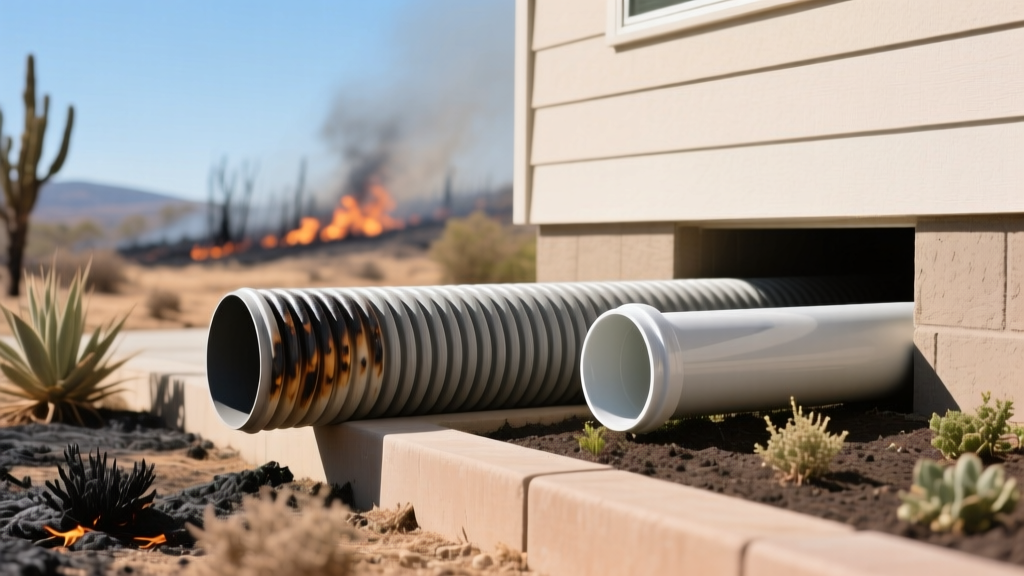
Corrugated vs PVC Drainage Pipes: 2026 Fire-Safe Guide
Sarah ChenPublished
The Hidden Wildfire Threat in Landscape Drainage
As we navigate the 2026 wildfire season, homeowners in the Wildland-Urban Interface (WUI) are increasingly aware of defensible space, fire-resistant plants, and home hardening. However, one critical vulnerability remains largely overlooked in landscape design: subterranean and surface drainage systems. When a wildfire sweeps through a neighborhood, wind-blown embers can travel up to a mile ahead of the flame front. These embers frequently land in dry catch basins, travel down corrugated or PVC landscape drainage pipes, and ignite combustible materials in crawlspaces or under decks.
Choosing the right drainage pipe is no longer just about water flow rates and soil erosion; it is a vital component of a comprehensive fire-resistant landscaping strategy. In this guide, we compare corrugated High-Density Polyethylene (HDPE) and rigid Polyvinyl Chloride (PVC) pipes through the lens of wildfire defense, providing actionable 2026 installation standards to protect your property.
Material Breakdown: PVC vs. Corrugated HDPE
Rigid PVC (Polyvinyl Chloride)
Schedule 40 PVC has long been the gold standard for high-flow landscape drainage due to its smooth interior walls and structural rigidity. From a fire perspective, PVC has a higher melting point (approximately 300°F to 400°F) compared to polyethylene. However, when PVC does catch fire or melt under extreme radiant heat, it releases highly toxic hydrogen chloride gas. Furthermore, exposed PVC pipes within the critical 5-foot non-combustible zone around a home can act as direct conduits for embers if the grates melt or fail. UV degradation is also a factor; if PVC is left exposed to the sun for years before a fire, it becomes brittle and more susceptible to shattering under thermal shock, creating immediate entry points for embers.
Corrugated HDPE (High-Density Polyethylene)
Corrugated drainage pipe is favored in 2026 for its flexibility, ease of installation, and lower cost (averaging $1.20 to $1.80 per linear foot compared to PVC's $1.50 to $2.50). However, single-wall corrugated HDPE presents a unique fire hazard: its ribbed interior. If dry leaves, pine needles, and debris accumulate in the ridges, a single ember entering the catch basin can ignite the debris inside the pipe. The HDPE material itself melts at a lower temperature (around 250°F to 270°F), meaning the pipe can collapse during a surface fire, leading to post-fire flooding and foundation erosion when fire hoses or rain hit the scorched earth.
Dual-wall corrugated HDPE (which features a smooth interior and corrugated exterior) mitigates the debris-trapping issue but still shares the low melting point of single-wall variants, requiring careful burial and protection in fire-prone zones.
2026 Comparison Chart: Corrugated vs. PVC in Fire Zones
| Feature | Schedule 40 PVC | Single-Wall Corrugated HDPE | Dual-Wall Corrugated HDPE |
|---|---|---|---|
| Melting Point | ~300°F - 400°F | ~250°F - 270°F | ~250°F - 270°F |
| Interior Surface | Smooth | Ribbed (High debris/ember trap risk) | Smooth |
| Toxicity When Burned | High (Chlorine gas) | Moderate (Hydrocarbons) | Moderate (Hydrocarbons) |
| Structural Integrity in Heat | Maintains shape longer, then shatters/melts | Collapses rapidly, causing soil sinkholes | Collapses rapidly, causing soil sinkholes |
| 2026 WUI Recommendation | Acceptable if buried & fitted with metal grates | Avoid entirely in fire-prone zones | Acceptable if buried & fitted with metal grates |
Fire-Resistant Installation Best Practices
To align with the latest 2026 WUI building codes and fire-safe landscaping principles, you must treat your drainage system as an extension of your home's ventilation system. According to Cal Fire's Ready for Wildfire guidelines, any opening that allows embers to enter the substructure of a home must be protected with non-combustible materials and fine mesh.
1. The 5-Foot Non-Combustible Transition
Never use plastic drainage pipes (PVC or HDPE) above ground or within the top 12 inches of soil within 5 feet of your home's foundation. In this critical zone, transition to non-combustible materials such as galvanized steel, cast iron, or concrete drainage pipes. While galvanized steel pipe costs upwards of $4.50 per linear foot, this short transition is a mandatory firebreak that prevents melting pipes from exposing your foundation to water damage or creating an ember entry point into your crawlspace.
2. Ember-Blocking Grates and Mesh
All surface catch basins and French drain exits must be covered with corrosion-resistant metal mesh. The Insurance Institute for Business & Home Safety (IBHS) strongly recommends using 1/8-inch or 1/16-inch galvanized steel mesh over all drainage inlets. Plastic pop-up emitters and standard plastic grate covers will melt during a surface fire, leaving a gaping hole for embers to enter the subterranean pipe network. Replace all plastic pop-up emitters with heavy-duty cast aluminum or steel emitters to ensure they remain intact under extreme thermal stress.
3. Trenching Depth and Soil Buffering
Soil is an excellent thermal insulator. To protect PVC or dual-wall HDPE pipes from radiant heat and surface fires, trench your drainage lines at least 18 to 24 inches deep. Cover the pipes with a minimum of 12 inches of compacted, mineral-heavy soil. Avoid using highly combustible mulch or peat moss directly over shallow drainage trenches, as a smoldering mulch fire can easily burn through the topsoil and melt the plastic pipe below, compromising your entire drainage network right when you need it to handle post-fire runoff.
Maintenance for Defensible Drainage Systems
A fire-resistant landscape requires rigorous seasonal maintenance. The UC Agriculture and Natural Resources (UC ANR) program emphasizes that defensible space is not a one-time project but an ongoing commitment. For your drainage system, this means:
- Weekly Inspections During Fire Season: Clear all dry leaves, pine needles, and dead grass from metal catch basin grates. Accumulated debris on top of a grate can ignite from an ember, generating enough localized heat to melt the plastic basin housing below.
- Annual Flushing: Use a high-pressure hose to flush out single-wall corrugated pipes (if they were installed prior to 2026) to remove trapped organic matter that could act as internal kindling.
- Vegetation Clearance: Maintain a strict clearance of low-growing, high-moisture succulents or gravel around all drainage inlets and outfalls. Keep combustible ornamental grasses at least 10 feet away from any drainage exit point.
- Mesh Integrity Checks: After heavy winter storms, inspect your 1/8-inch steel mesh for rust, warping, or displacement. A compromised mesh is entirely useless against the micro-embers generated by wind-driven wildfires.
"In the modern WUI environment, water management and fire management are inextricably linked. A drainage pipe that fails during a wildfire not only compromises the home's structural integrity through post-fire erosion but can serve as the very conduit that bypasses a homeowner's exterior hardening efforts." — 2026 WUI Landscape Architecture Consensus Report
Conclusion
When designing a fire-resistant landscape in 2026, the debate between corrugated and PVC drainage pipe extends far beyond hydraulic efficiency. While neither plastic is inherently fireproof, rigid PVC and dual-wall HDPE offer safer profiles than single-wall corrugated pipes when properly buried and fitted with metal ember-blocking grates. By integrating non-combustible transitions near the foundation, utilizing steel mesh, and maintaining rigorous debris-clearing protocols, you can ensure your landscape drainage system protects your home from water damage without inadvertently inviting wildfire inside.

