Lawn Care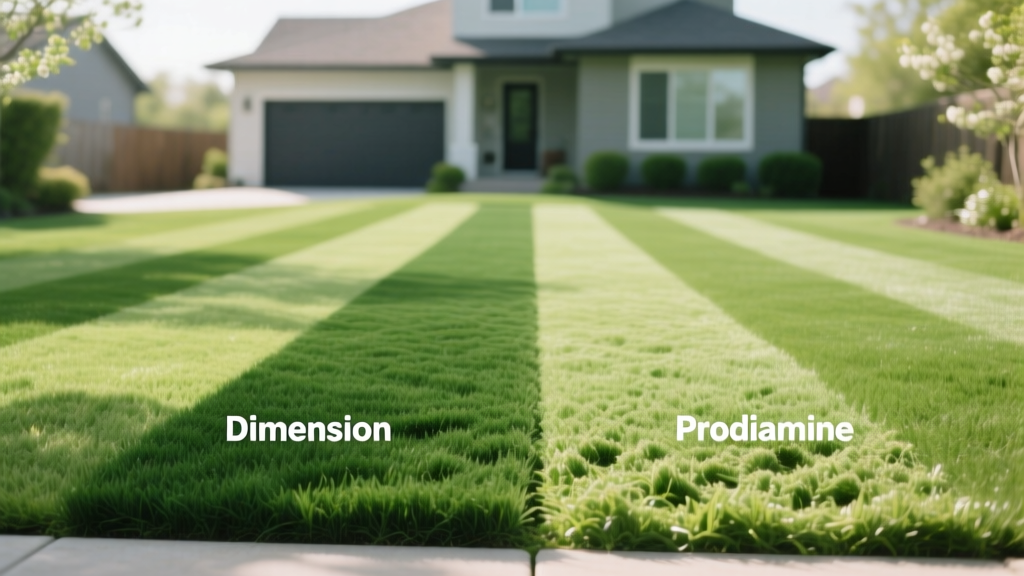
Dimension vs Prodiamine Spring Timing for Perfect Lawn Stripes 2026
James MillerPublished
The Art of the Stripe and the Canvas of Turf
For the aesthetic lawn enthusiast, spring 2026 is not just about greening up; it is about preparing the ultimate canvas for lawn striping and intricate mowing patterns. Creating those mesmerizing, high-contrast checkerboards and diamonds requires more than just a heavy roller and a well-calibrated mower. It demands a turf canopy that is exceptionally dense, uniform in species, and deeply rooted. When you bend a grass blade to reflect sunlight, you are relying on the cellular turgor pressure and structural integrity of the plant. If your lawn is compromised by weeds or weakened by improper chemical applications, your stripes will look muddy, broken, and amateurish.
The foundation of a flawless striping lawn is a pristine, weed-free canopy. Crabgrass, goosegrass, and spurge do not bend or reflect light the same way as premium cool-season or warm-season turfgrasses. Their prostrate growth habits and differing leaf sheens act as visual static, destroying the crisp lines you work so hard to create. This is where the debate between the two titans of pre-emergent herbicides—Dimension (dithiopyr) and Prodiamine—becomes critical for the aesthetic perfectionist. Choosing the right chemical, and more importantly, nailing the spring timing, will dictate the visual quality of your lawn from April through October.
Why Weeds Destroy Aesthetic Patterns
To understand why pre-emergent selection matters for striping, you must understand the physics of lawn aesthetics. Striping is an optical illusion created by light reflecting off the top and bottom of grass blades. When you mow in one direction, the mower deck and roller bend the grass away from you, exposing the darker, less reflective underside of the blade. When you mow in the opposite direction, the grass bends toward you, showing the lighter, waxy top side.
According to turfgrass researchers at the University of Minnesota Extension, maintaining a uniform turfgrass species is essential for consistent lawn health and appearance. When crabgrass infiltrates your lawn, it introduces a chaotic variable. Crabgrass grows laterally via stolons and has a lighter, almost yellowish-green sheen. When a striping roller passes over crabgrass, it mats down unpredictably rather than bending at a uniform angle. The result is a patchy, diluted stripe that lacks the deep, dark contrast required for professional-grade patterns. Preventing these weeds before they germinate is the only way to maintain the structural uniformity your lawn needs.
Prodiamine: The Long-Lasting Base Coat
Prodiamine (often known by the brand name Barricade) is the undisputed heavyweight champion of longevity. It works by forming a chemical barrier in the top half-inch of the soil profile, inhibiting cell division in the root tips of germinating weed seeds. For the striping enthusiast, Prodiamine offers the peace of mind that your canvas will remain untouched by summer annual weeds for up to six months or more, depending on the application rate.
However, Prodiamine comes with a significant aesthetic caveat: root pruning. Prodiamine is not entirely selective in its inhibition of cell division. If applied at excessively high rates, or if multiple high-rate applications are stacked without calculating the yearly maximum active ingredient per acre, Prodiamine can inhibit the initiation of new secondary roots on your desirable turfgrass.
Why does this matter for striping? Deep roots are responsible for water uptake, which maintains cellular turgor pressure. Turgor pressure is what allows a grass blade to bend smoothly under a striping roller and snap back into place without snapping or tearing. If Prodiamine causes root pruning, your turf will suffer from mild, often invisible drought stress during the heat of July. The grass blades will become brittle, your stripes will look frayed, and the overall density of the canopy will thin out, reducing the dark contrast of your patterns.
Dimension: The Flexible Finisher
Dimension (active ingredient: dithiopyr) is the favorite among turf managers who prioritize turfgrass safety and flexibility. While it does not have the sheer residual longevity of Prodiamine, Dimension possesses a unique superpower: early post-emergent activity. Dimension can control crabgrass even after it has germinated, up to the one-tiller stage of growth.
For the aesthetic lawn care specialist in 2026, Dimension is a lifesaver during erratic springs. If a sudden heatwave in early April triggers a massive crabgrass germination flush before you have had the chance to apply your pre-emergent, Prodiamine will be largely ineffective on the already-sprouted weeds. Dimension, however, will eliminate those young weeds, rescuing your uniform canopy and saving your summer striping patterns. Furthermore, Dimension is significantly gentler on the root systems of desirable turfgrasses. It does not cause the same degree of root pruning as Prodiamine, ensuring that your grass maintains maximum turgor pressure, resulting in deep, rich, and highly reflective stripes all season long.
2026 Spring Timing and Soil Temperatures
The NC State Turfgrass Science program continually emphasizes that calendar-based applications are a relic of the past. To protect your striping canvas, you must apply pre-emergents based on soil temperatures at a 2-inch depth.
- Prodiamine Timing: Target application when soil temperatures reach 50°F to 53°F for three to five consecutive days. This places the barrier before the initial crabgrass germination flush, which typically occurs at 55°F.
- Dimension Timing: Because of its post-emergent capabilities, Dimension can be applied slightly later, when soil temperatures are consistently between 55°F and 60°F. This makes it the ideal choice for the second half of a split-application program or for late-spring touch-ups.
In 2026, with climate models showing highly volatile spring temperature swings across the transition zone, relying on a single early application of Prodiamine is risky. A warm February might trigger early germination, while a cold snap in April could delay it. This volatility makes the strategic use of both chemicals essential for maintaining an unbroken, weed-free canvas.
The Split-Application Strategy for Flawless Stripes
To achieve the ultimate balance of long-lasting weed control and zero root pruning—thus preserving the turgor pressure needed for elite striping—the industry standard in 2026 is the split-application method.
Step 1: The Early Base (Late February to Mid-March)
Apply Prodiamine at a low to moderate rate (e.g., 0.38 to 0.57 lbs of active ingredient per acre, or roughly 1.5 to 2.3 lbs of Prodiamine 65 WDG per 1,000 sq ft). This establishes a baseline barrier without overloading the soil with root-pruning chemicals. Water it in with 1/4 to 1/2 inch of irrigation immediately to move it into the soil profile before UV degradation occurs.
Step 2: The Dimension Finisher (Late April to Early May)
Apply Dimension 2EW at a rate of 0.5 to 0.75 oz per 1,000 sq ft. This application catches any late-germinating weeds and utilizes its post-emergent properties to kill any crabgrass that might have slipped through the early spring cracks. Because Dimension is gentle on roots, your turf will enter the summer months with a massive, unrestricted root system, primed for deep watering and intense striping sessions.
Head-to-Head Comparison: Dimension vs. Prodiamine
| Feature | Prodiamine (Barricade) | Dimension (Dithiopyr) |
|---|---|---|
| Active Ingredient | Prodiamine | Dithiopyr |
| Ideal Soil Temp Window | 50°F - 55°F | 55°F - 65°F |
| Post-Emergent Activity | None | Yes (up to 1-tiller stage) |
| Root Pruning Risk | Moderate to High (at max rates) | Very Low |
| Impact on Turf Turgor (Striping) | Can reduce turgor if over-applied | Maintains high turgor and flexibility |
| Longevity | 4 to 6 months | 2 to 4 months |
| 2026 Est. Cost (Per 1,000 sq ft) | $0.08 - $0.12 | $0.15 - $0.22 |
Best Practices for the Aesthetic Lawn Enthusiast
Beyond chemical selection, how you apply these products directly impacts your mowing patterns. Granular formulations require heavy watering to wash the active ingredient off the grass blades and into the soil. If you are using a heavy striping roller immediately after watering in a granular pre-emergent, you risk pushing the chemical barrier deep into the soil or disrupting it entirely, creating weak spots where weeds can penetrate.
For the most pristine aesthetic lawns, liquid applications of Dimension or Prodiamine are preferred in the spring. Using a backpack sprayer with a flat fan nozzle ensures even distribution at the soil surface. Furthermore, always maintain your mowing height between 3.0 and 4.0 inches for cool-season grasses. Taller grass shades the soil, naturally suppressing weed seeds and providing a longer, more dramatic lever for your striping kit to bend. According to data from the Texas A&M AgriLife Extension, proper mowing height combined with pre-emergent herbicides creates a synergistic effect that virtually eliminates summer annual weeds, leaving you with a flawless, dark-green canvas ready for any pattern you can dream up.
Conclusion
As we navigate the 2026 growing season, the pursuit of the perfect lawn stripe requires a nuanced understanding of turfgrass chemistry. Prodiamine remains a vital tool for early-season, long-lasting protection, but its potential for root pruning makes it a liability if misused. Dimension offers the flexibility, safety, and post-emergent cleanup required to guarantee a uniform, dense canopy. By utilizing a split-application strategy timed precisely to soil temperatures, you protect your lawn from visual disruptions while preserving the deep root systems and cellular turgor pressure necessary to bend light, bend grass, and bend the envy of your entire neighborhood.