Lawn Care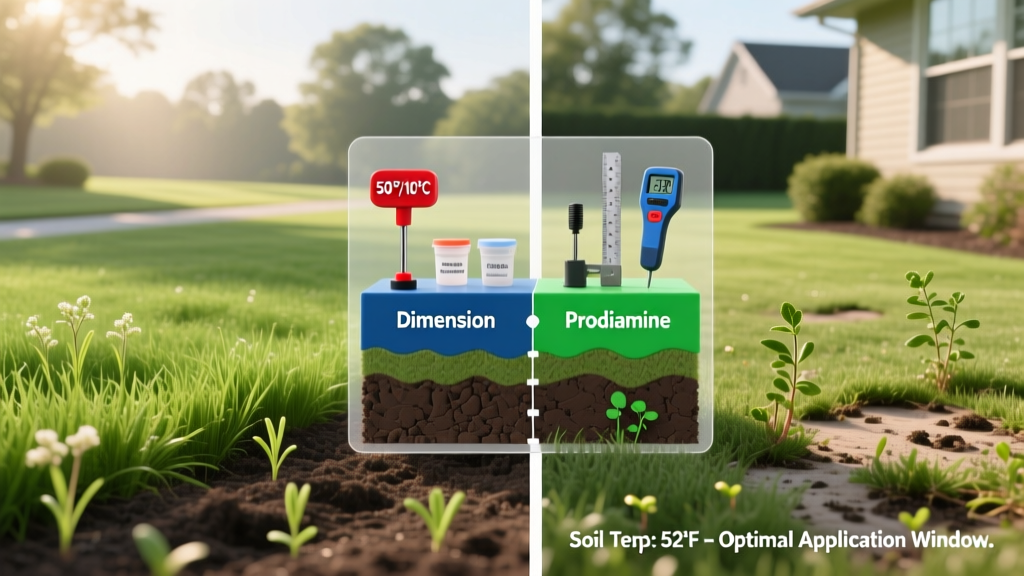
Dimension vs Prodiamine Spring Timing 2026: Turf Guide
Robert HayesPublished
As an arborist specializing in tree web worm control and canopy health, my spring begins with a pair of binoculars and a soil thermometer. While my primary focus is scouting for fall webworm pupae and eastern tent caterpillar egg masses to time my Btk (Bacillus thuringiensis) and dormant oil sprays, I know that a holistic landscape approach requires managing the turf below. Tree health is deeply connected to root-zone competition. If your lawn is overrun with crabgrass and annual weeds, your trees suffer from water and nutrient deprivation. Therefore, mastering the spring timing of turf pre-emergents like Dimension and Prodiamine is just as vital to my Integrated Pest Management (IPM) strategy as managing canopy pests. Let us break down the 2026 best practices for Dimension vs. Prodiamine spring timing from the perspective of a tree care professional who demands a healthy, weed-free root zone.
The Phenology Connection: Tree Pests and Turf Weeds
In the world of IPM, nature provides a synchronized calendar. The same environmental triggers that wake up tree pests also signal the germination of annual turf weeds. For instance, Eastern tent caterpillars typically hatch around 100 to 200 Growing Degree Days (GDD), coinciding with early spring bud break. Fall webworms, while more active in late summer, leave overwintering pupae that we scout for as soon as the canopy clears. Crabgrass, the primary target of spring pre-emergents, begins to germinate when soil temperatures at the 1-inch depth consistently reach 50°F to 55°F, which roughly aligns with 200 to 500 GDD.
According to NC State Extension, relying on a calendar date is a flawed strategy because spring weather fluctuates wildly. Instead, we use phenological indicators. The blooming of forsythia is a classic sign that soil temperatures are approaching the crabgrass germination threshold. As I am finishing my early spring dormant oil applications to smother overwintering tree web worm and scale insects, I am simultaneously prepping the spreader for the first round of turf pre-emergents. But which product should you use? The choice between Dimension and Prodiamine fundamentally alters your spring schedule.
Prodiamine: The Early Bird Barrier
Prodiamine (often sold under the brand name Barricade) is a dinitroaniline herbicide that works strictly as a pre-emergent. It inhibits root development in germinating weed seeds, effectively stopping crabgrass and broadleaf weeds before they ever breach the soil surface. Because it binds tightly to soil organic matter, it requires precise early spring timing. You must have the Prodiamine barrier in place and watered in before the soil hits that critical 55°F mark.
From a tree care perspective, Prodiamine is highly effective but requires caution. It has a long residual, often lasting 4 to 6 months depending on the application rate. However, because it inhibits root growth, Penn State Extension and other turf experts warn against heavy applications within the critical root zone (the drip line) of shallow-rooted or highly sensitive ornamental trees. If you are managing a landscape with mature oaks or maples that are already stressed by defoliating pests like web worms, you must be careful not to compound their stress with excessive root inhibition from high-rate Prodiamine applications.
Dimension: The Flexible Closer
Dimension (active ingredient: dithiopyr) is a pyridine herbicide that offers a unique advantage: it has early post-emergent activity. While it excels as a pre-emergent, Dimension can actually kill young crabgrass plants up to the one-tiller stage of growth. This makes it the ultimate "flexible closer" for spring timing. If you get busy managing a severe spring outbreak of tent caterpillars in your client's cherry trees and miss the early pre-emergent window for the turf, Dimension can save the day.
Dimension targets both the roots and the shoots of the weed. Because its residual is slightly shorter than Prodiamine (typically 2 to 4 months), it is an excellent candidate for split-application programs. Furthermore, Dimension is generally considered safer for the root zones of established ornamental trees and shrubs when applied at standard label rates, making it a preferred choice for arborists managing high-value landscape beds adjacent to turf areas.
2026 Head-to-Head Comparison
When planning your 2026 landscape maintenance budget and schedule, it is crucial to understand the operational differences between these two chemicals. Below is a comparison chart tailored for landscape professionals managing both turf and tree health.
| Feature | Prodiamine (Barricade) | Dimension (Dithiopyr) |
|---|---|---|
| Primary Action | Pre-emergent only (Root inhibitor) | Pre-emergent & Early Post-emergent |
| Ideal Soil Temp Trigger | 50°F - 55°F (Apply Early) | 55°F - 65°F (Apply Mid-Spring) |
| Crabgrass Post-Emergence | None | Effective up to 1-tiller stage |
| Residual Control | 4 - 6 months | 2 - 4 months |
| Fall Overseeding Wait | 16 weeks minimum | 6 weeks minimum |
| Approx. 2026 Cost / 1k sq ft | $4.50 - $5.50 | $7.00 - $9.00 |
| Tree Drip Line Safety | Use caution; can inhibit fine roots | Generally safer near ornamentals |
The 2026 Split-Application Strategy
For the 2026 spring season, I strongly advocate for a split-application strategy, especially in landscapes where tree health is a primary concern. Applying a full, high rate of pre-emergent all at once can stress the soil microbiome and potentially impact the fine feeder roots of trees battling canopy pests.
Application 1 (Early Spring - Forsythia Bloom): Apply a half-rate of Prodiamine. This establishes a baseline barrier just as eastern tent caterpillars are hatching and soil temps are crossing 50°F. This lower rate minimizes any risk to tree roots while catching the earliest flush of crabgrass. Application 2 (Mid-Spring - Dogwood Bloom): Apply a half-rate of Dimension. By the time dogwoods bloom, soil temps are usually pushing 60°F. Any crabgrass that managed to push through the initial Prodiamine barrier will be in its early post-emergent stage. The Dimension will eradicate those young tillers while extending your residual control well into the heat of summer, right when fall webworms begin their first generation of nesting.
Integrating Turf and Tree Care Schedules
Time is a luxury in the spring. As a professional, you are likely spraying liquid Btk or Spinosad for web worm and caterpillar control on the same day you are spreading granular pre-emergents. Always apply your granular pre-emergents before your liquid canopy sprays. Why? Because pre-emergents require 0.25 to 0.5 inches of irrigation to activate and move into the soil profile. If you spray your trees first, and then irrigate the lawn to activate the Prodiamine or Dimension, you risk washing your expensive tree pest control chemicals right off the leaves and into the soil, rendering your canopy treatment useless.
Furthermore, avoid using liquid sprayable pre-emergents near the base of trees that are currently stressed by defoliating insects. Granular applications allow for more precise boundary control, keeping the chemical strictly on the turf and away from the exposed root flares of your prized shade trees.
Conclusion
Effective landscape management in 2026 requires looking at the entire ecosystem. While my eyes are trained on the canopy for signs of tree web worms and tent caterpillars, my boots are firmly planted on the turf. Choosing between Dimension and Prodiamine is not just about weed control; it is about timing, root-zone safety, and integrated scheduling. By leveraging the early barrier of Prodiamine and the flexible, post-emergent cleanup of Dimension, you can protect your turf from aggressive weeds without compromising the health of the trees above. Monitor your soil temperatures, respect the drip line, and execute your split applications for a flawless, pest-free landscape this spring.