Lawn Care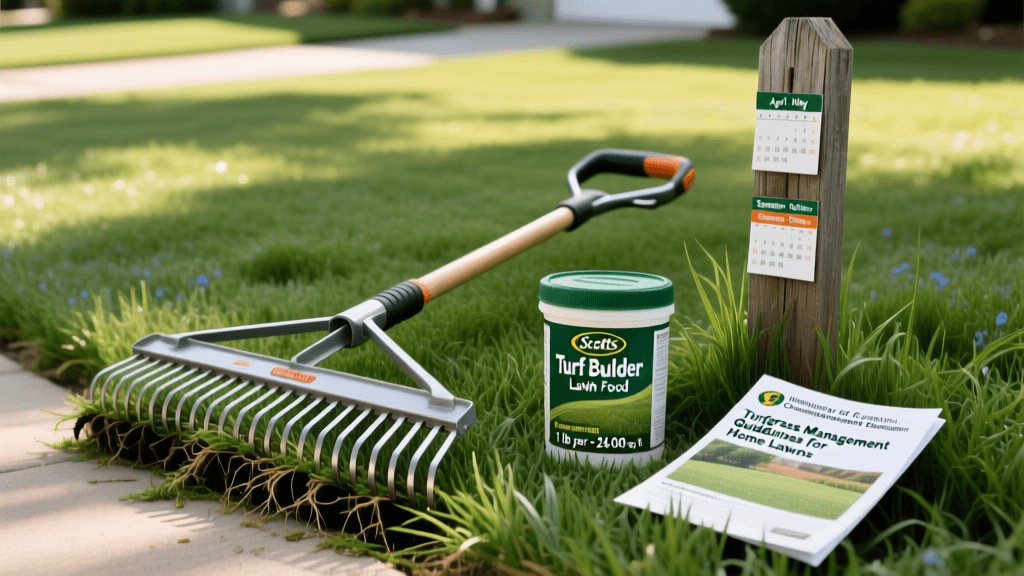
Diy Lawn Thatch Removal With Rake Or Dethatcher
Understanding Thatch and Its Impact on Turf Health
Thatch is a tightly interwoven layer of living and dead organic matter—primarily stems, stolons, rhizomes, and roots—that accumulates between the soil surface and green grass blades. While a thin thatch layer (≤½ inch) can insulate soil and buffer temperature extremes, excessive buildup (>¾ inch) impedes water infiltration, restricts gas exchange, and creates ideal conditions for fungal pathogens like Pythium and Fusarium. Research from the University of Wisconsin–Madison confirms that Kentucky bluegrass (Poa pratensis) and creeping bentgrass (Agrostis stolonifera) are especially prone to thatch accumulation due to high lignin content and slow decomposition rates (University of Wisconsin–Madison Extension, 2021).
When and How Often to Dethatch
Timing is critical: dethatching should coincide with peak grass growth and recovery capacity. For cool-season grasses—including Kentucky bluegrass, perennial ryegrass (Lolium perenne), and fine fescues (Festuca spp.)—early fall (mid-August to mid-September in USDA Hardiness Zones 4–6) is optimal. This window allows 4–6 weeks of regrowth before winter dormancy. In contrast, warm-season species such as zoysiagrass (Zoysia japonica) and bermudagrass (Cynodon dactylon) respond best to dethatching in late spring (late May to early June in Zones 7–10), when soil temperatures consistently exceed 65°F at 2-inch depth and turf is actively greening.
Seasonal Thresholds and Growth Stages
Never dethatch during drought stress, heat waves (>90°F for >3 consecutive days), or dormancy. The Penn State Extension recommends waiting until at least 50% of the lawn shows active vertical growth—measured by blade elongation exceeding ⅛ inch per day—and soil moisture is at field capacity (not saturated or dry). A simple screwdriver test confirms readiness: if you can insert a 6-inch screwdriver vertically into the soil with light pressure, conditions are suitable.
Raking vs. Mechanical Dethatching: Equipment Selection
Hand raking with a rigid-tine steel rake (e.g., Ames True Temper 12-Tine Bow Rake) works effectively for small lawns (<1,000 sq. ft.) with thatch ≤½ inch thick. Apply firm, overlapping strokes at a 30° angle to lift debris without gouging soil. For larger areas or thicker thatch layers (0.75–1.25 inches), powered dethatchers—such as the Sun Joe SDJ800E (8-inch width, 100W motor) or Agri-Fab 45-0295 (30-inch width, 12-amp motor)—deliver deeper penetration and consistent tine spacing. These units feature adjustable tine depth settings; set to ¼ inch for initial passes on established lawns and reduce to ⅛ inch for sensitive fine fescue stands.
Calibrating Tine Depth and Pass Frequency
- First pass: Set tines to remove top ⅛ inch of thatch; make parallel passes spaced 6 inches apart
- Second pass: Offset 45° from first direction; reduce tine depth by half
- Third pass (if needed): Use same offset but sweep only visible debris—never expose bare soil
Post-Dethatching Lawn Recovery Protocol
Immediately after dethatching, collect all debris using a leaf blower (e.g., Toro PowerJet 51619) or stiff-bristled broom to prevent smothering regrowth. Then apply a light nitrogen fertilizer—0.25 lb N per 1,000 sq. ft.—using a broadcast spreader calibrated for even distribution. Recommended products include Scotts Turf Builder Starter Food (24-25-4) applied at 3.5 lbs/1,000 sq. ft. or Espoma Organic Lawn Food (9-0-0) at 18 lbs/1,000 sq. ft. Water deeply to 6 inches within 24 hours, then maintain 1 inch of weekly irrigation split across three sessions (e.g., ⅓ inch every other day) for 14 days.
Overseeding is strongly advised for lawns with >20% bare soil exposure post-dethatching. Use certified seed blends matched to regional climate: for example, the “Midwest Cool-Season Mix” from Seedland contains 40% Kentucky bluegrass, 35% perennial ryegrass, and 25% chewings fescue (Festuca rubra ssp. rubra). Sow at 6–8 lbs/1,000 sq. ft. and cover with ⅛-inch compost topdressing. Avoid mowing until new seedlings reach 3 inches tall—typically 18–22 days under optimal conditions (soil temp 60–75°F, consistent moisture).
Preventive Maintenance to Minimize Future Thatch
Prevention hinges on balanced cultural practices—not just periodic removal. Mowing height directly influences thatch accumulation: maintain Kentucky bluegrass at 2.5–3.5 inches and zoysiagrass at 1–2 inches. Never remove >⅓ of blade length in a single mowing; frequent clipping promotes rapid decomposition. Soil pH must stay between 6.0–7.0 for microbial activity—test annually via your local extension lab (e.g., Cornell Cooperative Extension’s Soil Health Lab in Ithaca, NY). Acidic soils ( Fertilizer timing matters more than volume. Excess soluble nitrogen (especially quick-release urea) stimulates shoot growth faster than root decay, worsening thatch. Instead, use slow-release formulations like methylene urea (MU) or polymer-coated urea (PCU) at no more than 1.0 lb N/1,000 sq. ft. per application. The Purdue University Turf Science Program found that lawns receiving four annual MU applications (0.25 lb N each) accumulated 37% less thatch over three years compared to those treated with single-dose urea (Purdue Extension, 2020). Climate and soil type dictate dethatching frequency. In humid eastern regions like Raleigh, NC, cool-season lawns may require dethatching every 2–3 years due to rapid organic accumulation in clay loam. Conversely, arid western sites such as Phoenix, AZ demand vigilance with warm-season grasses: bermudagrass in sandy soils there often needs dethatching every 18 months because low microbial activity slows decomposition. Always consult region-specific guidance—Rutgers New Jersey Agricultural Experiment Station publishes detailed thatch management charts for Mid-Atlantic turfgrass, while the Texas A&M AgriLife Extension offers zone-mapped dethatching calendars validated across 250+ soil series. Finally, track progress with objective metrics: measure thatch depth annually using a straight-edge knife and ruler at five random locations across the lawn. Record data alongside mowing frequency, fertilizer dates, and rainfall totals. Over time, this log reveals whether cultural adjustments—like raising mowing height by 0.5 inch or shifting from ammonium nitrate to sulfur-coated urea—are reducing accumulation rates. Consistent monitoring transforms reactive dethatching into proactive turf stewardship grounded in measurable outcomes.Soil Microbial Support Strategies
Regional Considerations and Extension Resources
“Thatch is not inherently harmful—it becomes problematic only when management practices disrupt the natural balance between production and decomposition. Corrective action is rarely needed more than once every two to three years on well-maintained lawns.”
— Dr. Doug Soldat, Turfgrass Science Specialist, University of Wisconsin–Madison Extension (2021)
Grass Species
Optimal Dethatching Window
Max Safe Thatch Depth
Recommended Tine Depth
Recovery Time (Days)
Kentucky bluegrass
Aug 15–Sep 15 (Zones 4–6)
0.75 inch
¼ inch
21
Zoysiagrass
May 20–Jun 10 (Zones 7–10)
1.0 inch
⅜ inch
28
Perennial ryegrass
Sep 1–15 (Zones 4–7)
0.5 inch
⅛ inch
14