Lawn Care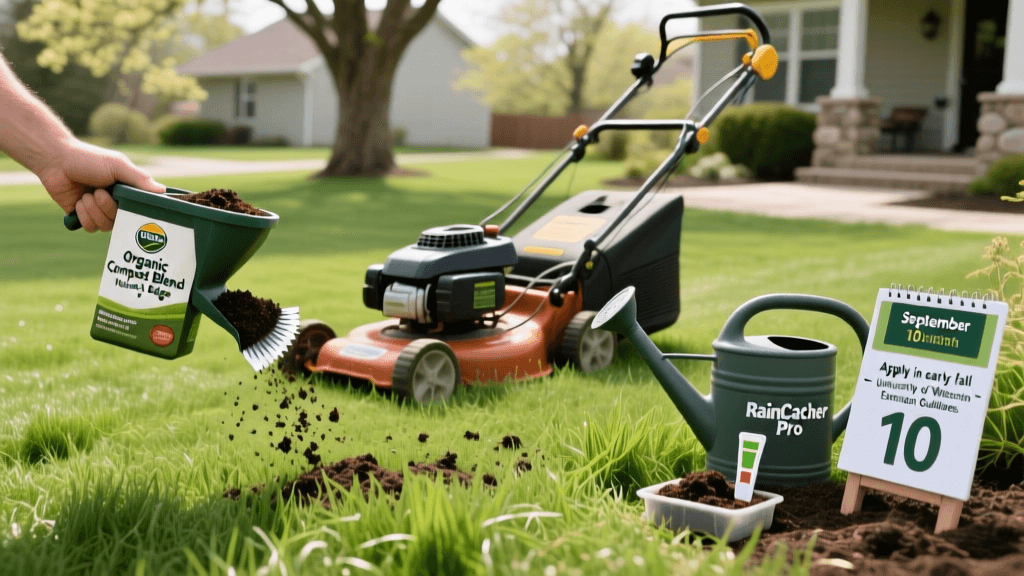
When And How To Topdress Thin Lawn With Compost
Why Compost Topdressing Strengthens Thin Turf
Thin lawns—especially those suffering from compaction, thatch buildup, or shallow rooting—respond exceptionally well to compost topdressing when applied correctly. Unlike synthetic fertilizers alone, compost delivers slow-release nutrients, beneficial microbes, and organic matter that improves soil structure over time. Research from the University of Minnesota Turfgrass Program confirms that a single ¼-inch compost application increased soil organic matter by 0.3% within six weeks in Kentucky bluegrass plots (UMN Extension, 2021). This measurable improvement enhances water retention, root penetration, and drought resilience—critical for cool-season grasses like Poa pratensis (Kentucky bluegrass), Lolium perenne (perennial ryegrass), and Festuca rubra (red fescue), which dominate lawns across the Upper Midwest, Northeast, and Pacific Northwest.
Optimal Timing by Grass Type and Region
Timing is non-negotiable: applying compost during active growth ensures rapid incorporation and minimizes smothering risk. For cool-season grasses—including the widely planted ‘Midnight’ Kentucky bluegrass and ‘Barlexas’ perennial ryegrass—late spring (mid-May to early June) and early fall (late August to mid-September) are ideal windows. These periods align with peak root and shoot growth while avoiding summer heat stress. In contrast, warm-season species such as Cynodon dactylon (bermudagrass) and Zoysia japonica (zoysiagrass) respond best to topdressing in late spring (mid-June in Raleigh, NC) when soil temperatures exceed 65°F and turf is fully greened up.
Regional Timing Benchmarks
- Raleigh, NC: Bermudagrass topdressing window opens June 10–July 15
- Madison, WI: Kentucky bluegrass best treated May 15–June 10 or August 20–September 15
- Corvallis, OR: Fine fescue lawns benefit most from September 1–20 applications
Selecting and Screening Quality Compost
Not all compost is suitable for turf. Use only Class A, STA-certified (U.S. Composting Council’s Seal of Testing Assurance) products with documented low weed seed counts (<1 weed seed per 100 g) and stable pH (6.2–7.2). Recommended products include Leaf-Gro® (Maryland), tested at the University of Maryland Extension for turf safety, and Soil Blend™ by Earth Care Products, verified at Rutgers Cooperative Extension for consistent particle size and nutrient release. Avoid immature compost—it often contains phytotoxic compounds that inhibit germination and cause yellowing.
Key Physical Specifications
- Particle size: ≤⅛ inch (3 mm) maximum; screened through ¼-inch mesh
- Moisture content: 35–45% (too dry causes dust; too wet clumps)
- Electrical conductivity (EC): <1.5 dS/m (prevents salt burn)
- Nitrogen content: 1.2–2.0% dry weight (provides gentle feeding)
- OM content: ≥45% (measured via loss-on-ignition test)
Application Rates and Equipment Calibration
Apply compost at precisely calibrated rates—excess material suffocates grass crowns, while too little yields negligible benefit. For thin but intact turf, use ¼ inch (6 mm) depth, equivalent to 1.2 cubic yards per 1,000 sq ft. That translates to approximately 3,200 pounds of compost per 1,000 sq ft at typical bulk density (2,600 lb/yd³). For severely degraded areas where overseeding will follow, increase to ⅜ inch (9.5 mm)—but never exceed ½ inch without core aeration first. Calibrate spreaders using the “drop-and-measure” method: place tarps in three zones, apply compost, then measure depth with a ruler and adjust gate opening accordingly.
Use a drop spreader for accuracy on small lawns (<5,000 sq ft); for larger areas (>10,000 sq ft), a broadcast spreader with adjustable spinner plate works efficiently if pre-sifted compost is used. Always apply when grass is dry and winds are calm—ideally at dawn or dusk—to prevent drift and ensure even settling.
Integration With Other Lawn Practices
Compost topdressing synergizes with core aeration and mowing—but timing matters. Aerate 3–7 days before topdressing to open pathways for compost infiltration into the root zone. Mow 1–2 days prior to application, lowering height to 2 inches for Kentucky bluegrass and 1.5 inches for fine fescues. Never topdress immediately after mowing wet grass—moisture traps compost against leaf blades, encouraging fungal development.
Watering post-application requires precision: irrigate lightly (0.1 inch) immediately after spreading to settle particles, then resume normal irrigation—no soaking. Overwatering leaches nutrients and encourages runoff. Fertilizer application should be delayed until 14 days after topdressing to avoid nitrogen volatilization and microbial competition. The Ohio State University Extension advises pairing compost with a low-analysis starter fertilizer (e.g., 5-10-10) only when overseeding, not for maintenance topdressing (OSU Extension, 2020).
Seasonal Integration Checklist
- Core aerate → wait 5 days → topdress → water 0.1" → resume regular mowing in 3 days
- Overseed (if needed) → topdress within 24 hours → water lightly 2× daily for 10 days
- Avoid herbicide application for 21 days post-topdressing (reduces microbial activity)
Monitoring Results and Troubleshooting
Evaluate success at 30 and 60 days. Healthy response includes darker green color, reduced bare patches, and improved soil moisture retention. Use a simple infiltration test: pour 1 cup of water onto a 4-inch square area—healthy topdressed soil absorbs it in <15 seconds. If water pools or runs off, compaction persists and re-aeration is needed.
Common issues include uneven coverage (corrected with second light pass), temporary yellowing (usually resolves in 7–10 days if EC was below threshold), and emergence of annual weeds (indicates immature compost—switch suppliers). Track progress with digital soil probes: the Cornell Soil Health Lab recommends measuring bulk density reduction—target 0.05 g/cm³ decrease after one season—and earthworm counts (≥10 per cubic foot indicates thriving biology).
“Compost topdressing isn’t just feeding the grass—it’s rebuilding the soil food web. One application won’t fix years of neglect, but two well-timed treatments annually, combined with proper mowing and irrigation, consistently increases turf density by 22–38% in research trials.” — Dr. Nick Christians, Iowa State University Department of Horticulture, 2019
Long-term success depends on consistency—not volume. Reapply every 12–18 months for maintenance lawns, or annually for high-traffic or shaded sites. Pair with sharp mower blades (sharpened every 8–10 hours of use), mowing at recommended heights (3 inches for Kentucky bluegrass, 2.5 inches for tall fescue), and irrigation based on evapotranspiration data—not fixed schedules. In Corvallis, Oregon, homeowners using weekly ET-based watering alongside biannual compost topdressing reduced irrigation use by 27% while increasing turf density scores by 31% over three years (OSU Turfgrass Research Station, 2022).
Remember: compost is a soil amendment, not a miracle cure. It cannot overcome chronic shade, severe drainage failure, or persistent pest pressure without complementary cultural adjustments. But when timed, measured, and integrated with science-backed lawn care—especially for regionally adapted grasses—it delivers measurable, lasting improvements in both appearance and ecological function.
| Grass Species | Optimal Topdressing Window | Max Depth (inches) | Min. Soil Temp (°F) | Post-Application Mow Delay |
|---|---|---|---|---|
| Kentucky bluegrass | May 15–Jun 10; Aug 20–Sep 15 | 0.25 | 55 | 3 days |
| Bermudagrass | Jun 10–Jul 15 | 0.25 | 65 | 2 days |
| Red fescue | Sep 1–20 | 0.25 | 50 | 4 days |
University extension resources provide free, localized guidance: the University of Minnesota Extension offers downloadable compost calculators; Rutgers Cooperative Extension publishes annual compost quality reports for Mid-Atlantic suppliers; and the Ohio State University Extension maintains a searchable database of STA-certified products validated for turf use. These tools eliminate guesswork—turning precise topdressing from theory into repeatable practice.