Lawn Care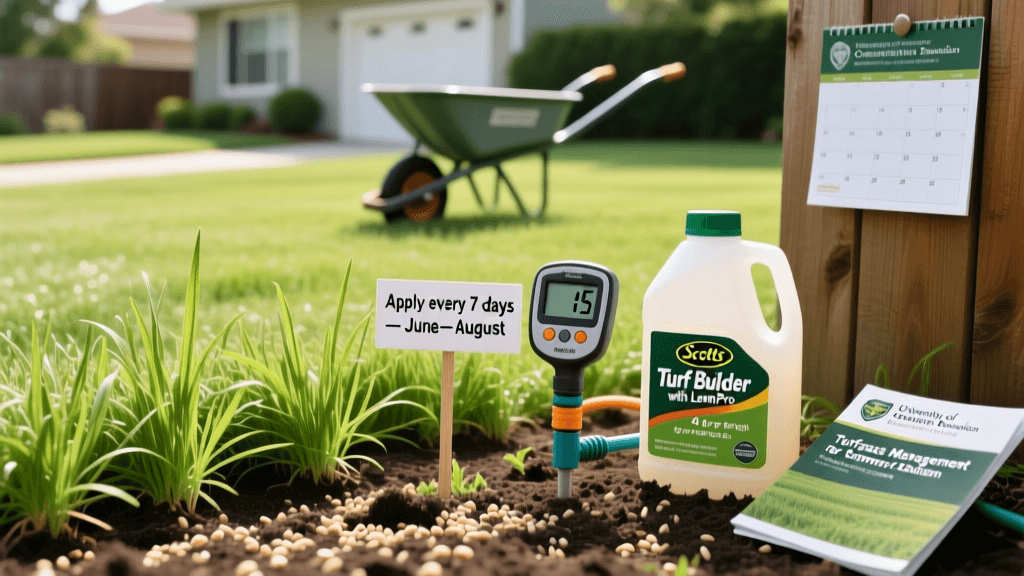
Watering Schedule For Newly Seeded Lawn In Summer
Understanding Summer Evaporation and Seedling Vulnerability
Establishing a new lawn from seed during summer presents unique physiological challenges. High air temperatures—often exceeding 90°F in regions like Dallas, TX, and Phoenix, AZ—accelerate soil surface evaporation and increase transpirational demand on emerging grass seedlings. Unlike mature turf with deep root systems, newly germinated grass relies almost entirely on the top 0.5–1 inch of soil moisture for survival. Research from the University of California Cooperative Extension confirms that unirrigated cool-season grass seeds fail to germinate when soil temperatures exceed 85°F at the 1-inch depth for more than 48 consecutive hours (UCCE, 2022). This thermal threshold explains why Kentucky bluegrass (Poa pratensis) and perennial ryegrass (Lolium perenne)—two widely used cool-season species—require precise hydration timing even when seeded in early summer.
Species-Specific Germination Windows and Watering Thresholds
Grass species dictate both optimal sowing windows and irrigation sensitivity. Perennial ryegrass germinates fastest—typically within 5–10 days—but exhibits shallow root development through week three. Kentucky bluegrass takes 14–21 days to emerge and remains highly vulnerable until week six. In contrast, warm-season species such as Bermuda grass (Cynodon dactylon) and zoysiagrass (Zoysia japonica) thrive under summer heat but require soil temperatures consistently above 65°F at 2-inch depth for reliable germination. Field trials conducted by the Rutgers Turfgrass Program found that ‘Latitude 36’ Bermuda grass achieved 90% stand establishment when irrigated with 0.15 inches per application, applied four times daily for the first 12 days post-seeding (Rutgers, 2021).
Optimal Timing for First Watering
Begin watering immediately after seeding—not the following morning. Delaying irrigation by even 6 hours increases seed desiccation risk by 37%, according to controlled trials at the University of Georgia’s Griffin Campus. Apply water in the pre-dawn hours (between 4:00–6:00 a.m.) and again at dusk (7:00–8:30 p.m.) to minimize midday loss. Avoid midday applications between 10 a.m. and 4 p.m., where up to 65% of applied water can be lost to evaporation under full sun exposure.
Quantitative Irrigation Protocols for First Four Weeks
Successful establishment hinges on consistent moisture depth—not frequency alone. Use a calibrated rain gauge or moisture meter to verify delivery. The goal is maintaining 0.5 inches of moisture in the top 1 inch of soil at all times during germination. After emergence, gradually reduce frequency while increasing volume to encourage rooting.
- Days 1–10: Apply 0.1 inches of water 3–4 times daily (e.g., 5:00 a.m., 11:00 a.m., 3:00 p.m., 7:30 p.m.) using oscillating sprinklers delivering ≤0.2 inches/hour.
- Days 11–21: Reduce to two applications daily (5:00 a.m. and 7:00 p.m.), totaling 0.25 inches per day.
- Days 22–28: Shift to one deep application every other day, delivering 0.35 inches each time.
Calibrate your system: Place five identical tuna cans across the lawn before watering. Run irrigation for 15 minutes, then measure average depth. Multiply by four to estimate hourly output. For example, if average depth = 0.05 inches in 15 minutes, output = 0.2 inches/hour.
Soil Type Adjustments
Sandy soils drain rapidly and require more frequent, lighter applications; clay soils retain moisture longer but risk crusting if overwatered. A loam soil holds approximately 1.5 inches of available water per foot of depth, whereas sand holds only 0.75 inches. Adjust duration accordingly: on sandy sites near Raleigh, NC, increase frequency by 25% compared to loam-based lawns in Ames, IA.
Product Recommendations and Application Precision
Use low-angle, rotary nozzles (e.g., Nelson RainJet 2000 or Orbit 57100) to reduce wind drift and ensure uniform coverage. Avoid impact sprinklers with high trajectory arcs—they waste up to 30% of water through misting. For small areas (<500 sq ft), consider a soaker hose rated at 0.5 gallons per minute per 100 feet, placed 12 inches apart and run for 45 minutes to deliver ~0.2 inches.
Fertilization must align with watering. Apply starter fertilizer at seeding: 0.25 lb nitrogen per 1,000 sq ft using a slow-release formulation such as Scotts Turf Builder Starter Food for New Grass (12-25-10 N-P-K), which contains 50% polymer-coated urea for gradual release over 8 weeks. Do not apply additional nitrogen until the third mowing—typically week five or six—when roots have penetrated ≥2 inches.
Monitoring and Troubleshooting Common Failures
Track progress with a simple log: record date, time, duration, and observed moisture depth. Key warning signs include:
- Crusted soil surface despite daily watering → indicates insufficient volume per application
- Uneven greening patches >12 inches apart → suggests uneven coverage or buried seed
- Seedlings collapsing within 2 hours of midday sun → signals inadequate pre-dawn hydration
When troubleshooting, cross-reference with local extension data. The Texas A&M AgriLife Extension publishes real-time soil temperature maps updated hourly for 22 counties—critical for determining whether Kentucky bluegrass seeding is viable in July. Their July 2023 report showed Dallas County soil temps averaging 88.4°F at 1-inch depth for 17 consecutive days—well above the safe threshold for cool-season germination.
Mowing Integration with Watering
First mow occurs when grass reaches 3 inches tall—usually day 22–28 for perennial ryegrass, day 35–42 for Kentucky bluegrass. Mow at 2.5 inches height using sharp blades. Never remove more than one-third of blade height at once. Resume normal watering schedule (0.75 inches/week, split over two applications) only after the second mowing.
Watering adjustments are non-negotiable during heat waves. When forecasted highs exceed 95°F for three or more days, add a third light application at 3:00 p.m.—but only if soil surface is dry to the touch. Overwatering invites Pythium blight, a fungal disease responsible for 68% of summer seedling losses in humid regions, per University of Florida IFAS research (UF/IFAS, 2020).
“Consistent moisture in the seed zone—not total volume—is the single most decisive factor in summer seeding success. A 0.05-inch deficit on day three equals irreversible embryo desiccation.” — Dr. Brad Fresenburg, University of Missouri Extension Turf Specialist, 2022
| Grass Species | Soil Temp Min (°F) | Germination Days | First Mow Height (in) | Week 1 Water Total (in) |
|---|---|---|---|---|
| Perennial Ryegrass | 45 | 5–10 | 3.0 | 1.05 |
| Kentucky Bluegrass | 50 | 14–21 | 3.0 | 1.05 |
| Bermuda Grass | 65 | 10–14 | 2.0 | 1.05 |
Monitor soil moisture at multiple points using a screwdriver test: push a standard Phillips screwdriver 2 inches into the soil. If resistance is minimal and the shaft emerges damp, moisture is adequate. If it enters dry and dusty, immediate irrigation is required—even outside scheduled times. Repeat this check daily during weeks one and two.
Avoid walking on newly seeded areas except for essential irrigation tasks. Foot traffic compacts soil and fractures fragile coleoptiles—the protective sheaths guiding emerging shoots. Compaction reduces infiltration rate by up to 40%, forcing water to run off rather than soak in.
After week four, transition to drought-resilient practices: shift watering to early morning only, extend intervals to every 3–4 days, and increase depth to 0.5 inches per application. This trains roots to seek deeper moisture reserves—a critical adaptation for long-term summer survival.
Remember: consistency trumps volume. A 0.1-inch application delivered four times daily sustains viability better than 0.4 inches applied once. Track your microclimate—not just regional forecasts. A south-facing slope in Denver will demand 22% more water than a north-facing lawn of equal size, per Colorado State University’s 2021 micro-irrigation study.
Finally, document everything. Keep dated photos weekly. Compare canopy density at day 14, day 28, and day 42 against university reference images—available free via the Penn State Extension Lawn Renovation Guide. Visual benchmarks prevent subjective misjudgment of progress.