Lawn Care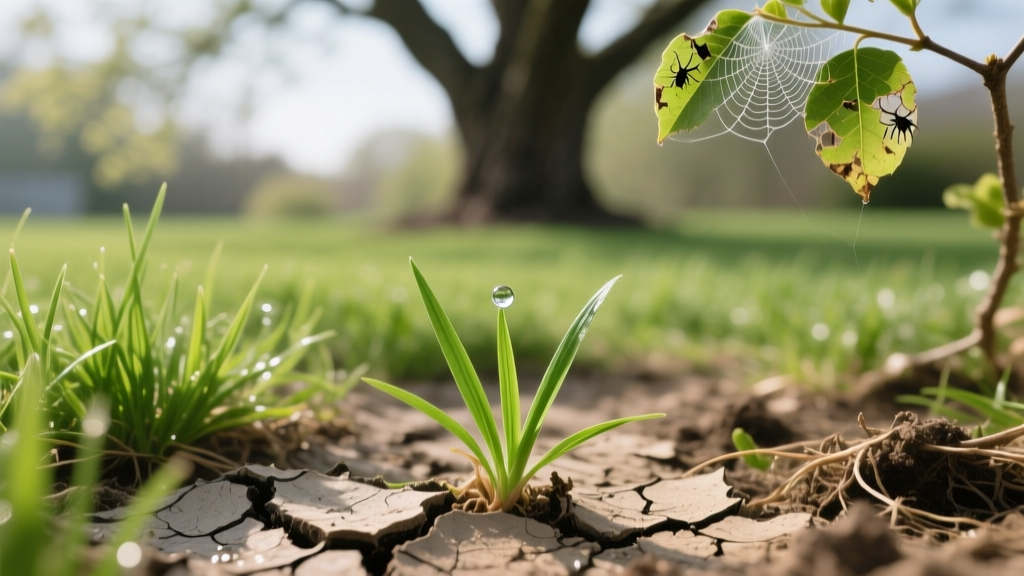
2026 Drought Stress Lawn Recovery Deep Watering Guide
Emily WatsonPublished
The 2026 Climate Challenge: Drought, Lawns, and Tree Webworms
As we navigate the extreme weather patterns of 2026, prolonged regional droughts have left countless lawns dormant, brown, and highly susceptible to damage. However, as a turf and arboriculture specialist, I often see homeowners treat the lawn and the shade trees above it as separate entities. In reality, they are one interconnected ecosystem. When your lawn is suffering from severe drought stress, the mature trees shading it are likely experiencing critical subterranean moisture deficits. This hidden stress triggers the release of specific volatile organic compounds (VOCs) from the trees, which act as a chemical beacon for destructive pests like the fall webworm (Hyphantria cunea) and the eastern tent caterpillar.
Therefore, a strategic deep watering schedule does double duty in your landscape: it recovers your drought-stressed turf while simultaneously fortifying your trees' natural chemical defenses against webworm infestations. Shallow, frequent watering is a relic of the past. In 2026, deep, infrequent irrigation is the gold standard for holistic lawn and tree care.
The Biological Link: Drought Stress and Webworm Vulnerability
Tree webworms are opportunistic pests. While they can attack healthy trees, they heavily target trees that are already weakened by environmental stressors, particularly drought. When a tree lacks sufficient soil moisture, its ability to produce defensive sap and secondary metabolites drops significantly. According to the Colorado State University Extension, stressed trees are far more likely to suffer severe defoliation from webworms, which in turn reduces the tree's ability to photosynthesize and shade the lawn below, creating a vicious cycle of heat exposure and turf burn.
By implementing a deep watering schedule, you ensure that both the turfgrass roots (which typically extend 4 to 6 inches deep) and the tree's absorbing roots (which often share the same top 12 to 18 inches of soil) receive the hydration they need. A well-hydrated tree can naturally fend off severe webworm damage, while the lawn beneath it recovers its vibrant green color and dense growth habit.
Why Shallow Watering Fails Both Turf and Trees
Many homeowners attempt to revive a brown lawn by running their sprinklers for 15 minutes every day. This is a critical mistake. Shallow watering only moistens the top half-inch of soil. The grass roots remain shallow and vulnerable to the next heatwave, and the deep roots of your shade trees receive absolutely no benefit. Furthermore, daily shallow watering keeps the surface soil and thatch layer perpetually damp, creating a humid microclimate that encourages fungal diseases like brown patch and dollar spot, which will quickly destroy a drought-weakened lawn.
The 2026 Deep Watering Schedule for Lawn Recovery
To properly recover a drought-stressed lawn while supporting the canopy above, you must transition to a deep soaking schedule. The goal is to apply enough water to penetrate the soil to a depth of at least 6 to 8 inches. Here is how to execute this strategy in 2026.
Step 1: The Screwdriver Soil Test
Before you set your irrigation timer, you need to know your soil's moisture penetration. Take a standard 6-inch flathead screwdriver and push it into the lawn in a shaded area beneath your tree canopy. If you cannot easily push it to the 6-inch mark, your soil is hydrophobic and severely compacted. You will need to apply a liquid soil surfactant (such as Aqua-Aid or Lesco Hydro-Wet) to break the surface tension and allow water to infiltrate rather than run off into the street.
Step 2: Calibrating Your Smart Irrigation
In 2026, smart irrigation controllers like the Rachio 4 or the Orbit B-hyve XR are essential tools. These devices use hyper-local weather data and soil moisture sensors to prevent overwatering. To calibrate your system for deep watering, place three empty tuna cans in different zones of your lawn (one in full sun, one under the tree canopy). Run your sprinklers for 30 minutes and measure the water in the cans. Most standard rotary nozzles deliver about 0.5 inches of water per 30 minutes. To achieve the recommended 1 to 1.5 inches of weekly water, you will need to run your system for longer durations, but less frequently.
Step 3: Timing and Frequency
Deep watering should only occur 1 to 2 times per week. Always schedule your irrigation cycles to finish just before sunrise (typically between 4:00 AM and 6:00 AM). This allows the grass blades to dry quickly once the sun comes up, minimizing fungal risks, while ensuring the water has time to percolate deeply into the root zone before the midday heat causes evaporation.
Structured Deep Watering Chart for Shade Trees and Turf
The following table outlines the recommended deep watering parameters for recovering drought-stressed lawns in 2026, specifically tailored for yards with mature shade trees that require pest defense.
| Grass Type | Tree Canopy Density | Weekly Water Requirement | Watering Days | Duration Per Zone |
|---|---|---|---|---|
| Kentucky Bluegrass (Cool-Season) | Heavy Shade | 1.0 - 1.2 inches | 2 Days (e.g., Tue, Sat) | 45-60 mins (Rotary) |
| Tall Fescue (Cool-Season) | Mixed Sun/Shade | 1.2 - 1.5 inches | 2 Days (e.g., Wed, Sun) | 60-75 mins (Rotary) |
| Bermudagrass (Warm-Season) | Full Sun / Light Shade | 1.0 - 1.2 inches | 1 to 2 Days | 40-50 mins (Rotary) |
| Zoysiagrass (Warm-Season) | Mixed Sun/Shade | 0.8 - 1.0 inches | 1 Day per week | 45-60 mins (Rotary) |
Note: If using high-efficiency MP Rotator nozzles, you may need to double the duration times listed above due to their slower precipitation rates.
Integrating Tree Web Worm Control into Your Lawn Care
While deep watering builds long-term resistance, you must also monitor your trees for active webworm infestations, especially in late summer and early fall when the fall webworm is most active. The webs typically appear at the outer edges of the tree canopy. Because you are maintaining a healthy lawn beneath the tree, you want to avoid harsh, broad-spectrum chemical pesticides that can drip down and harm the soil microbiome or beneficial insects in your turf.
Instead, rely on targeted biological controls. According to the Colorado State University Extension's lawn and garden guidelines, maintaining proper soil moisture is the first line of defense, but when webs appear, Bacillus thuringiensis var. kurstaki (Bt) is the treatment of choice. Bt is a naturally occurring soil bacterium that specifically targets caterpillars. When the webworms ingest the Bt-treated leaves, it disrupts their digestive system, killing them within a few days without harming your lawn, pets, or beneficial pollinators.
Pruning and Physical Removal
If the webworm nests are small and accessible, physical removal is highly effective. Use a pole pruner to cut out the affected branch tips. Do not attempt to burn the webs out of the tree, as this is a severe fire hazard and will damage the tree's healthy cambium layer, making it even more susceptible to future drought stress and secondary borers. Dispose of the pruned webs in sealed bags to prevent the caterpillars from migrating back into the canopy.
The Role of Liquid Aeration in Drought Recovery
If your soil remains hydrophobic despite the use of surfactants, consider liquid aeration. Unlike traditional core aeration, which can sever the shallow absorbing roots of your shade trees, liquid aeration uses ammonium lauryl sulfate to chemically break up compacted soil particles. This creates microscopic channels that allow your deep watering schedule to penetrate even the hardest, most drought-baked clay soils. Applying a liquid aerator in the spring and early fall of 2026 will maximize the efficiency of every drop of water you apply, ensuring both your turf and your trees thrive.
Conclusion
Recovering a drought-stressed lawn in 2026 requires a shift in perspective. By viewing your lawn and shade trees as a single, interconnected ecosystem, you can implement a deep watering schedule that revives your turfgrass while simultaneously starving tree webworms of their preferred stressed-host environment. Stick to the 1 to 1.5 inches per week rule, water deeply and infrequently, and utilize biological controls like Bt when necessary. Your lawn will be lush, your trees will be resilient, and your landscape will be prepared to withstand whatever the 2026 climate throws its way.