Lawn Care
2026 Deep Watering Guide: Recover Drought-Stressed Fire-Safe Lawns
The Critical Link Between Drought Recovery and Fire-Resistant Landscaping in 2026
As we navigate the increasingly erratic climate patterns of 2026, homeowners in fire-prone regions face a dual challenge: keeping lawns alive during severe drought stress while maintaining a defensible, fire-resistant landscape. A drought-stressed, brown, or dormant lawn is not merely an aesthetic issue; it is a dangerous bed of flash fuel. Dry turf, combined with accumulated dead thatch, can ignite from a single wind-blown ember, threatening your home and surrounding structures.
From a fire-resistant landscaping perspective, a well-hydrated, actively growing lawn serves as a vital green buffer—a natural firebreak that halts the spread of ground fires. However, simply turning on the sprinklers for a few minutes a day will not recover a drought-damaged lawn, nor will it establish the deep root systems required for long-term fire resilience. To transform your crispy yard back into a defensible space, you must implement a strategic deep watering schedule. This guide outlines the exact 2026 protocols for reviving drought-stressed turf while adhering to strict wildfire mitigation standards.
Understanding Defensible Space and Turf Hydration
According to Cal Fire's Defensible Space guidelines, the area immediately surrounding your home (Zone 1, extending 30 feet from structures) requires the most stringent vegetation management. While hardscaping and high-moisture succulents are popular here, a meticulously maintained, deeply watered lawn remains one of the most effective non-combustible groundcovers available.
When grass enters severe drought stress, its cellular moisture content drops below the threshold of fire resistance. The blades curl, turn brown, and eventually die, leaving behind highly flammable cellulose. Deep watering forces moisture deep into the soil profile, encouraging roots to chase the water downward. This not only revives the grass but ensures the plant can access subterranean moisture reserves during surface-level heatwaves, keeping the blades succulent and fire-resistant even when ambient temperatures soar.
Diagnosing Drought Stress vs. Natural Dormancy
Before initiating a recovery schedule, verify that your lawn is suffering from drought stress rather than natural seasonal dormancy. In 2026, many cool-season grasses (like Kentucky Bluegrass and Tall Fescue) will deliberately go dormant during peak summer heat to survive.
- The Footprint Test: Walk across your lawn. If your footprints remain visible for several minutes and the grass blades do not spring back, the turf is severely stressed and lacks the turgor pressure necessary for fire resistance.
- Color and Texture: Dormant grass turns a uniform straw-brown but the crowns remain white and firm. Drought-stressed grass often shows patchy browning, grayish-blue hues before turning brown, and the crowns may be brittle.
- Thatch Accumulation: Drought-stressed lawns often develop a thick layer of dry thatch (dead organic matter) between the soil and the green blades. Fire Safety Warning: Dry thatch is essentially tinder. It must be addressed during the recovery process.
The 2026 Deep Watering Recovery Schedule
Recovering a drought-stressed lawn requires a phased approach. You cannot immediately apply a massive volume of water to hydrophobic (water-repellent) dry soil; it will simply run off into the street, wasting water and violating local 2026 conservation ordinances. Instead, use the 'Cycle and Soak' method.
Phase 1: Breaking Hydrophobicity (Weeks 1-2)
Dry soil often develops a waxy coating that repels water. To break this surface tension, apply a non-ionic soil surfactant or wetting agent (such as Aqua-Aid or a generic yucca-based surfactant, costing roughly $45 per gallon in 2026).
Water the lawn in short bursts. Set your irrigation controller to water for 5 minutes, wait 15 minutes for absorption, and repeat twice more. Do this every other day. The goal is to moisten the top 2 inches of soil to wake up the shallow feeder roots without causing runoff.
Phase 2: Transition to Deep Watering (Weeks 3-4)
Once the soil accepts water and you see new green shoots emerging from the crowns, transition to deep, infrequent watering. This forces roots to grow 4 to 6 inches deep, creating a resilient, fire-resistant turf mat.
Phase 3: Maintenance for Fire Resilience (Week 5 and Beyond)
Establish a deep watering schedule based on your specific soil type. The goal is to apply 1 to 1.5 inches of water per week, delivered in 1 or 2 deep sessions rather than daily shallow sprinklings.
| Soil Type | Watering Frequency | Duration per Zone (Cycle & Soak) | Target Depth |
|---|---|---|---|
| Clay | 1x per week | Three 10-minute cycles (30 min soak between) | 4-6 inches |
| Loam | 2x per week | Two 15-minute cycles (20 min soak between) | 6-8 inches |
| Sandy | 3x per week | One 20-minute cycle (no soak needed) | 4-5 inches |
Upgrading to Fire-Smart Irrigation Technology
To maintain a fire-resistant landscape efficiently, manual watering is no longer viable. In 2026, smart irrigation controllers are essential for adapting to micro-climates and local fire-season water restrictions. Devices like the Rachio 4 Smart Sprinkler Controller (retailing around $229) integrate with local weather stations to automatically skip watering before rain events and increase hydration during dry, high-wind Santa Ana or Diablo wind events—precisely when your lawn's moisture content is most critical for ember resistance.
Furthermore, replace standard spray heads with Hunter MP Rotator nozzles. These rotary nozzles apply water at a much slower rate (0.4 inches per hour), allowing heavy clay soils to absorb the moisture deeply rather than creating runoff. By ensuring water penetrates deeply, you maintain the high cellular moisture content in the grass blades required to resist ignition.
Complementary Fire-Safe Lawn Care Practices
Deep watering is only one pillar of a fire-resistant lawn. To ensure your drought-recovered turf does not become a fire hazard, integrate the following practices:
- Strategic Mowing Heights: Never scalp your lawn. Maintain cool-season grasses at 3 to 3.5 inches and warm-season grasses at 2 to 2.5 inches. Taller grass shades the soil, reducing evaporation and keeping the root zone cool and moist. However, do not let grass grow excessively tall and flop over, as this creates a dense, dry canopy that can harbor embers.
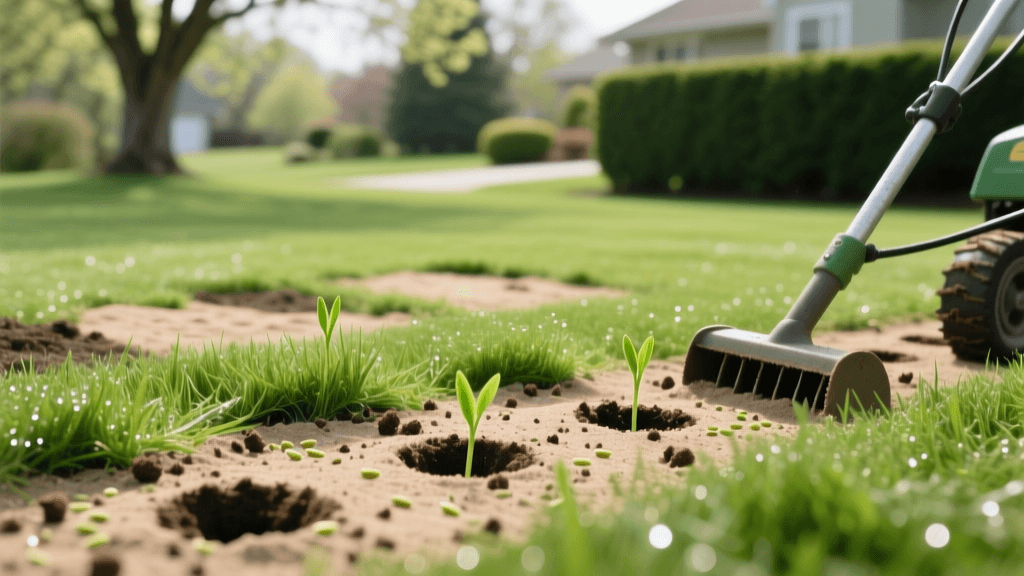
- Aggressive Thatch Management: As mentioned by the NFPA's Firewise USA program, removing dead vegetative material is crucial for defensible space. If your thatch layer exceeds 0.5 inches, rent a power dethatcher ($60-$80 per day in 2026) or perform core aeration. Removing this dry, dead layer eliminates the primary wick that carries ground fire across a lawn.
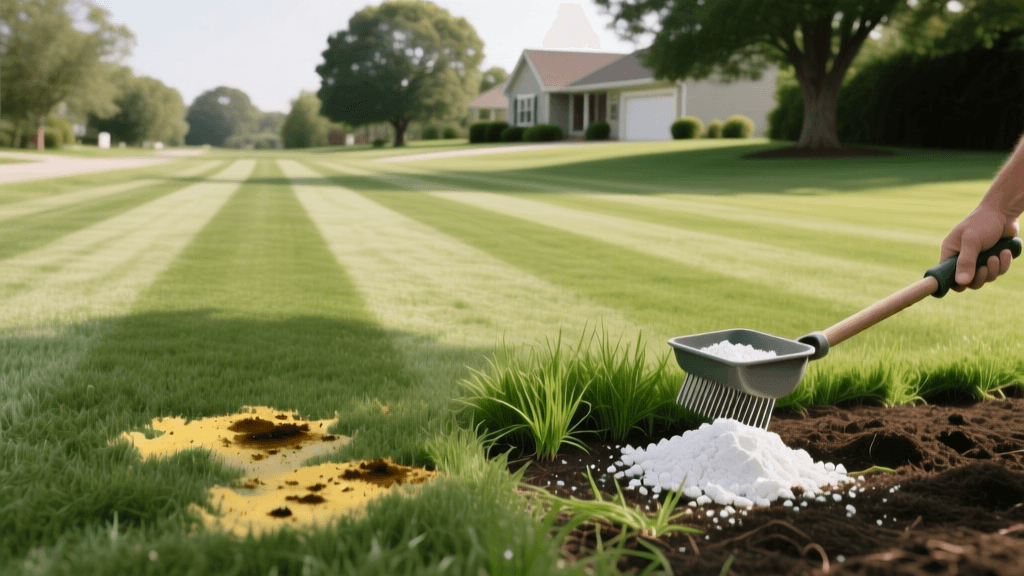
- Avoid High-Nitrogen Fertilizers During Fire Season: While recovering a drought-stressed lawn, it is tempting to blast it with nitrogen to force green growth. Avoid this during peak fire season (late summer/early fall). High nitrogen forces rapid, weak, and highly succulent top growth that quickly turns to dry, flammable tinder when the heat spikes. Instead, use a slow-release, organic fertilizer with a higher potassium ratio (like a 5-10-15 NPK), which strengthens cell walls and improves the grass's natural drought and heat tolerance.
Pro Tip for 2026: Keep a dedicated garden hose with a shut-off nozzle connected to an outdoor spigot near your lawn. During extreme red-flag warning days, you can quickly hand-water the perimeter of your lawn and the edges of your property to create a localized high-moisture firebreak against wind-blown embers.
Conclusion
Recovering a drought-stressed lawn in 2026 requires a shift in mindset: you are not just growing grass; you are engineering a living, breathing firebreak. By implementing a strategic deep watering schedule, utilizing cycle-and-soak irrigation techniques, and removing flammable thatch, you transform a vulnerable, dry yard into a robust, fire-resistant defensible space. Invest in smart irrigation technology, monitor your soil's moisture depth, and maintain your turf at the proper height to ensure your landscape remains both beautiful and resilient against the growing threat of wildfires.