Home & Garden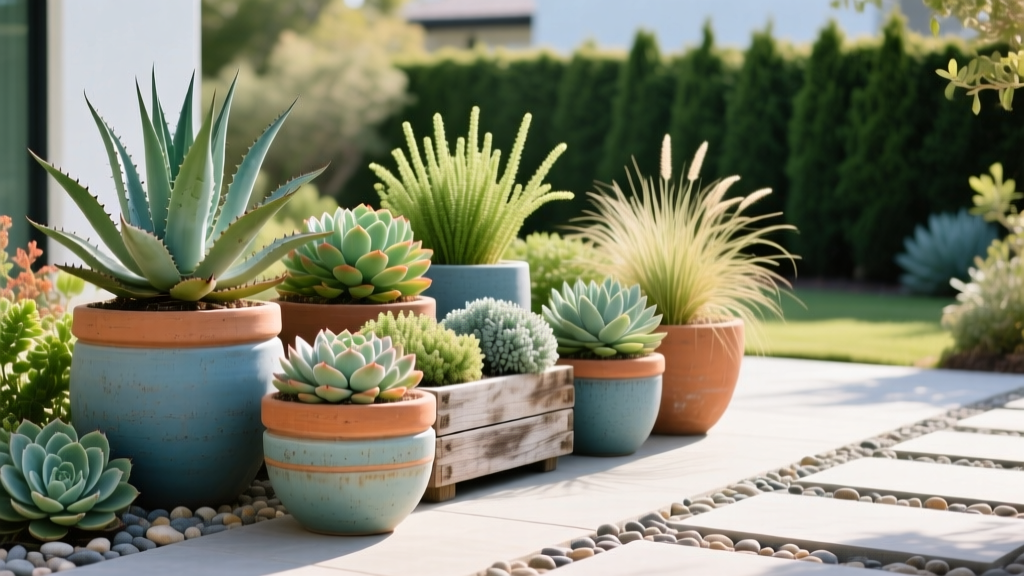
Drought Tolerant Container Garden Combinations For Patios
Designing Resilient Container Gardens for Hot, Dry Patios
Container gardening on patios presents unique challenges when drought conditions persist—especially in USDA Hardiness Zones 7b through 10b, where summer temperatures regularly exceed 95°F and annual rainfall often falls below 20 inches. Unlike in-ground beds, containers heat up rapidly, dry out faster, and offer limited root volume for moisture retention. Yet with strategic plant selection and structural planning, it’s possible to create lush, low-water gardens that thrive from late spring through early fall. This approach prioritizes plant physiology over aesthetics alone: succulent tissues, silvery or hairy foliage, deep taproots, and CAM photosynthesis all contribute meaningfully to drought tolerance.
Core Principles of Drought-Tolerant Container Design
Successful container combinations rely on three interlocking principles: hydraulic compatibility, thermal buffering, and structural layering. Hydraulic compatibility means grouping plants with similar water-use patterns—even within a single pot—to prevent overwatering stress-sensitive species while under-watering others. Thermal buffering involves using large, insulated containers (minimum 16-inch diameter and 14-inch depth) made from clay, wood, or double-walled fiberglass; these reduce soil temperature fluctuations by up to 12°F compared to thin plastic pots, according to research from the University of California Cooperative Extension (2021). Structural layering refers to intentional vertical arrangement: tall architectural elements at the back, mid-height flowering perennials in the center, and trailing or ground-covering species spilling over the rim.
Soil Composition Matters More Than You Think
Standard potting mixes dry too quickly for drought-prone settings. A custom blend should contain 40% aged pine bark fines (¼–½ inch), 30% expanded shale (⅛–¼ inch particle size), 20% composted coconut coir, and 10% coarse horticultural sand. This mixture achieves a pH range of 6.2–6.8—ideal for most Mediterranean-origin ornamentals—and retains 35% more moisture after 72 hours of full sun exposure than conventional peat-based mixes (Chicago Botanic Garden, 2022). Avoid garden soil entirely: its density impedes drainage and encourages compaction in confined spaces.
Proven Plant Combinations by Sun Exposure
Full-sun patios (6+ hours direct light daily) demand the toughest performers. Partial-shade locations (3–5 hours) open options for subtler textures and cooler-toned blooms. Each combination includes at least one woody element for year-round structure, two herbaceous bloomers with staggered flowering windows, and one trailing or filler species. All recommended plants are reliably hardy in Zones 7b–10b unless otherwise noted.
Full-Sun Trio: “Desert Mesa”
This combination mimics the sculptural rhythm of the Sonoran Desert. At its center stands Yucca rostrata, a Zone 5–11 evergreen with a 3-foot-tall rosette and 6-foot flower spike blooming May–June. Flanking it are Lavandula angustifolia ‘Hidcote’ (Zones 5–9), which flowers June–September, and Verbena bonariensis (Zones 7–11), blooming July–October. Trailing over the pot’s edge is Sedum spurium ‘Dragon’s Blood’, hardy to Zone 3, with foliage that intensifies to burgundy under drought stress. All prefer slightly alkaline to neutral soil (pH 6.8–7.5).
Partial-Shade Ensemble: “Olive Grove Shadow”
Ideal for east- or north-facing patios, this grouping features Olea europaea ‘Little Ollie’ (Zones 8–11), a compact olive reaching 6 feet tall but staying narrow at just 3 feet wide. Beneath it, Lamium maculatum ‘Beacon Silver’ (Zones 3–8) provides silver-flecked ground cover from April through October, while Heuchera ‘Palace Purple’ (Zones 4–9) offers deep maroon foliage and delicate pink flowers May–July. Soil pH must remain between 6.0 and 6.5 for optimal iron uptake in the Heuchera.
Structural Elements That Support Water Conservation
Garden structures aren’t merely decorative—they directly influence microclimate and irrigation efficiency. A pergola draped with Wisteria frutescens ‘Amethyst Falls’ (Zones 5–9) reduces ambient patio temperature by an average of 8°F during peak afternoon hours, lowering evapotranspiration rates in underlying containers. Tiered metal plant stands elevate pots off hot concrete, cutting root-zone heat gain by 15%. Even simple ceramic saucers placed beneath pots—filled with pea gravel and a half-inch of water—create localized humidity zones that reduce transpiration in nearby foliage.
For those with limited space, vertical wall planters offer high-impact solutions. The Chicago Botanic Garden’s 2023 Rooftop Resilience Trial demonstrated that modular felt-pocket systems irrigated via drip lines used 42% less water per square foot than traditional hanging baskets planted with identical species—including Echeveria imbricata, Phlomis russelliana, and Thymus vulgaris.
Seasonal Maintenance Without Compromise
Drought-tolerant doesn’t mean neglect-tolerant. Key seasonal actions include:
- Early spring: Prune Lavandula by one-third to encourage dense branching and prevent woody legginess.
- Midsummer: Apply a ½-inch top-dressing of composted oak leaves—rich in tannins that slow decomposition and improve moisture retention.
- Early fall: Replace spent annuals like Zinnia elegans ‘Queen Lime’ (Zones 2–11, pH 5.5–7.5) with cool-season performers such as Viola cornuta ‘Sorbet Yellow’ (Zones 4–9).
- Winter: Move Zone 7–8 marginally hardy specimens—like Cistus x purpureus—to a sheltered, south-facing wall where reflected heat raises ambient temperature by 5–7°F.
Watering frequency should be guided by soil moisture probes rather than calendars. Insert a probe 3 inches deep: if the reading shows less than 25% volumetric water content, it’s time to water slowly until runoff begins. This method prevents shallow root development and leaching of nutrients.
Regional Performance Data From Public Institutions
Long-term observational data from botanical institutions validate regional suitability. At the Lady Bird Johnson Wildflower Center in Austin, Texas, a 2020–2023 trial of 47 container-grown native and adapted species found that Rudbeckia fulgida var. sullivantii ‘Goldsturm’ maintained 92% floral coverage under zero supplemental irrigation after establishment, while Salvia farinacea ‘Victoria’ showed 86% survival with biweekly deep watering. Similarly, the Missouri Botanical Garden’s St. Louis Urban Heat Island Study (2022) recorded that Nepeta faassenii ‘Walker’s Low’ required only 0.75 gallons per week per 12-inch pot to sustain bloom—less than half the amount needed by comparable non-drought-adapted mints.
“Drought resilience in containers isn’t about choosing ‘tough’ plants—it’s about matching physiological strategy to physical constraint. A yucca’s deep taproot has no function in a 10-inch pot, but its CAM metabolism lets it open stomata only at night, slashing water loss by 60%.” — Dr. Elena Ruiz, Senior Horticulturist, UC Davis Arboretum and Public Garden, 2023
The following table compares key metrics across five high-performing species tested across three USDA zones:
| Plant | USDA Zones | Bloom Duration (weeks) | Soil pH Range | Max Container Depth (in) | Annual Water Use (gal/yr per 12″ pot) |
|---|---|---|---|---|---|
| Lavandula angustifolia ‘Hidcote’ | 5–9 | 12–16 | 6.5–7.5 | 14 | 32 |
| Yucca rostrata | 5–11 | 4–6 (spike only) | 5.8–7.8 | 18 | 18 |
| Heuchera ‘Palace Purple’ | 4–9 | 6–8 | 6.0–6.5 | 12 | 44 |
| Sedum spurium ‘Dragon’s Blood’ | 3–9 | 8–10 | 6.0–7.5 | 8 | 14 |
| Phlomis russelliana | 5–9 | 10–12 | 6.2–7.2 | 16 | 26 |
Spacing matters even in containers. Overcrowding increases competition for water and airflow, raising disease risk. Maintain at least 4 inches between crown centers for perennials and 6 inches for subshrubs. For example, planting three Lavandula ‘Hidcote’ specimens in a 24-inch-wide planter exceeds ideal density—two is the maximum for sustained health.
Re-potting every 2–3 years remains essential. After that interval, organic matter depletes, salts accumulate, and root-bound conditions restrict water infiltration. When re-potting, prune circling roots by up to 30% and replace 100% of the growing medium—not just the top layer.
Drainage holes must total at least 1 square inch per gallon of container volume. A 15-gallon pot (approx. 18 inches wide × 16 inches deep) requires minimum drainage area equal to a 1.25-inch-diameter circle—or three ½-inch holes spaced evenly.
Micro-irrigation systems dramatically improve consistency. Drip emitters calibrated to deliver 0.5 gallons per hour, run for 25 minutes twice weekly, provide precisely 0.42 gallons per session—enough to wet the root zone to 10 inches without runoff. This precision is why the Brooklyn Botanic Garden’s Terrace Garden reduced container plant mortality by 71% after installing pressure-compensating driplines in 2021.
Finally, avoid black or dark-colored containers in full sun. Surface temperatures on matte-black 12-inch pots reach 158°F at 3 p.m. on a 95°F day—well above the 115°F threshold that damages fine roots of Heuchera and Lavandula. Opt instead for terracotta, white-glazed ceramic, or stone-finish composites.
With attention to container mass, soil science, species physiology, and microclimate engineering, drought-tolerant patio gardens become not just survivable—but vibrant, layered, and deeply satisfying expressions of place-specific horticulture.
