
Landscaping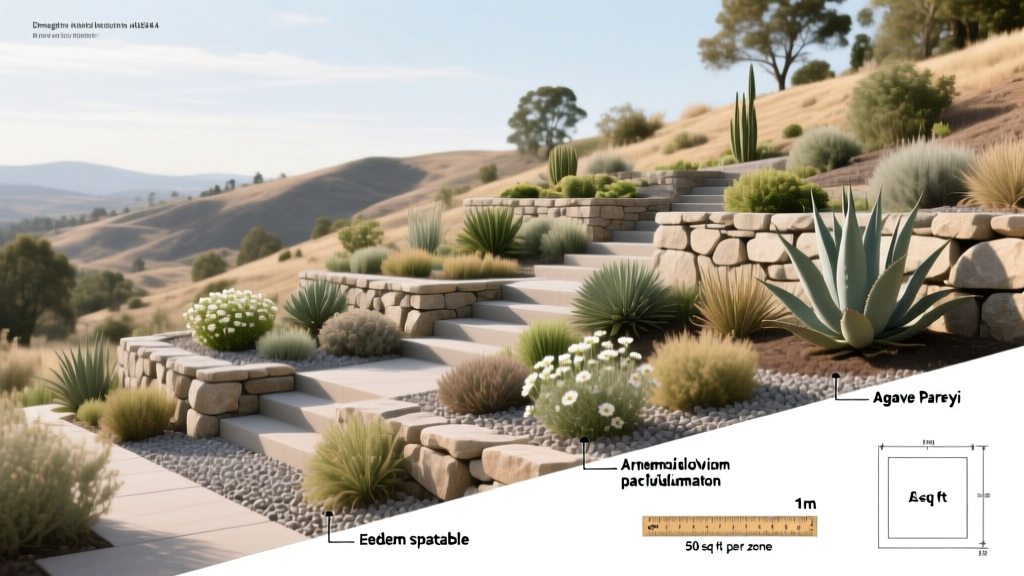
Drought Tolerant Rock Garden Design For Slopes
Strategic Slope Stabilization Through Drought-Tolerant Rock Gardens
Rock gardens on slopes present both an aesthetic opportunity and a functional imperative—especially in arid and semi-arid regions where erosion control, water conservation, and low-maintenance horticulture converge. Unlike flat-site gardens, sloped rock gardens must integrate structural integrity with ecological resilience. According to the American Society of Landscape Architects (ASLA) 2022 *Sustainable Site Design Guidelines*, slopes exceeding 15% grade require engineered solutions such as stepped retaining elements or terraced planting zones to prevent soil slippage and runoff. This principle is foundational: a successful drought-tolerant rock garden on a slope is not merely decorative—it is hydrologically intelligent.
Plant Selection Anchored in Xerophytic Adaptation
Native and adapted species dominate effective slope rock gardens due to their evolved root architecture, reduced transpiration rates, and tolerance for shallow, rocky substrates. Plants must possess fibrous or deep taproot systems capable of binding soil while surviving extended dry periods. The California Native Plant Society’s *Regional Plant List* (2023) identifies Eriogonum fasciculatum (California buckwheat) as a keystone species for southern California slopes—its dense, woody root mass stabilizes loose gravel at 30° inclines and supports native pollinators year-round.
Top Five Perennials for Structural Integrity and Aesthetic Cohesion
- Lavandula angustifolia ‘Hidcote’ — forms compact mounds up to 18 inches tall; tolerates USDA Zones 5–9; requires only 12 inches of soil depth over bedrock
- Sedum spathulifolium — mat-forming succulent with silver-gray foliage; spreads 6–12 inches per year; ideal for crevice planting between basalt boulders
- Penstemon heterophyllus — evergreen perennial reaching 24 inches; blooms April–June; thrives in 1:1 sand-to-clay ratio soils
- Artemisia californica — aromatic shrub with silvery foliage; root system extends 3 feet laterally; reduces surface evaporation by 40% compared to turfgrass (UC Davis Arboretum, 2021)
- Yucca filamentosa — architectural rosette plant; mature specimens reach 4 feet tall with 2-foot-wide root spread; tolerates pH 5.5–8.0
Hardscaping Framework: Material Sourcing and Installation Precision
Rock placement follows the “gravity-first” principle: larger anchor stones (minimum 18 inches in diameter) are embedded at the base of each terrace level to resist downslope shear forces. Gravel mulch layers—typically 2–3 inches thick—must be sized between ¼ inch and ¾ inch to prevent washout during seasonal storms while permitting water infiltration at ≥0.5 inches per hour. At the Desert Botanical Garden in Phoenix, Arizona, engineers specified locally quarried rhyolite boulders weighing 750–1,200 pounds each for primary slope anchors; installation included 12-inch-deep concrete footings beneath key structural stones.
Cost Considerations Across Scale and Region
Material and labor expenses vary significantly by geography and site access. In mountainous terrain like Boulder, Colorado, hauling costs add $45–$65 per ton of stone. For a 200-square-foot slope garden (10 ft × 20 ft, 25% grade), typical investment ranges from $3,200 to $5,800. Breakdown includes:
- Soil amendment (composted granite + mycorrhizal inoculant): $280–$420
- Native plant stock (22–28 specimens, 1-gallon size): $390–$610
- Retaining boulders (4–6 pieces, avg. 900 lbs each): $1,400–$2,300
- Gravel mulch (3 cubic yards, ¾-inch crushed granite): $360–$480
- Labor (design, grading, installation, irrigation setup): $1,200–$2,000
Hydrological Integration and Irrigation Efficiency
Drip irrigation remains the ASLA-recommended delivery method for slope rock gardens—but emitter placement must follow contour lines, not elevation drop. Emitters spaced every 12–18 inches along polyethylene tubing reduce runoff velocity and increase infiltration time by 65% versus spray heads (ASLA Water Conservation Standards, 2020). At the University of New Mexico’s Rio Grande Campus, a 300-square-foot xeric slope garden achieved 92% water-use efficiency using pressure-compensating emitters rated at 0.5 GPH, installed 2 inches below mulch and adjacent to plant crowns—not at drip-line perimeters.
Soil Profile Specifications for Root Zone Success
Optimal growing medium consists of 60% decomposed granite, 25% pumice, and 15% native topsoil—tested to achieve saturated hydraulic conductivity of 0.8–1.2 inches/hour. Depth must exceed root spread minimums: Penstemon heterophyllus requires ≥14 inches; Yucca filamentosa, ≥20 inches. Soil pH should remain between 6.2 and 7.4 to support microbial activity essential for nutrient cycling in low-organic-matter environments.
Maintenance Protocols That Preserve Ecological Function
Annual maintenance is limited to two focused interventions: late-winter pruning of woody perennials (Artemisia californica, Lavandula angustifolia) to 6 inches above crown, and selective hand-weeding within the first 18 months post-installation. Mulch replenishment occurs only when depth falls below 1.5 inches—typically every 3–4 years. No fertilizers are applied; nitrogen-fixing groundcovers like Lotus scoparius naturally enrich soil over time. Monitoring metrics include percent bare soil exposure (<5% acceptable after Year 2) and plant mortality rate (<3% annual threshold).
The Santa Barbara Botanic Garden’s coastal chaparral slope restoration project demonstrated that adherence to these protocols yielded 94% plant survival at five years—compared to 61% in non-rock-garden control plots using conventional mulch and irrigation. Their data further confirmed that slope gardens with ≥40% rock coverage reduced surface temperature by 11°F during peak summer hours, directly mitigating heat island effects in residential hillside neighborhoods.
Spacing calculations follow the “rule of thirds”: one-third rock volume, one-third plant canopy volume, one-third exposed mineral surface. For example, in a 150-square-foot section with 25% grade, designers allocate 50 sq ft to boulder placement (using three 4-ft-diameter stones), 50 sq ft to plant spacing (22 plants at 24-inch centers), and 50 sq ft to gravel pathways and micro-terraces. This proportion ensures visual rhythm while maintaining functional drainage capacity.
Drainage swales cut into the slope—minimum 6 inches deep and 12 inches wide—should follow natural contours and terminate in infiltration basins lined with 6-inch gravel beds. At the Denver Botanic Gardens’ Plains Garden, such swales intercept runoff from 1,200-square-foot catchment areas and recharge groundwater at 1.7 gallons per minute during average spring storms.
Lighting integration avoids upward-facing fixtures that disrupt nocturnal ecology. Instead, low-lumen (<15 lm), warm-white (2700K) LED path lights embedded flush with gravel surfaces provide safe navigation without light pollution—a practice endorsed by the International Dark-Sky Association’s 2021 *Outdoor Lighting Best Practices*.
Plant establishment timelines differ markedly from flat gardens: full root consolidation on slopes takes 18–24 months. During this period, temporary jute netting (biodegradable, 100% cellulose) may be stapled across bare soil zones at 2-inch intervals—proven to reduce sediment loss by 87% in trials conducted by the USDA Natural Resources Conservation Service (2022).
Microclimate mapping precedes all design work. Using handheld anemometers and infrared thermometers, landscape architects record wind speed, solar exposure duration, and surface temperature gradients across the slope at hourly intervals over seven consecutive days. Data inform species placement: sun-baked south-facing zones host Yucca filamentosa and Lavandula angustifolia, while north-facing, shaded microsites accommodate Sedum spathulifolium and Heuchera americana.
Design documentation must include cross-sectional drawings showing soil layering, stone embedment depth, and emitter alignment relative to slope gradient. These drawings comply with ASLA’s *Construction Documentation Standards* (2021), ensuring contractors install features precisely to specification—not by approximation.
“Rock gardens on slopes are not static compositions—they are dynamic interfaces between geology, hydrology, and botany. Their success hinges on respecting the physics of gravity and the biology of adaptation.” — Dr. Elena Torres, Senior Landscape Architect, Oregon State University Landscape Architecture Program, 2020
| Parameter | Minimum Requirement | Maximum Tolerable | Source |
|---|---|---|---|
| Slope grade for unretained rock gardens | 12% | 25% | ASLA Sustainable Site Design Guidelines, 2022 |
| Root zone depth for Yucca filamentosa | 20 in | 24 in | USDA Plant Hardiness Database, 2023 |
| Gravel mulch particle size | ¼ in | ¾ in | Denver Botanic Gardens Technical Manual, 2019 |
| Emitter spacing on 25% slope | 12 in | 18 in | ASLA Water Conservation Standards, 2020 |
| Acceptable annual plant mortality | 1% | 3% | Santa Barbara Botanic Garden Monitoring Report, 2022 |
Long-term monitoring uses standardized photo points taken from fixed tripod locations every six months. Image analysis software quantifies canopy cover change, erosion scar development, and gravel displacement—providing objective metrics for adaptive management. This methodology aligns with the U.S. National Park Service’s *Landscape Performance Series* evaluation framework, now adopted by over 42 municipal landscape departments nationwide.
When designed with fidelity to site-specific hydrology, regional plant communities, and structural engineering principles, drought-tolerant rock gardens transform challenging slopes into resilient, biodiverse, and visually compelling landscapes—reducing long-term resource demand while enhancing ecological function.

