Tree Care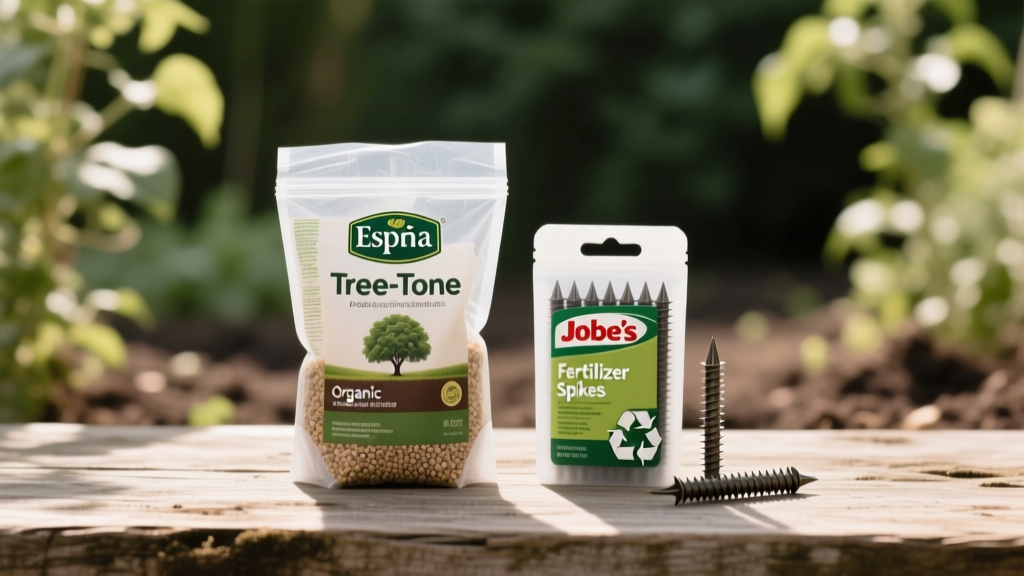
Espoma Tree-Tone vs Jobes Spikes: Best Tree Fertilizer
Mike RodriguezPublished
Introduction to Urban Tree Fertilization
Trees in natural forest environments thrive on a continuous cycle of decaying organic matter, naturally replenishing the soil with essential nutrients. However, trees planted in urban and suburban landscapes face a very different reality. Raking away fallen leaves, soil compaction from foot traffic, and competition from turfgrass severely limit a tree's access to vital minerals. When visual symptoms like chlorosis (yellowing leaves), stunted twig growth, or premature fall coloration appear, it is often a sign that your tree requires supplemental nutrition.
When homeowners head to the garden center to address these deficiencies, they are typically faced with two dominant product formats: granular organic fertilizers and concentrated fertilizer spikes. In this comprehensive comparison, we will evaluate two of the most popular products on the market: Espoma Organic Tree-Tone and Jobe's Tree & Shrub Fertilizer Spikes. By breaking down their nutrient profiles, application methods, long-term soil health impacts, and overall cost-effectiveness, you will be equipped to make the best decision for your landscape's canopy.
Product A: Espoma Organic Tree-Tone (4-3-4)
Espoma Tree-Tone is a premium, all-natural, organic granular fertilizer designed specifically for the long-term health of trees and shrubs. It features an NPK (Nitrogen-Phosphorus-Potassium) ratio of 4-3-4, providing a gentle, slow-release feed that won't burn delicate feeder roots. What truly sets Tree-Tone apart from standard synthetic fertilizers is the inclusion of Espoma's proprietary Bio-tone formula. This blend introduces thousands of beneficial soil microbes and mycorrhizal fungi directly into the root zone.
Because it is a granular product, Tree-Tone is broadcast evenly across the soil surface and lightly incorporated or watered in. This mimics the natural decomposition of forest floor litter, feeding the entire critical root zone uniformly. The organic matter in the formula also helps improve soil structure, increasing water retention in sandy soils and improving drainage in heavy clay. It is an investment in the soil ecosystem, not just a quick chemical fix for the plant.
Product B: Jobe's Tree & Shrub Fertilizer Spikes (15-3-3)
Jobe's Fertilizer Spikes offer a completely different approach to tree nutrition. These solid, spike-shaped capsules are driven directly into the soil around the base of the tree. The standard Tree & Shrub formula boasts a high-nitrogen NPK ratio of 15-3-3, designed to push rapid vegetative growth and deep green foliage. The spikes are formulated to release nutrients slowly over the course of a season, activated by moisture and soil temperatures.
The primary appeal of Jobe's Spikes is the perceived ease of application and the elimination of surface runoff. Because the nutrients are deposited below the soil surface, they are theoretically placed closer to the tree's active feeder roots, bypassing competing turfgrass. However, this localized delivery method means that nutrients are concentrated in small, distinct pockets rather than being distributed evenly throughout the expansive root system.
Head-to-Head Comparison Chart
| Feature | Espoma Organic Tree-Tone | Jobe's Tree & Shrub Spikes |
|---|---|---|
| NPK Ratio | 4-3-4 (Balanced, Slow-Release) | 15-3-3 (High Nitrogen, Concentrated) |
| Formulation Type | Organic Granular with Bio-tone microbes | Synthetic/Organic Blend Solid Spike |
| Application Method | Broadcast over root zone, water in | Driven into soil with mallet/cap |
| Soil Health Impact | Builds microbiome, improves structure | Localized feeding, potential salt buildup |
| Risk of Root Burn | Very Low | Moderate (if placed too close to trunk) |
| Best Used For | Overall soil health, large canopies, new transplants | Quick nitrogen boosts, small isolated shrubs |
Nutrient Profile and Soil Health Impact
When evaluating tree fertilizers, it is crucial to look beyond the immediate greening effect and consider the long-term biology of the soil. According to the Morton Arboretum, maintaining a healthy soil ecosystem is just as important as the raw nutrients provided to the tree. Espoma Tree-Tone excels in this arena. Its lower, balanced NPK ratio ensures that the tree receives a steady diet without triggering excessive, weak flushes of growth that attract sap-sucking pests like aphids. Furthermore, the mycorrhizal fungi in the Bio-tone formula form symbiotic relationships with tree roots, effectively expanding the root system's surface area and aiding in the uptake of water and phosphorus.
Conversely, Jobe's Spikes deliver a massive dose of nitrogen (15%) in a highly concentrated area. While this can quickly correct severe nitrogen deficiencies, the localized concentration of synthetic salts can be detrimental to soil biology. Over time, repeatedly driving spikes into the same general areas can lead to salt accumulation, which damages delicate feeder roots and harms beneficial earthworms and microbes. For long-term soil stewardship, the broad-spectrum, organic approach of Tree-Tone is vastly superior to the localized chemical deposits of fertilizer spikes.
Application Process and Labor
The most common argument in favor of fertilizer spikes is convenience. However, proper application of spikes is more labor-intensive than many homeowners realize. To avoid root burn and ensure even feeding, spikes must be driven into the ground along the tree's drip line (the outer edge of the canopy) and spaced evenly in a circular pattern. For a mature oak or maple with a 40-foot canopy spread, this requires driving dozens of spikes into the ground using a mallet, which can be incredibly difficult in compacted urban soils or areas heavily populated with surface roots.
Applying Espoma Tree-Tone requires a different type of effort. The granules must be broadcast evenly from the trunk's drip line outward. The University of Minnesota Extension notes that a tree's most active absorptive roots are located in the top 12 to 18 inches of soil, often extending well past the drip line. Therefore, broadcasting granular fertilizer over this vast area, followed by a deep watering to activate the microbes and carry the nutrients into the root zone, aligns perfectly with the tree's natural anatomy. While spreading granules takes time, it is generally less physically demanding than hammering spikes into hard, root-bound soil.
Cost Analysis and Long-Term Value
When comparing costs, it is essential to calculate the price per square foot of the critical root zone, rather than just the price of the box. A standard 4 lb. box of Jobe's Spikes costs around $10 to $15 and contains roughly 5 to 8 spikes. A large mature tree with a 30-foot canopy requires a significant number of spikes placed along the drip line to achieve even coverage, meaning you may need multiple boxes per tree, driving the cost up to $30 or more per application.
A 4 lb. bag of Espoma Tree-Tone typically retails for $10 to $12 and can cover up to 120 square feet of root zone. Because it is broadcast evenly, a single bag can effectively treat a much larger area of the root system compared to a box of spikes. Over a five-year period, the granular organic approach not only saves money on a per-tree basis but also reduces the need for supplemental soil amendments, as the organic matter continuously improves the soil's natural fertility and water-holding capacity.
Environmental Considerations and Runoff
Environmental stewardship is a critical component of modern lawn and garden care. High-nitrogen synthetic fertilizers are notorious for contributing to nutrient runoff, which can lead to algal blooms in local waterways. Because Jobe's Spikes are driven into the soil, they do mitigate surface runoff to some degree. However, if placed in poorly draining soils, the concentrated salts can leach downward into the groundwater.
Espoma Tree-Tone, being entirely organic and reliant on microbial breakdown, is inherently less prone to leaching. The nutrients are bound within organic molecules and are only released as soil microbes consume them, which naturally correlates with the tree's active growing seasons and soil temperatures. This biological lock-and-release mechanism makes Tree-Tone a much safer choice for properties located near lakes, streams, or sensitive watersheds.
Final Verdict: Which Should You Choose?
The choice between Espoma Tree-Tone and Jobe's Fertilizer Spikes ultimately depends on your specific landscape goals, the size of your trees, and your commitment to long-term soil health.
Choose Espoma Tree-Tone If:
- You are treating large, mature shade trees with expansive root zones.
- You want to improve overall soil structure and promote beneficial microbial life.
- You are fertilizing newly transplanted trees and need a gentle formula that will not burn tender new roots.
- You live near a body of water and want to eliminate the risk of synthetic chemical runoff.
Choose Jobe's Spikes If:
- You are treating small, isolated shrubs or very young trees where broadcasting granules is impractical.
- You need a rapid, targeted nitrogen boost to correct severe chlorosis in a specific, localized plant.
- Your landscape consists of heavily mulched beds where surface broadcasting of granules is difficult to incorporate.
For the vast majority of homeowners seeking a comprehensive, sustainable tree care regimen, Espoma Organic Tree-Tone is the clear winner. By feeding the soil rather than just the plant, you build a resilient foundation that supports robust canopy growth, drought tolerance, and natural disease resistance for decades to come.
